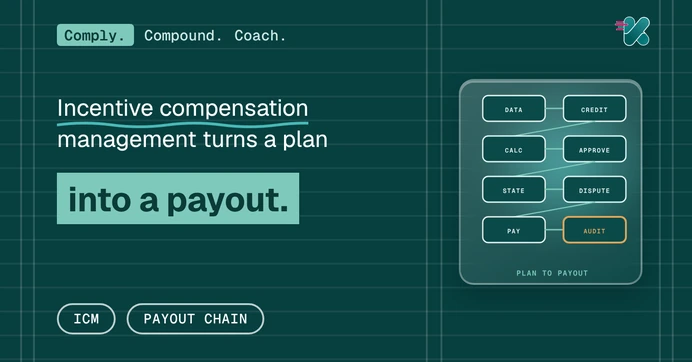
Incentive compensation management turns a plan into a payout.
October 28, 2026
Puneet Gupta
Puneet Gupta
Key Insights
WorldatWork and SalesGlobe found 35% of firms calculated 2021 payouts in Excel or Word.
In this blog:
What incentive compensation management is, and the eight-step payout chain
What goes wrong without it, from crediting gaps to weak audit
What it does for pharma, banking, insurance and FMCG
How to evaluate software and how long implementation takes
Every month I meet CFOs who sign off a large incentive bill. Few can trace one payout to source in a day. The plan is sound. The chain between the plan and the payout is where it breaks.
The pattern repeats across industries. A pharma brand gate reads stale data. A bank splits credit by hand. An insurer recovers a clawback months late. An FMCG scheme overlaps with the sales plan.
The fix is the same each time. Connect the data and version the plan. Show the rep the build. Keep the record.
A question worth asking the CFO this week: can we trace our ten largest payouts to source by Friday?
Table Of Content
Where sales incentives are calculated today
Many companies still pay incentives from spreadsheets. WorldatWork and SalesGlobe surveyed firms on 2021 payouts. 35% calculated them manually in Excel or Word. Another 33% used a homegrown system. 29% used a third-party solution.
Spreadsheets carry a known error rate. Raymond Panko of the University of Hawaii reviewed spreadsheet field audits. In audits from 1997 onward, 91% of 54 spreadsheets had errors.
Leaders are adding controls around the payout. SalesGlobe's 2026 research looked at those controls. 84% of organizations use a payout control. 43% use payout caps. 52% have a formal policy for very large deals.
Sources: WorldatWork with SalesGlobe, 2022 Sales Compensation Programs and Practices, August 2022, 693 responses, the calculation question covers 2021 with 360 responses, India share not stated · Panko, Spreadsheet Errors: What We Know, EuSpRIG proceedings, July 2000, field audits of 367 spreadsheets, older data · SalesGlobe, Sales Compensation: The Big Issues of 2026, 14 September 2026, sample not disclosed
A third of firms calculate payouts by hand, and audited sheets often hold errors.
What incentive compensation management is
Incentive compensation management turns a sales plan into a correct payout. It covers rules, data, approvals and records. Software runs the discipline at scale.
Gartner tracks the category inside sales performance management. Its Peer Insights market lists mandatory features, updated August 2026. They include incentive calculation and payouts. They include plan explainability and commission expense accounting. They include two-way integration with CRM, ERP and HR systems.
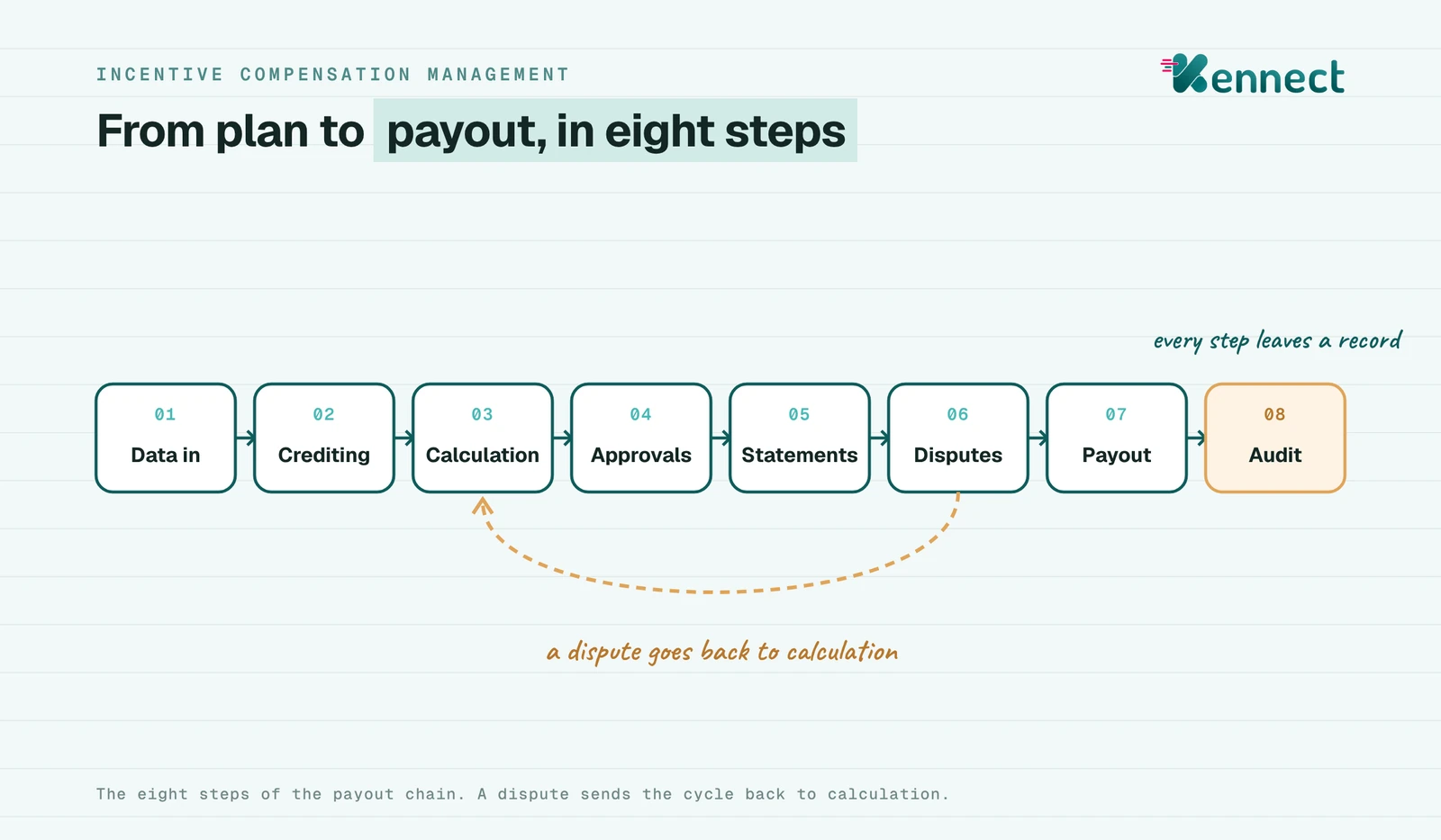
In plain terms, the work runs as a chain of eight steps. Each step hands its output to the next.
The eight steps of the payout chain. A dispute sends the cycle back to calculation.
Data in. Sales, targets and headcount arrive from CRM, SFA, DMS and HRMS.
Crediting. Each sale is assigned to the right person and period.
Calculation. The plan rules turn credited sales into earnings.
Approvals. Managers and finance sign off on exceptions and totals.
Statements. Each person sees how the payout was built.
Disputes. Queries are logged, resolved and recomputed.
Payout. Final figures go to payroll or accounts payable.
Audit. Every change is recorded with who, what and when.
Incentive compensation management runs the chain from sales data to a recorded payout.
What goes wrong without it
Leaders tend to see the symptoms before the cause. Errors start early in the chain and surface late.
Crediting gaps. A sale lands in the wrong territory or month. The rep notices before finance does.
Formula drift. A slab is edited in one sheet and not another. Two people hold two versions of the truth. See the common types in this guide to commission calculation errors.
Slow close. Data arrives in pieces, so the cycle stretches for weeks. Reps wait two or three months for a payout they earned.
Query load. Each unexplained payout becomes a query. Managers spend sales time answering finance questions. A structured process sits in incentive dispute management.
Weak audit. India's Companies Act 2013 matters here. Section 143(3)(i) covers internal financial controls. The auditor reports on their adequacy and operating effectiveness. Incentives are a material expense in many sales-led firms. A payout built in spreadsheets is hard to defend in that review.
Payout errors cost money, sales time and audit comfort, and they compound.
What incentive compensation management software does for pharma, banking, insurance and FMCG
The chain is the same in every industry. The rules and data differ. Here is one example per industry.
Pharma. A medical representative earns on slabs of achievement against target. Many plans add a brand gate. The MR must hit a focus brand before the slab pays. Data comes from secondary sales and the SFA.
Banking. A relationship manager earns on cross-sell across products. Credit must be split when two teams work one customer. Conduct gates hold back payout where complaints or mis-selling are found.
Insurance. An agent earns first-year commission on new premium. Renewal commission follows when the policy persists. A clawback recovers commission on early lapse.
FMCG. A sales officer earns on primary and secondary sales. Primary is company to distributor. Secondary is distributor to retailer. Distributor schemes run in parallel and need their own calculation.
One example per industry, with the rule that breaks first and the regulatory context.
Industry
Payout rule
Breaks first
Regulatory context
Pharma
MR slabs with brand gates
Gate read on stale data
UCPMP 2024 marketing code
Banking
RM cross-sell with conduct gates
Split credit across teams
RBI conduct directions, 15 June 2026, from 1 January 2027
Insurance
First-year and renewal commission
Clawback after early lapse
IRDAI commission regulations 2023
FMCG
Primary and secondary sales
Distributor scheme overlap
Companies Act 2013, Section 143(3)(i)
Each industry has one line of regulation to respect.
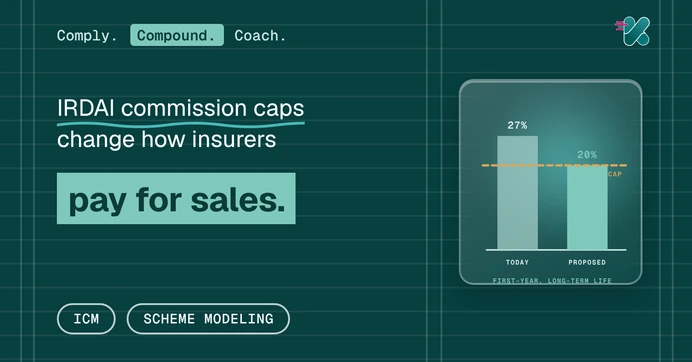
Insurance first. The IRDAI (Payment of Commission) Regulations 2023 began on 1 April 2023. They removed product-wise commission caps. Payouts follow a board-approved policy. They stay within the expenses of management cap.
The Department of Pharmaceuticals issued UCPMP 2024 in March 2024. The executive head files an annual self-declaration of compliance. It is due within two months of each financial year end.
For banks, the RBI issued conduct directions on 15 June 2026. They take effect on 1 January 2027. Bank employees may take no incentive from a third-party product provider, such as an insurer or a mutual fund. We cover the detail in BFSI sales incentive software.
Then data. The DPDP Rules 2025 were notified on 13 November 2025. Their core duties, including security safeguards, apply from 13 May 2027. Payout records hold personal data on every rep. They fall in scope.
Sources: JSA, New Regulations on Payment of Commission and Expenses of Management, 2023, summary of IRDAI notification of 26 March 2023 · Medical Dialogues, report on UCPMP 2024, 13 March 2024 · RBI/2026-27/115, Commercial Banks Responsible Business Conduct Second Amendment Directions, 15 June 2026, effective 1 January 2027 · SCC Online, 14 November 2025, on the DPDP Rules 2025 and their phased start dates
The chain is the same in every industry, and the rules around it change.
How to evaluate incentive compensation management software
A CFO can test any option with six questions. Ask for a demo on your own plan and data.
Can it run our hardest rule? Bring the brand gate, the split or the clawback.
Does it connect to our systems? Look for connectors to CRM, SFA, DMS, HRMS and SAP.
Can a rep see how each payout was built? A visible build cuts queries.
Is every plan change dated and versioned? Mid-year changes should never overwrite history.
Can finance trace any payout to its source? That is what the auditor will ask.
How long to the first live payout? Ask for a dated plan, week by week.
A typical rollout runs in four phases. Our reference build reached a first live payout in eight weeks.
Illustrative phasing of an eight-week reference build to first live payout.
Weeks
Phase
Output
1 to 2
Plan and data discovery
Rules written down, sources mapped
3 to 4
Configuration and connectors
Plan built, data flowing
5 to 6
Parallel run
New and old payouts compared
7 to 8
First live payout
Statements issued to the field
The parallel run matters. It shows finance where the old sheets were wrong. Run it on one full cycle before you switch.
Source: Kennect claim register · 8 weeks from kickoff to first live payout · reference build · phase split is illustrative
Test on your hardest rule, and write the rules down before the build starts.
How Kennect helps run incentive compensation management
We hold one principle in every rollout. Fill the white spaces, do not disrupt the foundation. HR stays in the HRMS. Sales stays in the CRM and SFA. Finance stays in SAP.
Data in and calculation. Connectors pull from HRMS, CRM, SFA, DMS and SAP. The ELT and calculation engine runs plans 90x faster. That holds once inputs are clean.
Approvals and audit. Plans and targets are held as dated versions. An audit trail and change log record every edit. Clawbacks use recompute and carry-forward.
Statements and disputes. Each rep gets a personal cockpit. It has a slab view and what-if simulator. Every payout question is logged in query management.
Secondary sales. Pharma and FMCG need distributor data. Secondary sales automation brings it into the chain.
In one mid-sized Indian pharma deployment, payout queries fell by 80%. Close to payout fell to 5 days. It took 2 to 3 months before.
Source: Kennect claim register · 80% fewer payout queries and close to payout in 5 days against 2 to 3 months · mid-sized Indian pharma deployment, 1,000+ medical representatives · 90x faster calculation once inputs are clean
Kai, Kennect's AI: Kai writes plain earnings summaries for reps. It writes coaching summaries for managers. It explains why each payout came out as it did. Admins can trace any payout to the plan and KPIs behind it. Tracing to source data follows by end of December 2026. Admins build KPIs by describing them in a prompt. Kai helps resolve rep and manager payout queries. Expected January to March 2027: exceptions handled end to end. Also expected: scenario modeling from a described plan change. Also expected: payout deep-dives for leadership.
Kennect runs the chain on your existing systems, with a record at each step.
What this means for the plan year starting April 2027
Plans for FY 2027-28 are drafted between now and March. That window suits a change in how payouts are run. The DPDP core duties also start in May 2027. A clean chain by April puts both on a firm footing.
Start with one question. Can finance trace the previous quarter's payouts to source? If the answer takes a week, the chain needs work. The wider model is in how to manage sales incentives.
Fix the payout chain before April, so the new year starts clean.