BFSI sales incentive software has to answer ten board questions.
October 17, 2026
Puneet Gupta
Puneet Gupta
Key Insights
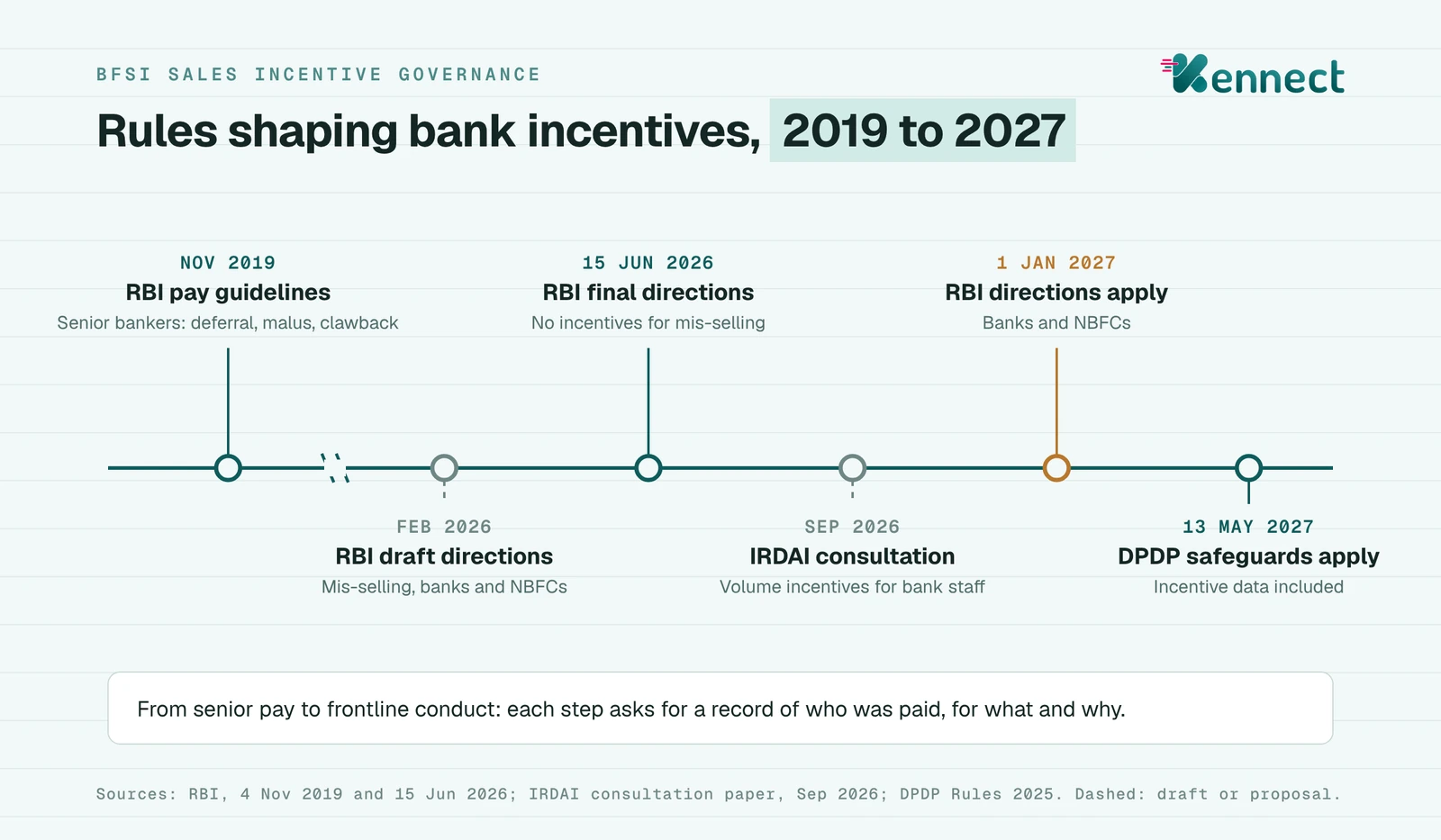
When I speak with risk heads at banks, the incentive conversation used to stop at the senior team. Deferral, malus and clawback for whole-time directors have been required under RBI's 2019 guidelines since April 2020. The frontline schemes sat with sales, in spreadsheets the board rarely saw.
That has changed this year. RBI's directions of 15 June 2026, issued for banks and NBFCs alike, apply from 1 January 2027. Policies and practices must not create incentives for mis-selling, employees must not receive incentives from third-party providers, and a product found mis-sold on a timely complaint is refunded in full.
BFSI sales incentive software now has to answer the board's questions from records. Which roles carry incentives, and on which products? Does any payment come from a third-party provider? Do complaints and refunds reach the seller's record? Can any payout be reconstructed? Ten questions like these show a board whether its frontline schemes can be explained before the directions apply.
A question worth asking the chief risk officer this week: for a product found mis-sold in September, could you name every person who earned an incentive on it?
When I speak with risk heads at banks, the incentive conversation used to stop at the senior team. Deferral, malus and clawback for whole-time directors have been required under RBI's 2019 guidelines since April 2020. The frontline schemes sat with sales, in spreadsheets the board rarely saw.
That has changed this year. RBI's directions of 15 June 2026, issued for banks and NBFCs alike, apply from 1 January 2027. Policies and practices must not create incentives for mis-selling, employees must not receive incentives from third-party providers, and a product found mis-sold on a timely complaint is refunded in full.
BFSI sales incentive software now has to answer the board's questions from records. Which roles carry incentives, and on which products? Does any payment come from a third-party provider? Do complaints and refunds reach the seller's record? Can any payout be reconstructed? Ten questions like these show a board whether its frontline schemes can be explained before the directions apply.
A question worth asking the chief risk officer this week: for a product found mis-sold in September, could you name every person who earned an incentive on it?
Table Of Content
Why bank boards are looking at frontline incentives
For years, board oversight of pay in Indian banks centered on the top. RBI has issued pay guidelines for senior bankers since 2012, and replaced them with stricter ones in November 2019, applicable from April 2020. The 2019 guidelines require private sector banks, and foreign banks to the extent applicable, to make at least half of a whole-time director's pay variable. They also require at least 60% of variable pay for whole-time directors and material risk takers to be deferred over at least three years, with malus and clawback.
Supervisors have since turned to the frontline. In November 2024, then RBI Governor Shaktikanta Das asked the directors of private sector banks to strengthen governance against unethical practices, including mis-selling. As reported, he said staff incentives should be designed so they do not encourage such conduct.
On 15 June 2026, RBI issued final directions on responsible business conduct, one set for each type of regulated entity, including commercial banks and NBFCs. Both apply from 1 January 2027. Paragraph 85U of the commercial bank directions says a bank "shall ensure that its policies and practices do not create incentives for mis-selling of products / services". Paragraph 101U of the NBFC directions says the same for NBFCs. Three points touch incentives directly.
Policies and practices must not create incentives for mis-selling, whether of the lender's own products or third-party products.
Employees must not receive any incentive, directly or indirectly, from a third-party product provider for selling its products.
Where mis-selling is established on a complaint made within the set window, the lender refunds the entire amount the customer paid, and pays the customer for any loss under its approved policy. Where the sector regulator sets no window, the customer has 30 days from receiving the signed terms.
Complaints about how products are sold are rising in life insurance, a product banks sell in volume. IRDAI's annual report for 2024-25 recorded 26,667 complaints about unfair business practices against life insurers, 22.14% of life insurance complaints, up from 23,335 the year before. For insurance sold through banks, IRDAI's consultation paper of September 2026 proposes ending volume-linked incentives for bank and NBFC staff, as set out in bancassurance incentive management.
Source: RBI circular DBOD No.BC.72/29.67.001/2011-12, 13 January 2012; RBI circular RBI/2019-20/89 on remuneration of whole-time directors, CEOs, material risk takers and control function staff, 4 November 2019; RBI (Commercial Banks, Responsible Business Conduct) Second Amendment Directions 2026, RBI/2026-27/115, 15 June 2026, paragraphs 85U and 85Z; RBI (Non-Banking Financial Companies, Responsible Business Conduct) Second Amendment Directions 2026, RBI/2026-27/123, 15 June 2026, paragraphs 101U and 101Z; RBI Governor's address to directors of private sector banks, 18 November 2024, as reported by Outlook Business; IRDAI Annual Report 2024-25 as reported by Outlook Money
Read the RBI directions themselves before changing any scheme, and take legal advice on how they apply to your bank or NBFC.
From January 2027, a frontline incentive that rewards mis-selling becomes a conduct issue the board will be asked about.
Who carries an incentive in a bank
A bank's incentive population is wider than its sales team. Relationship managers, branch staff, wealth advisors, the insurance desk, collections teams and direct sales agents can all carry targets. Many of them sell the bank's own products and third-party products in the same month.
Each group may sit on a different plan, often run in a different spreadsheet by a different team. A board question about incentives therefore needs an answer that spans all of them.
A bank board asking about incentives is asking about every payee type at once, on the bank's payroll and off it.
Ten questions a board can ask
The ten questions below test whether frontline incentives can stand up to the new directions. Each one names the record that answers it.
Ten board questions on frontline incentives, and the record that answers each
#
Question
The record that answers it
1
Which roles carry incentives, and on which products?
A register of plans by role and product, including third-party products
2
Does any employee receive anything from a third-party provider?
Payout records showing the source of every incentive paid
3
Do incentives read the quality of a sale as well as its volume?
Plan measures such as persistency, complaints and suitability records
4
Are contests and product drives approved before they run?
An approval log for every contest, with dates and approver
5
What happens to an incentive when a sale is found mis-sold?
A written clawback rule, applied to every person credited
6
Do complaints and refunds reach the seller's record?
Complaint and refund data linked to the seller and the sale
7
Who approves an exception, and where is it recorded?
An exception log with reason, approver and date
8
Can any payout be reconstructed for an auditor?
Dated plan versions and the source rows behind each payout
9
Do senior and frontline incentives point the same way?
Senior scorecards read beside the frontline measures they oversee
10
What does the board see each quarter?
A quarterly report on incentive cost, concentration and recoveries
The rules shaping bank incentives, from senior pay in 2019 to frontline conduct in 2027
Ten questions, each tied to a record, show a board whether frontline incentives can be explained.
Reading the answers
Third-party incentives
Question 2 needs more than a policy statement. A bank has to show that no payment to an employee came from a product provider, directly or through a contest the provider funded. That requires every incentive the bank pays to carry its source, every provider-sponsored contest to be recorded, and staff declarations of anything received directly.
Quality measures
Questions 3, 5 and 6 work together. A plan can read complaints and refunds when that data is linked to the person who sold the product. A clawback that recovers from one person when a sale was shared leaves part of the payout standing, a pattern covered in insurance agent commission software.
Question 10 gives the board a rhythm. The same readings each quarter, set out in a quarterly incentive plan review, let the board see whether recoveries, complaints and concentration are moving.
Each answer depends on a record kept at the time of sale, which is why governance starts in the incentive system.
Who owns incentive governance in a bank
Board oversight works when ownership below the board is clear. Three groups usually share it.
The Nomination and Remuneration Committee oversees pay for senior staff and can extend its view to frontline schemes.
Risk and compliance reads incentives for conduct risk, including mis-selling and complaints.
Sales and finance design the plans, run the calculation and report the cost.
Settle who approves a scheme, who approves a change and who answers a dispute. The questions are the same ones that sit behind who owns a change to sales incentives in any sales team.
Clear ownership below the board lets each of the ten questions reach the person who can answer it.
What BFSI sales incentive software has to hold
Whatever the bank's mix of products and channels, software that runs its incentives has to hold six things.
Every plan for every payee type as a dated version, with the products and measures it pays on.
The source of every incentive paid and every provider-sponsored contest, read beside staff declarations.
Seller-level links to complaints, refunds and persistency data.
Clawback rules that reach every person credited on a sale.
Exception and contest approvals, with reason, approver and date.
An audit trail that reconstructs any payout for the board, the auditor or the regulator.
BFSI incentive software is judged on whether it can answer the board's questions from records, without a reconstruction exercise.
How Kennect supports BFSI incentive governance
In our conversations with banks and lenders, governance questions come back to the record behind each payout. So we build the cycle around that record.
We hold plans for employees, agents and channel partners on one engine, with each change effective from a dated point. Data held in the bank's existing systems can be synced in for the plan to read. Each payout can be drilled down to the parameters and data behind it. Manual adjustments go for approval, and an approved payout cannot be edited.
Finance and compliance teams export payout and calculation detail for review. Payees see how each payout was built, in their own view.
One record for every payee type, with the source behind each payout, lets a bank answer its board from the system it pays from.
What this means before January 2027
RBI's directions apply from 1 January 2027, and IRDAI's consultation closes on 25 October 2026. Banks and NBFCs have one planning cycle to bring frontline schemes into line. A board that asks the ten questions now will know which records are missing while there is still time to build them.
One record for every payee type, with the source behind each payout, lets a bank answer its board from the system it pays from.
RBI's directions apply from 1 January 2027. Ten board questions test whether frontline incentives can be explained, sale by sale.
See how Kennect supports finance and compliance teams with audit-ready incentive records.