Banking, NBFC and lending
BFSI sales incentive software for banks, NBFCs and lenders.
Kennect runs variable pay for relationship managers, branch teams and direct selling agents on one engine: weighted KRA scorecards, disbursement-linked payouts, hold-and-release on portfolio quality, and clawback when a loan or account reverses. Every payout is approved, logged and explained, ready for internal audit and RBI review.
Updated on 11 Oct 2026
Built for scale
2,50,000+: Kennect installed base. 8 weeks: reference build, kickoff to first live payout. 7 levels: approval depth configured in a banking evaluation.
What a quarter-end costs today
Variable pay that a branch, an RM and a regulator can all read.
When a retail banking or lending head asks about incentive automation, the worry underneath is the quarter-end file. Weighted KRAs, data from separate systems and a manual file sent to HR, followed by weeks of RM queries that pull senior people away from the business.
The quarter-end file goes to HR by hand.
Why it hurtsKRA scores are pulled from BI dashboards, weighted in Excel and checked line by line. When a data error surfaces later, numbers are corrected after payout, and the RM finds out from a revised file.
The data needs a PMO before anyone can calculate.
Why it hurtsOrigination, loan management and core-banking data arrive from separate systems. A PMO team cleans and cuts them off by hand each cycle, and the calculation waits for them.
Disbursements reverse after the payout.
Why it hurtsA cancelled loan, a closed account or a balance that drops in the second month means money already paid has to come back. Without a written rule, every recovery becomes a negotiation.
The payee map
DSA commission management alongside every employee payee.
Lending and banking pay people on both sides of the payroll boundary. Relationship managers and branch heads earn on scorecards, while direct selling agents, connectors and collection agencies earn on disbursement and collection grids. Kennect runs both on one rule engine, with one audit trail.
One rule engine for every payee type, inside and outside the payroll.
The mechanics
NBFC sales incentive management, rule by rule.
Lending plans pay on volume and then test it against quality. These are the rules that hold both in one payout, each with its history kept.
DSA commission management
RBI and audit
Built for RBI review and internal audit.
RBI's directions on advertising, marketing and sale of financial products were issued on 15 June 2026 and take effect on 1 January 2027 for banks, NBFCs and housing finance companies. They ask regulated entities to calibrate incentives and sales targets so they do not push aggressive or unsuitable selling, and they bar staff from taking incentives from third-party product providers. Where mis-selling is established, the entity refunds and compensates the customer.
Scorecard to payout
From scorecard to payout, on one engine.
Calculate, approve and recover.
- The ELT and Calculation Engine scores every KRA and grid at each close.
- Payouts lock after approval; a manual adjustment carries a comment and stays on record.
- Clawback and recovery carry forward to the next cycle automatically.
- Query and Dispute Management gives every RM query a route, an owner and the evidence behind the number.
Model a scheme or contest before it launches.
- Budget simulation shows what a new scheme or a seven-day contest costs before it goes live.
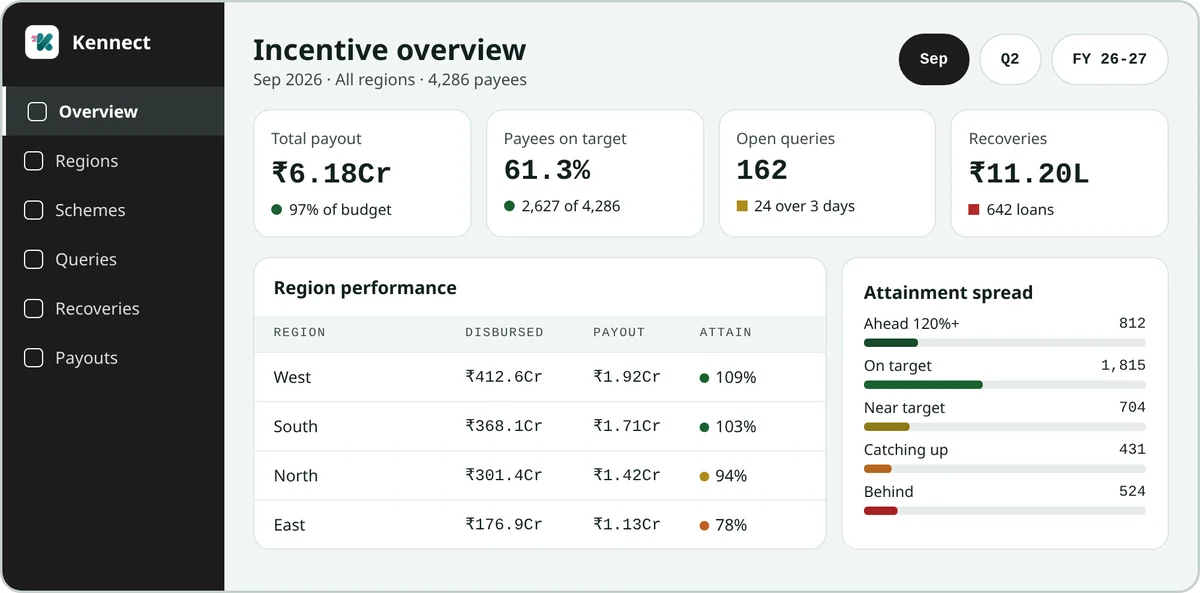
- The management cockpit shows payout, attainment and open queries by branch, cluster and region.
- Targets reach each branch from one approved plan.
Show every RM the next slab.
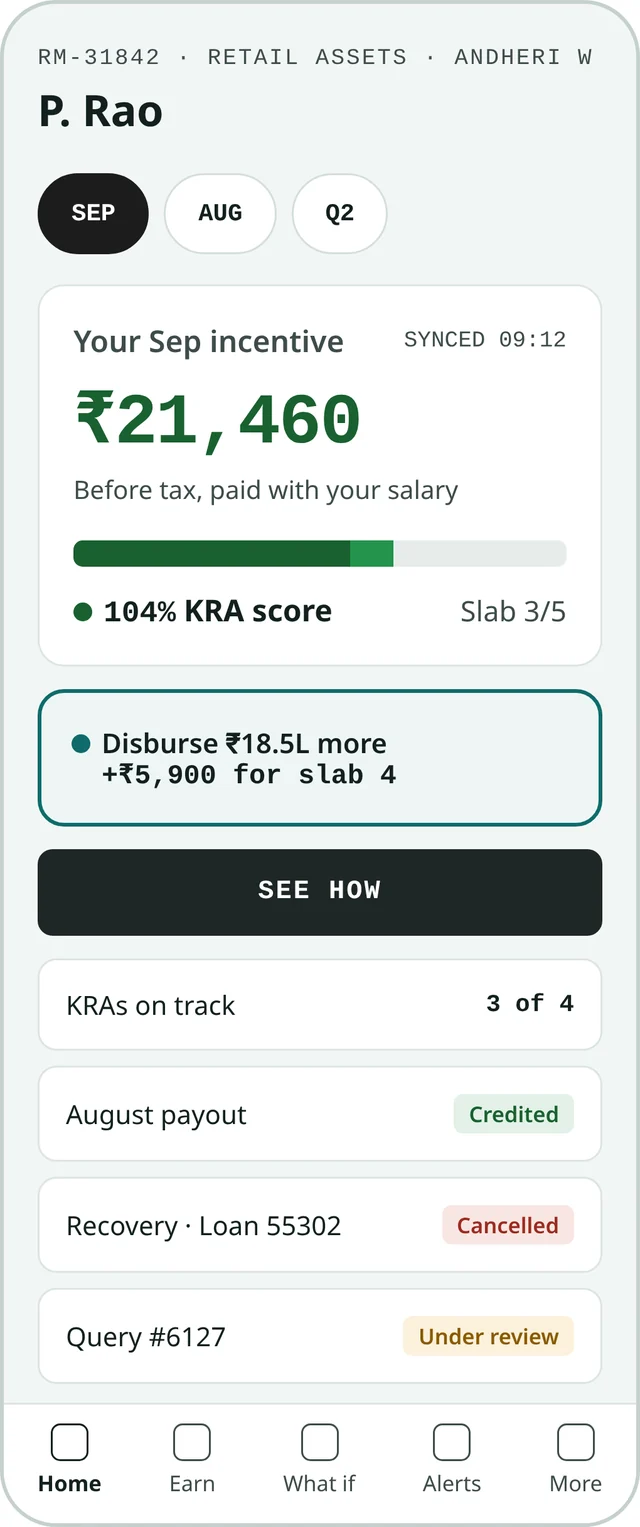
- The cockpit shows KRA scores, the gap to the next slab and pending recoveries.
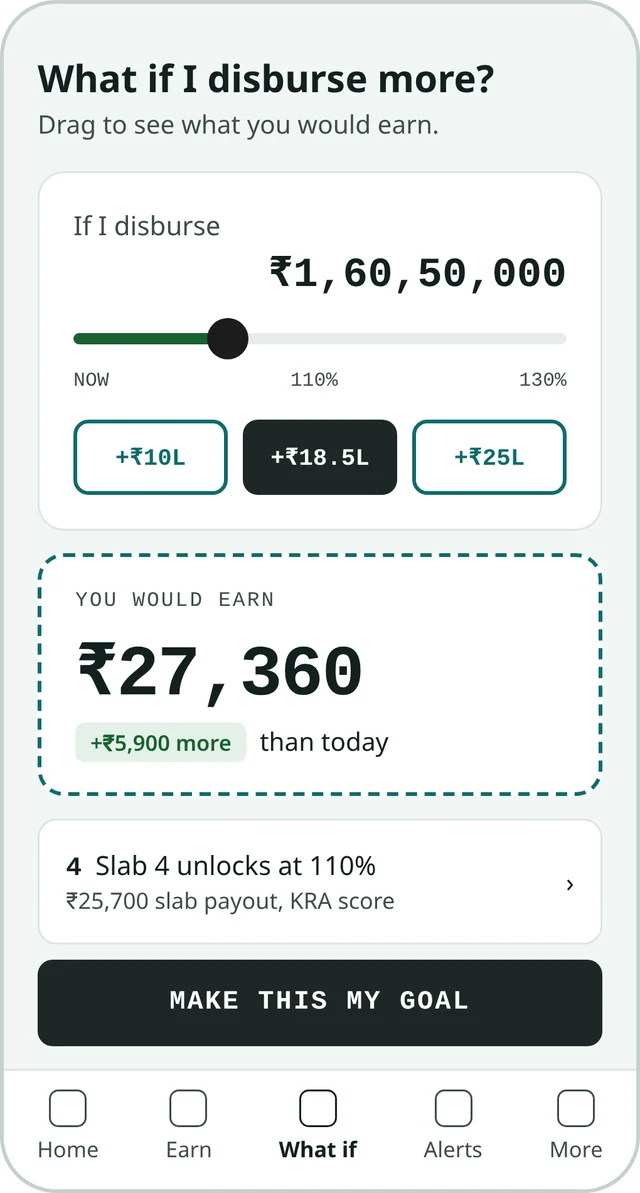
- The what-if simulator lets an RM test the effect of more disbursement or CASA.
- AI-Powered Nudges name the gap in rupees while it can still change the month.
The RM's cockpit
What the RM sees in the app they already use.
Relationship managers already carry a CRM, a lead app and an account-opening app. The cockpit sits inside one of them with single sign-on, so there is nothing new to install.
Home: KRA score, earnings to date and the gap to the next slab.
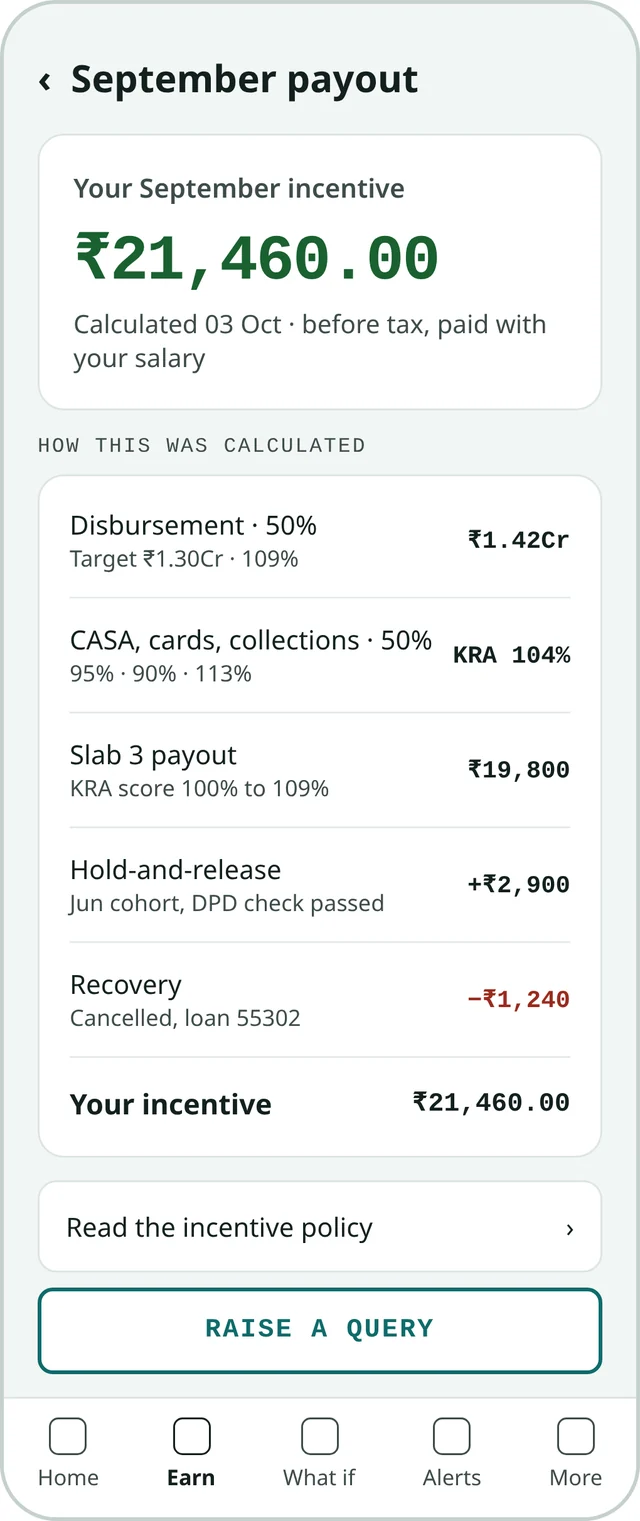
Earnings detail: the calculation, with recoveries and arrears shown line by line.
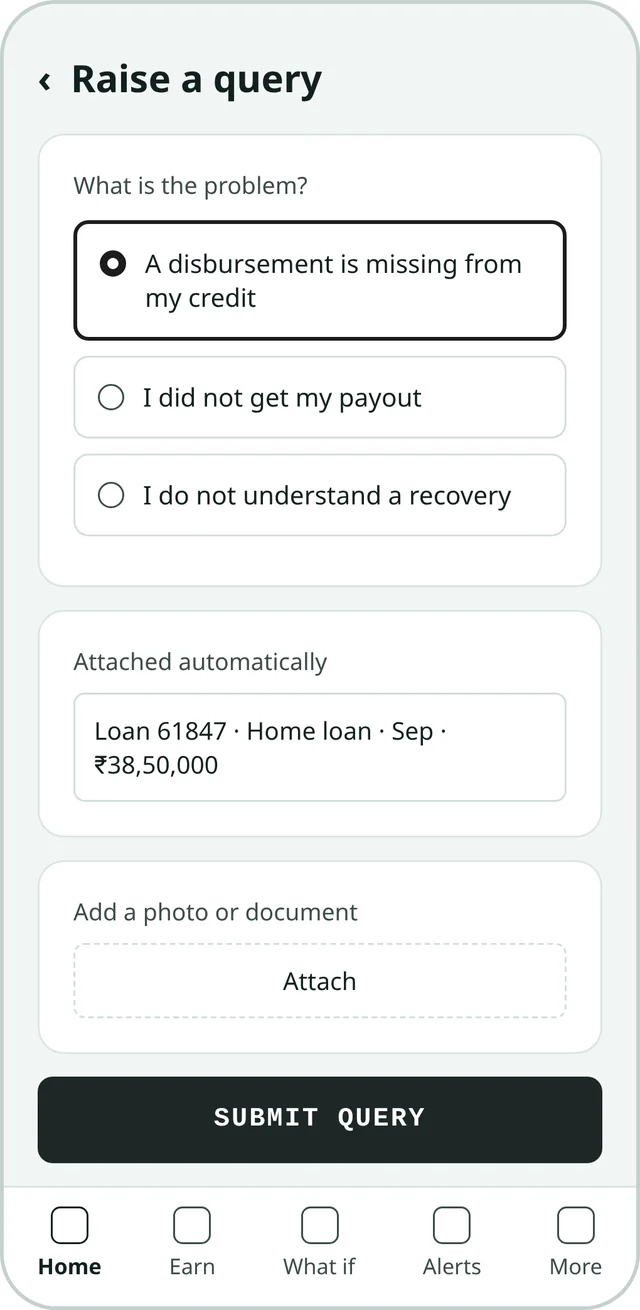
Raise a query: the question, the attached record and its status.
What if: the payout at a higher disbursement figure.
Customer story
How Midland Microfin pays its field on one engine.
Midland Microfin is a technology-led microfinance institution with more than 4,000 employees, headquartered in Jalandhar. It needed an incentive system that could keep pace with rapid growth: a seven-level hierarchy, more than 50 incentive schemes with different metrics, short-term contests, and different structures for each loan type.
Kennect automated incentives end to end. The team now designs and launches contests quickly, the field receives AI-Powered Nudges, leadership reads ready analytics, and every exception is handled inside the system.
Source: Midland Microfin case study, Kennect.
Going live
Live without asking IT to rebuild a single system.
A bank or lender has spent years and budget on its core banking system, its LOS and its CRM. Kennect leaves every one of them untouched.
We connect to the loan origination and management systems for disbursements and collections, to the core banking system for balances, and to the HRMS for the hierarchy.
We recalculate two to three closed cycles in parallel and reconcile them to what was paid.
We go live when the numbers match.
Branch teams stay in the CRM. The PMO keeps its data in the systems it already runs. Finance keeps payroll. The RM keeps the app already on their phone.
Connect
LOS, LMS, core banking, CRM and HRMS, by API, SFTP or file upload.
Parallel run
Two to three closed cycles recalculated and reconciled.
First live payout
8 weeks in the reference build. Deployments on bank-hosted infrastructure take longer.
By role
What each leader gets from the same number.
Schemes that reward disbursement and portfolio quality together, visible by branch as the quarter runs.
Accruals, recoveries and payouts from one calculation, ready for internal audit.
KRA scorecards, grids and contests on one engine, with every adjustment recorded.
The same scorecard engine for populations paid on KRAs without a sales incentive.
Their score, their slab and their recoveries, in an app they already use.
Keep reading
More on lending and banking incentives.
Questions leaders ask
Banking and lending incentive questions, answered.
What do the new RBI rules on selling financial products mean for how we pay branch and RM incentives?
From 1 January 2027, RBI's directions require banks and NBFCs to calibrate incentives and sales targets so they do not drive aggressive or unsuitable selling, and staff selling third-party products may not take incentives from the product provider. Plans therefore need a record of how targets and weights were set and approved. Kennect keeps every plan version with its effective date and approver.
How do we pay DSAs commission on disbursement without paying twice when a loan is cancelled?
Tie each DSA payout to the disbursement record and its cancellation window: commission computes at disbursement, and a cancellation inside the window triggers a recompute that carries the difference into the next cycle as a recovery. Kennect runs that recompute automatically and keeps the original and revised payout on record.
Our RM scorecard has 15 weighted KRAs with gates and multipliers. Can incentive software run that without custom development?
A weighted KRA scorecard is standard configuration when weights, gates, caps and multipliers are rule parameters: each KRA scores against its target, gates decide eligibility, and the multiplier applies to the weighted total. Kennect configures scorecards this way and routes each payout through up to seven approval levels before it locks.
Should collection performance and delinquency reduce a lending team's sales incentive?
Many NBFCs link part of the sales payout to portfolio quality by holding back a share of the incentive and releasing it after the loan clears a days-past-due check, which keeps volume and credit quality in one plan. Kennect runs hold-and-release as a rule, so the release date and the check behind it are recorded.
Can our relationship managers see their incentive inside the app they already use instead of a new one?
Yes, an incentive cockpit can sit inside an existing CRM, lead or account-opening app through an embedded view with single sign-on, so the RM sees earnings, the gap to the next slab and open queries without another login. Kennect embeds this way, which keeps the RM's day in the tools the bank already runs.
Why do NBFC incentive calculations take weeks when the data already sits in the LOS?
The delay sits before the calculation: origination data has to be cut off, cleaned and matched to the month's hierarchy each cycle, and when a PMO team does that by hand the calculation waits for them. Kennect connects to the LOS and the HRMS directly, so the cut-off and the hierarchy match run inside each close.
Is it safe to run a seven-day sales contest on top of our regular incentive plan?
A short contest stays contained when it runs as its own scheme with its own dates, budget cap and qualifiers, so the regular plan's payout is untouched and the contest's cost is known before launch. Kennect runs contests as separate schemes and simulates their cost first.
What security reports should an incentive platform have before our bank's infosec team will review it?
Bank infosec reviews commonly start from ISO 27001 and SOC 2 Type II reports, then test PII masking, single sign-on and how data moves between the core system and the platform. Kennect holds ISO 27001 and SOC 2 Type II and supports single sign-on.
Start with one scorecard
Send one KRA scorecard and see it calculated.
Share a scorecard and one quarter of sample data. We will run the close in Kennect and walk the PMO and finance teams through every payout it produced.