A dealer incentive management system has nine schemes to run.
October 8, 2026
Pulkit Agarwal
Pulkit Agarwal
Key Insights
Every festive season I speak with channel heads who run more schemes than they can list from memory. A volume slab, a focus model kicker, an exchange bonus, a display scheme and an early payment discount can all apply to one dealer in one month. The circulars are clear. The settlement is where the month gets long.
Each scheme pays on a different kind of proof, and the proof sits in a different place. Units sit in the DMS, payment dates in the finance ledger, displays in a folder of photographs and claims in the dealer's own spreadsheet.
A dealer incentive management system works when each scheme carries its own rule, its own data source and its own control, and each claim is settled against that record. India retailed 2,96,71,064 vehicles in FY2026 through more than 15,000 dealerships, and every one of those sales can sit under several schemes at once.
A question worth asking the head of channel sales this week: for the scheme that closed in September, which record proved each claim before it was paid?
Every festive season I speak with channel heads who run more schemes than they can list from memory. A volume slab, a focus model kicker, an exchange bonus, a display scheme and an early payment discount can all apply to one dealer in one month. The circulars are clear. The settlement is where the month gets long.
Each scheme pays on a different kind of proof, and the proof sits in a different place. Units sit in the DMS, payment dates in the finance ledger, displays in a folder of photographs and claims in the dealer's own spreadsheet.
A dealer incentive management system works when each scheme carries its own rule, its own data source and its own control, and each claim is settled against that record. India retailed 2,96,71,064 vehicles in FY2026 through more than 15,000 dealerships, and every one of those sales can sit under several schemes at once.
A question worth asking the head of channel sales this week: for the scheme that closed in September, which record proved each claim before it was paid?
Table Of Content
How large the dealer channel has become
India retailed 2,96,71,064 vehicles in FY2026, up 13.30% on the year before, according to the Federation of Automobile Dealers Associations. Two-wheelers made up 2,14,20,386 of those sales and passenger vehicles 47,05,056. Tractors grew 18.95% and commercial vehicles 11.74%.
FADA represents more than 15,000 dealerships with about 30,000 outlets. Each of those outlets runs several OEM schemes at once, and each scheme pays on its own rule.
The same structure holds in consumer durables, tyres, paints and FMCG distribution. A manufacturer pays the channel to sell a volume, a model, a display or a payment behavior, and the dealer claims against each scheme separately.
Source: FADA, FY2026 and March 2026 vehicle retail data, released 6 April 2026 · registered retail sales across two-wheelers, three-wheelers, passenger vehicles, tractors, commercial vehicles and construction equipment
The dealer channel carries crores in scheme spend every month, spread across schemes that each need their own proof.
Why one control does not fit every scheme
A volume slab pays on units. A display scheme pays on a photograph. An early payment discount pays on the date money reached the manufacturer. Each one is proved by a different record, held by a different team.
When all schemes are settled from one claim sheet, the sheet checks what it can see, which is usually the amount. The proof behind the amount sits in a DMS, a finance ledger, a field app or an email thread.
This is where a dealer incentive management system earns its place. It holds each scheme with its own rule, its own data source and its own check, and it settles the claim against that record.
A control has to match the proof a scheme pays on, and the nine common scheme types pay on nine different kinds of proof.
Nine dealer scheme types and the control each one needs
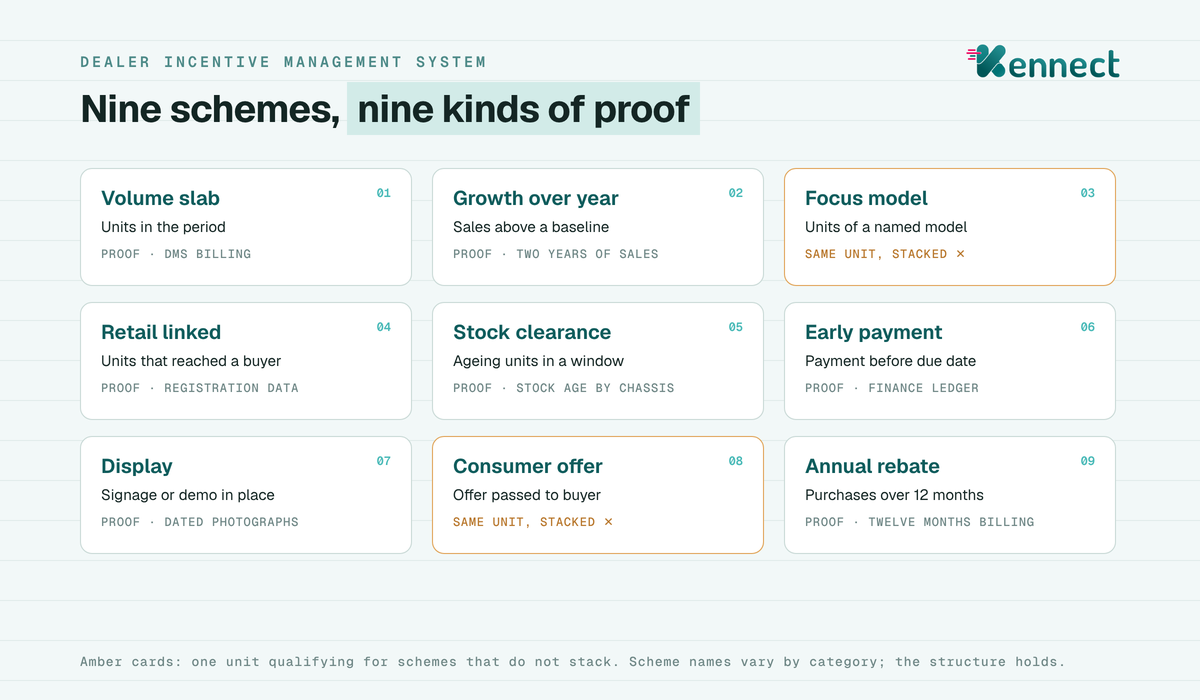
Manufacturers run some mix of the nine schemes below. The names change by category, and the structure stays the same.
Nine dealer scheme types, the proof each pays on and the control it needs
Scheme type
What it pays for
The record that proves it
The control
Volume slab
Units sold in the period, paid at the slab reached
Billing or retail data per dealer
Slab and period fixed in the scheme version before the month opens
Growth over the previous year
Sales above the same period a year earlier
Two periods of clean sales data per dealer
A baseline locked at scheme launch, adjusted for new or closed outlets
Focus model or SKU
Units of a named model or product
Sales by model code
Model list frozen in the scheme, so a late addition does not pay backward
Retail or registration linked
Units that reached a customer
Registration, warranty activation or invoice to customer
Claim matched to the end sale, with a cut-off for late registrations
Stock clearance
Ageing units sold within a window
Stock age by chassis or batch
A list of eligible units fixed on day one of the window
Early payment or cash discount
Payment received before a due date
Finance ledger receipt date
Paid from the ledger, with no manual date entry
Display and visibility
Shelf, signage or demo vehicle in place
Dated, geotagged photographs or audit visits
An audit sample with a named approver
Consumer offer support
Exchange bonus, finance offer or cash discount passed to buyers
Customer invoice showing the offer
One claim per customer invoice, checked against duplicates
Annual turnover rebate
Total purchases across the year
Twelve months of billing
Accrued monthly and settled once, after returns
Nine dealer scheme types and the record each one pays on
Each scheme type pays on a different record, so each claim has to be checked against that record and nothing else.
Where dealer schemes leak
Three failures account for many of the disputes and overpayments in a dealer program.
One unit, several schemes
A two-wheeler sold in October can qualify for the volume slab, the focus model kicker and the exchange bonus support at the same time. If the schemes allow stacking, the cost is planned. If they do not, a unit can still be paid three times when each scheme is settled from a separate sheet.
The control is a stacking rule written into each scheme, checked at the unit level before any claim is paid.
A claim settled from the dealer's own sheet
Dealers send claims in their own format, often by email. The scheme team checks the totals and approves. The dealer's sheet becomes the record, and the manufacturer has no independent check on the units behind it.
A slab revised on the 20th, or a model added to a focus list after the month opens, reaches back over sales already made. Dealers who sold under the old rule ask which rule applies. The same discipline that governs a mid-year incentive plan change applies here: a dated scheme version, applied from the next period.
Stacking, self-reported claims and mid-period edits each move money without a record that explains it.
How to set the controls before the next scheme
Five steps put a control in place for every scheme before it reaches the channel.
Write each scheme as a version with a start date, an end date, the rule and the record it pays on.
Name the data source for each scheme: DMS billing, registration data, the finance ledger or audit photographs.
Write the stacking rule for every pair of schemes that can apply to the same unit.
Settle claims against the source record, and keep the dealer's own claim as a cross-check.
A scheme circular that names the rule but not the record leaves the claim to be settled on trust.
A scheme with its rule, record and stacking terms written before launch can be settled without a dispute.
How Kennect runs dealer schemes
Across the deployments we run, dealer and distributor schemes sit on the same record as the sales data that earns them. So we build the scheme cycle around that record.
We hold each scheme as a dated version with its rule and its data source. We bring in billing, secondary sales and retail data from the systems the business already uses. We calculate each claim from those rows, flag a unit that qualifies for schemes that do not stack, and show the dealer the claim as it builds through the month.
Finance sees the accrual for each scheme as the month runs. The channel team keeps writing circulars the way it does today. Dealers see the same number the manufacturer sees, which ends many claim disputes before they start.
One record per scheme, settled from source data, turns a monthly claim negotiation into a lookup.
What this means for the next scheme circular
Dealer schemes will keep multiplying as categories add models and channels add formats. The scheme count is less of a problem than the proof behind each claim. A manufacturer that writes the record into every scheme can run nine schemes as cleanly as one.
A scheme with its rule, record and stacking terms in writing can be settled without a dispute.
Each of the nine dealer scheme types pays on a different record. The control that matters is the one that checks the claim against that record.
See how incentive compensation management holds dealer and distributor schemes on one record.


.jpeg)