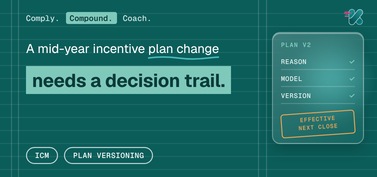
A mid-year incentive plan change needs a written decision trail.
October 6, 2026
Pulkit Agarwal
Pulkit Agarwal
Key Insights
Every October I hear a version of the same request from sales leaders. The first half has closed, the numbers are in, and something in the plan has to change before Diwali. A target set in April now looks out of reach for one zone. A launch slipped and its product weight is wrong. One region is running so far ahead that the budget looks exposed.
Agreeing the change usually takes a week. The harder part is making it without the field feeling that the goalposts moved, and without losing a good regional manager in November over a slab nobody explained.
What works is simpler than it sounds. A mid-year incentive plan change holds up when three things are written down before the new rule applies. The first is why the plan is changing, drawn from first-half results. The second is who gains and who loses, modeled on live data. The third is the date the new rule starts, with deals already in motion protected. In India the second half began on 1 October 2026, so this is the month to put those three records in place.
A question worth asking the head of sales operations this week: if a rep disputes an October payout in March, which document explains the rule that paid it?
Every October I hear a version of the same request from sales leaders. The first half has closed, the numbers are in, and something in the plan has to change before Diwali. A target set in April now looks out of reach for one zone. A launch slipped and its product weight is wrong. One region is running so far ahead that the budget looks exposed.
Agreeing the change usually takes a week. The harder part is making it without the field feeling that the goalposts moved, and without losing a good regional manager in November over a slab nobody explained.
What works is simpler than it sounds. A mid-year incentive plan change holds up when three things are written down before the new rule applies. The first is why the plan is changing, drawn from first-half results. The second is who gains and who loses, modeled on live data. The third is the date the new rule starts, with deals already in motion protected. In India the second half began on 1 October 2026, so this is the month to put those three records in place.
A question worth asking the head of sales operations this week: if a rep disputes an October payout in March, which document explains the rule that paid it?
Table Of Content
Why the second half matters for variable pay
Plan changes are normal. In the Alexander Group's 2026 Sales Compensation Trends Survey, 97% of companies changed their annual plans for 2026, up from 86% a year earlier. 65% said they need to improve governance and program management.
In India the financial year runs April to March, so a reset made now governs six months of variable pay, through the festive quarter and the year-end close.
Source: 97%, 86% and 65% · Alexander Group, 2026 Sales Compensation Trends Survey, reported in WorldatWork Workspan Daily, 13 August 2026, and the Alexander Group research briefing · companies across 11 industries · sample size not published
A reset made this month decides how six months of variable pay will be read, by the field and by finance.
Five steps to change the plan mid-year
Each step leaves a record. Together the records are the decision trail.
Read the first half against the objective the plan set.
Write the reason down, with the figures that support it.
Model the change on live data and show who gains and who loses.
Fix a plan version with an effective date that protects deals in motion.
Publish the change to every payee with a worked example and a window for queries.
Steps 1 and 2 give the reason. Step 3 gives the model. Steps 4 and 5 give the dated version. The next three sections take each one in turn.
The decision trail of a mid-year plan change, and which rule pays which deal
Five steps, three records, and every one of them exists before the first payee is paid on the new rule.
Write down why the plan is changing
A reset starts with what the first half measured. Read attainment by role and by zone, then read what the money returned. The return on incentives paid for the first half tells the plan owner whether H1 spend bought the behavior the plan asked for.
A quarterly review is usually where the proposal first appears. Write the proposal down in the same week, while the reasoning is fresh.
What the record holds
Four lines are enough: what is changing, which first-half figures show the need, who proposed it and who approves it. A reason with no figure behind it reads to the field as a preference.
Reasons that hold
A target built on a market assumption that has since moved. A product launch that slipped by a quarter. A scheme objective that the first half has already met. Each one names something the plan measured.
Reasons that do not hold
A reset aimed at a few people who are earning well is a different decision. Unusually large earnings belong in a policy written before the year starts, with a written exception rule that names the threshold and the approver. Many organizations already write one for very large deals.
In WorldatWork's 2021 Sales Compensation Programs and Practices survey, 41% ran a bluebird or mega-deal policy, up from 28% the year before.
Source: 41% and 28% · WorldatWork with SalesGlobe, Sales Compensation Programs and Practices, key findings, August 2021 · 472 responses · the policy covers special treatment of very large deals
The reason record shows that the change answers something the first half measured.
What the new rules pay across October to March, against what the old rules would have paid. Finance needs this figure for the accrual. Ind AS 19 asks for a reliable estimate of a bonus obligation, and a mid-year reset changes the estimate.
Who gains and who loses
Count the payees who earn more and the payees who earn less, by role and by zone. A reset that moves money from one cohort to another needs saying out loud to both.
What happens to the pipeline
Take the deals already past a defined stage on the effective date. Show what each would pay under the old rule and the new one. This is the number reps check first, because these are the deals they have already worked.
Share the model with regional managers before the version is fixed, and note their response in the record. Leventhal's procedural rules call this representation. In practice it is how a manager comes to defend the reset in the field.
The model record lets finance and the field see the effect of a reset before anyone is paid on it.
Fix the date the new rules start
The third record fixes the rule. It names a plan version, the date it takes effect and the closes it governs. Changes apply from the next close forward, which is the discipline behind a plan version fixed to the period.
Effective date and deals in motion
Pick the date before announcing it. Then write the rule for deals already in motion. A common choice holds the old rule for any deal past a named stage on the effective date. Whatever the choice, it is written into the version.
Approval
Record who proposed the change, who approved it and when. Settle in advance who owns a change to sales incentives, so the approval route is known before October.
The record sits beside the plan version, in the same place as the payout it will calculate. An incentive approval workflow that lives in email cannot be reopened a year later, and incentive policy enforcement depends on that record.
Notice to the field
Publish the change to every payee before it applies. Include a worked example in rupees for each role, and open a short window for queries. This is Leventhal's correctability rule in practice: a rep who can ask a question early raises fewer disputes later.
India's Industrial Relations Code 2020 has been in force since 21 November 2025. It requires 21 days' notice before changing listed conditions of service for workers. Its worker definition includes sales promotion employees, which covers non-supervisory medical representatives. Commission sits outside the Code on Wages definition of wages, unless excluded items pass half of total pay.
Whether a given scheme change needs notice under the labor codes depends on how the scheme is built, so take legal advice before the change is announced.
For a listed company, the version record also answers the auditor. Under Section 143(3)(i) of the Companies Act 2013, the auditor reports on internal financial controls. A dated, approved plan version is the control evidence for every payout calculated under it.
The version record decides which rule paid which sale, and every dispute about a reset comes back to that question.
Where mid-year changes go wrong
Three failures sit behind many of the disputes that follow a reset. Each one is visible early, as a query from the field.
The rule reaches backwards
A new slab announced on 20 October and applied to the whole of October reaches back over sales already booked. The field reads that as a retrospective cut, whatever the intent. Applying the change from the next close removes the dispute before it starts.
The change lands on the strongest performers
A target raised mid-year for reps who are ahead teaches the field that strong performance invites a higher bar. Martin Weitzman modeled this ratchet principle in 1980. Bouwens and Kroos later found store managers who were ahead after three quarters easing off in the fourth, under targets set from past results. That costs the business the performance the plan was paying for.
The decision lives in a meeting and a spreadsheet
The reset is agreed on a call and applied in a live workbook. Months later a transfer forces a recalculation of October, and today's rules run against October's sales. The difference that falls out reads as an error, and nobody can show which rule was in force.
All three are failures of record, and each one shows up first as a query from a payee.
Why an explained change keeps the field's trust
One study shows where an unexplained change does its damage. Robert Folger and Mary Konovsky surveyed 217 employees at a US manufacturing plant about their pay raise decisions.
Fairness of the amount explained more of how satisfied people were with their pay. Fairness of the process explained more of two other things: trust in the supervisor and commitment to the organization.
The process measures included feedback, planning and recourse, meaning the ability to find out why a decision was made and to appeal it.
Source: Folger and Konovsky, "Effects of procedural and distributive justice on reactions to pay raise decisions", Academy of Management Journal, vol. 32, no. 1, 1989 · 217 employees · one US manufacturing plant
The limit matters. This is one plant, in the United States, studying pay raises in 1989. Sales incentives and India both sit outside its scope.
What it supports is narrower and still useful. The explanation and the route to appeal bear on trust in the manager.
A meta-analysis by Colquitt and colleagues across 183 studies found a related pattern: procedural fairness related more strongly to commitment to the organization. An H2 reset puts that commitment under load.
The research places the cost of an unexplained change on trust in the manager, and an H2 reset leans on that trust for six months.
How Kennect keeps the decision trail in one place
Across the deployments we run, the resets that hold are the ones where the three records live in one place. So we build the cycle around that.
We keep every plan version against the closes it calculated. We run a proposed change on live sales data before it is published. We record who proposed, approved and published each change, with the date. We publish the new slab to each payee's cockpit, with the gap to the next slab in rupees.
A change that touches a closed period runs as a recalculation. The difference is carried into the next payout, with the reason shown line by line. The targets the reset changes sit on the same record as the payouts they drive.
Finance keeps an accrual it can explain at year end. Sales operations keeps a version history it can defend. Regional managers keep a reason they can repeat to their teams. Reps see the new number before they are paid on it.
One record carries the reason, the model and the version, so a reset can be explained in March as clearly as in October.
Before the new plan reaches the field
The reset itself is a normal business decision. Plans change every year, and in India the October reset is part of the calendar. What decides how it lands is whether three records exist before the first payee is paid on the new rule.
A reset with its reason, model and version in writing can be defended by the manager who announces it.
A reset is fair when the field can see why it happened, what it was modeled to do and from which date it applies. All three are in writing before the change reaches a payee.
See how the sales incentive plan guide sets out the version, approval and notice a mid-year change needs.


.jpeg)