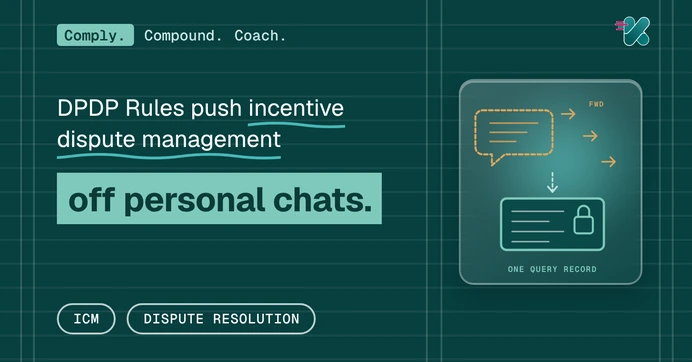
DPDP Rules push incentive dispute management off personal chats.
October 17, 2026
Puneet Gupta
Puneet Gupta
Key Insights
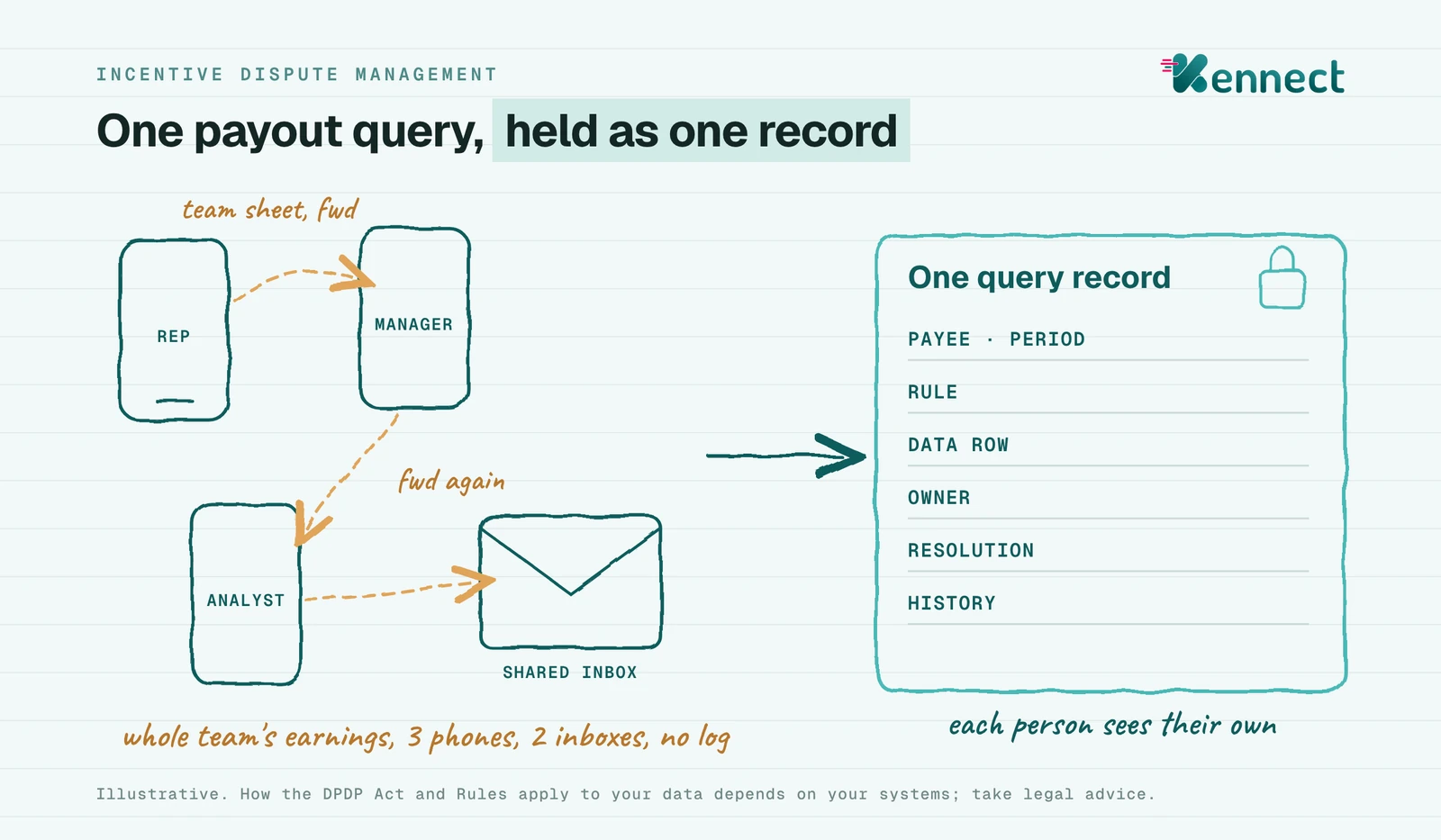
Late one evening a rep forwards a photograph of the area payout sheet to his manager. He wants to ask about one number. The photograph carries the targets and earnings of his whole team, and by the next morning it is on three phones and in two inboxes.
I see this pattern in many incentive teams. It is how queries get answered quickly when there is no other channel.
Incentive dispute management works when each query is raised against the payout record, routed to an owner and answered there, with access limited to the people who need it. That matters more now. India's Digital Personal Data Protection Rules were notified in November 2025, and from 13 May 2027 they expect reasonable security safeguards, logs and breach reporting for personal data, including incentive data. Under the Act, failing to take reasonable safeguards can attract a penalty of up to ₹250 crore.
A question worth asking the head of sales operations this week: through which channels did payout queries arrive during the previous close?
Late one evening a rep forwards a photograph of the area payout sheet to his manager. He wants to ask about one number. The photograph carries the targets and earnings of his whole team, and by the next morning it is on three phones and in two inboxes.
I see this pattern in many incentive teams. It is how queries get answered quickly when there is no other channel.
Incentive dispute management works when each query is raised against the payout record, routed to an owner and answered there, with access limited to the people who need it. That matters more now. India's Digital Personal Data Protection Rules were notified in November 2025, and from 13 May 2027 they expect reasonable security safeguards, logs and breach reporting for personal data, including incentive data. Under the Act, failing to take reasonable safeguards can attract a penalty of up to ₹250 crore.
A question worth asking the head of sales operations this week: through which channels did payout queries arrive during the previous close?
Table Of Content
Where incentive disputes happen today
In many Indian sales teams, a payout query starts as a message. A rep photographs the area payout sheet and sends it to his manager on WhatsApp to ask about one number. The manager forwards it to the incentive analyst. The analyst replies on email with a corrected sheet.
The query is answered. Along the way, the earnings and targets of a whole team have been copied to three phones and two inboxes, with no record of who saw them.
Many companies also use WhatsApp Business channels for official notices to the field. The concern in this post is narrower: payout sheets forwarded between personal accounts, outside any access control the company runs.
Disputes without a resolution path are a known breakdown. Writing in WorldatWork in July 2026, Ellie Leites and Rachel Parrinello listed crediting disputes with no resolution path among the common failures of incentive governance.
An incentive query sent on chat gets answered, and the personal data in it travels further than the question needed.
What the DPDP Rules expect, and when
India's Digital Personal Data Protection Rules 2025 were notified in November 2025. They give effect to the Digital Personal Data Protection Act 2023, in phases.
13 November 2025. The Data Protection Board provisions took effect.
13 November 2026. The consent manager provisions apply.
Processing for employment is one of the legitimate uses in Section 7 of the Act, so an employer does not need consent to calculate incentives. The safeguard, breach and retention duties still apply to that data. The Rules list measures such as access controls, encryption or masking, monitoring and logs kept for at least a year. A breach must be reported without delay to the Board and to each person affected, with a fuller report to the Board within 72 hours.
Under the Act's schedule, failing to take reasonable security safeguards can attract a penalty of up to ₹250 crore. Failing to report a breach can attract up to ₹200 crore.
Some duties apply today. Until the DPDP provisions take effect, Section 43A of the Information Technology Act and the 2011 rules on sensitive personal data remain in force. Those rules treat financial information, such as bank account details, as sensitive personal data and require reasonable security practices. A company that is negligent in maintaining them can be liable to pay damages to the person affected.
Source: Digital Personal Data Protection Rules 2025, notified November 2025; Hogan Lovells summary of the phased commencement; PIB note "DPDP Rules, 2025 Notified", 17 November 2025; Information Technology (Reasonable security practices and procedures and sensitive personal data or information) Rules 2011, Rule 3
How the Act and Rules apply to your incentive data depends on your systems and contracts. Take legal advice before changing how payout data is shared.
A payout sheet with bank details already falls under the IT Act's security rules. From May 2027, all incentive data falls under the DPDP duties for access control, logging, breach reporting and retention.
What a payout dispute exposes
An incentive dispute carries some of the more sensitive data a company holds about its sales staff: earnings, targets, rankings and sometimes deductions. The channel decides how far it travels.
Where an incentive dispute travels, and the control each channel lacks
Channel
What travels with the query
The control that is missing
Personal chat apps
Screenshots of team payout sheets, forwarded between phones
No access control once forwarded, no log of who viewed it, no erasure
Email
Spreadsheet attachments with every payee's figures
Copies in every inbox, no link to the payout record
Phone call
The rep's account of the number
No record of the query or the answer
Shared drive
The full payout file, opened to answer one line
Access wider than the query needs
One payout query, sent around on chat and held as one record
Each informal channel copies more personal data than the query needs and leaves no record of where it went.
Six things a dispute record should hold
A dispute raised against the payout record answers the question and keeps the data inside one access-controlled place. Six fields make the record useful.
The payee and the period. Who is asking, and about which close.
The rule. The plan component the query concerns, such as a slab, a split or a deduction.
The data row. The sale, policy or invoice behind the disputed number.
The owner. The person responsible for answering, set by routing rules.
The resolution. The answer, any correction and the date it was given.
The history. Who viewed and changed the record, kept for the retention period.
A rep sees his own figures. The manager sees his team. The analyst sees what the query needs. That is the access control the Rules describe, applied to a payout query.
A dispute held as a record answers the rep and keeps his team's data out of circulation.
Where disputes come from
A dispute log is also a diagnostic. Queries cluster on the rules that cause them, and the cluster points to the fix.
A plan change mid-period. A change applied without notice brings a wave of queries. A mid-year incentive plan change should open a short query window before it applies.
Shared credit. A split agreed after the deal closes becomes a dispute between colleagues. The rule belongs in the plan, as set out in split sales compensation.
Deductions without a reason. A clawback that appears as one lump deduction draws queries, a pattern covered in insurance agent commission software.
A rerun of a closed period. A difference that arrives without its reason is queried, which is why retrospective incentive calculation carries each adjustment as a labeled line.
Disputes cluster on a few rules, and a log that records the rule shows which one to fix.
Moving disputes into one channel
Five steps move disputes from personal chats into a record before the May 2027 obligations apply.
Name one channel for payout queries, and tell the field that queries sent elsewhere will be redirected there.
Set routing rules, so each query reaches its owner by category and region.
Publish payout statements in the same place, so a rep can query a line without sharing a sheet.
Set a response time for each category, and report on it monthly.
One channel, with routing and a response time, gives the field a faster answer and the company a record.
How Kennect handles incentive queries
In the sales teams we work with, many incentive queries come from payees who cannot see how a number was built. So we put the statement and the query in the same place.
Payees see their own earnings and slabs in the Kennect app. A payee raises a query against a period, chooses a category, describes it and attaches a file. The query is routed to the manager or administrator responsible, who can reply in a chat on the same record. The payee sees whether it is pending or closed.
Incentive circulars can be shown in the app without being downloadable. The query, the replies and the outcome stay on one record.
A query raised inside the payout system keeps the answer, the data and the history in one access-controlled record.
What this means before May 2027
The DPDP obligations for safeguards, breach notification and retention apply from 13 May 2027. Incentive disputes will keep arriving every close. A team that moves them into one record now will have seven months of practice, and a log of which rules cause them, before the deadline.
A query raised inside the payout system keeps the answer, the data and the history in one access-controlled record.
An incentive dispute carries earnings and targets. India's IT Act rules already expect reasonable security for financial details such as bank accounts, and from May 2027 the DPDP Rules add access control, logs and breach reporting for all personal data.
See how query management handles payout disputes inside the incentive record.