Insurance
Insurance commission software for every agent and channel.
Kennect runs commission and incentives for insurer sales teams, agents, POSPs, bancassurance partners and brokers on one engine: policy weightages, renewal and portability business, persistency gates, and clawback when a policy is cancelled or returned in free look. Every payout is locked, approved and explained, ready for IRDAI and internal audit.
Updated on 11 Oct 2026
Built for distribution
2,50,000+: Kennect installed base. 8 weeks: reference build, kickoff to first live payout. 13 and 25: persistency checks configured as plan rules.
What a payout cycle costs today
Insurance commission software for a business that pays on 13 months of data.
When a head of distribution asks about automating commissions, the worry underneath is the week after payout day. That is when the base sheet meets the field, and every mapping change nobody filed comes back as a query.
The base sheet is worked by hand.
Why it hurtsData lands in the data lake, a base sheet is downloaded, and the incentive team applies each vertical's rules in Excel. Agency, banker and broking business each need their own logic, so the work multiplies with every vertical.
Credit lands on the wrong RM.
Why it hurtsWhen a manager does not file a mapping change, a policy credits to the wrong relationship manager. The fix is a manual recalculation after the payout has gone out.
Renewals are known in month 13.
Why it hurtsRenewal eligibility, persistency and free-look cancellations arrive long after the first payout. Without a written rule, every recovery is argued case by case.
The payee map
Insurance agent commission software for every channel the insurer sells through.
An insurer pays across channels that each work differently. Its own sales staff earn on goal sheets by level, agents and POSPs earn commission on premium, bank staff and corporate agents sell through bancassurance, and brokers earn on placed business. Kennect runs every channel on one rule engine, with one audit trail.
One rule engine for every channel, with each policy credited once.
The mechanics
Commission rules by policy, product and policy year.
Insurance pays on a policy that keeps changing after it is sold. These are the rules that follow it through renewal, persistency and cancellation, each with its history kept.
Bancassurance incentive management
IRDAI and audit
Built around IRDAI's commission framework.
IRDAI's Expenses of Management, including Commission, of Insurers Regulations 2024, notified on 22 January 2024, ask each insurer to pay commission within its expense of management limits and under a board-approved commission policy. On 23 September 2026, IRDAI released a consultation paper on the economics of insurance distribution, with comments due by 25 October 2026. The paper observes that remuneration “is growing four to five times faster than the business.”
Every close also carries an audit pack: locked payouts, maker-checker approvals and a change log, ready for internal audit and for review under Section 143(3)(i) of the Companies Act 2013.
Goal sheet to payout
An agency commission management system from goal sheet to payout.
Calculate, approve and recover.
- The ELT and Calculation Engine runs weightage, persistency and clawback rules for every vertical at each close.
- Maker-checker approval locks each payout; a later change is issued as an incremental advice.
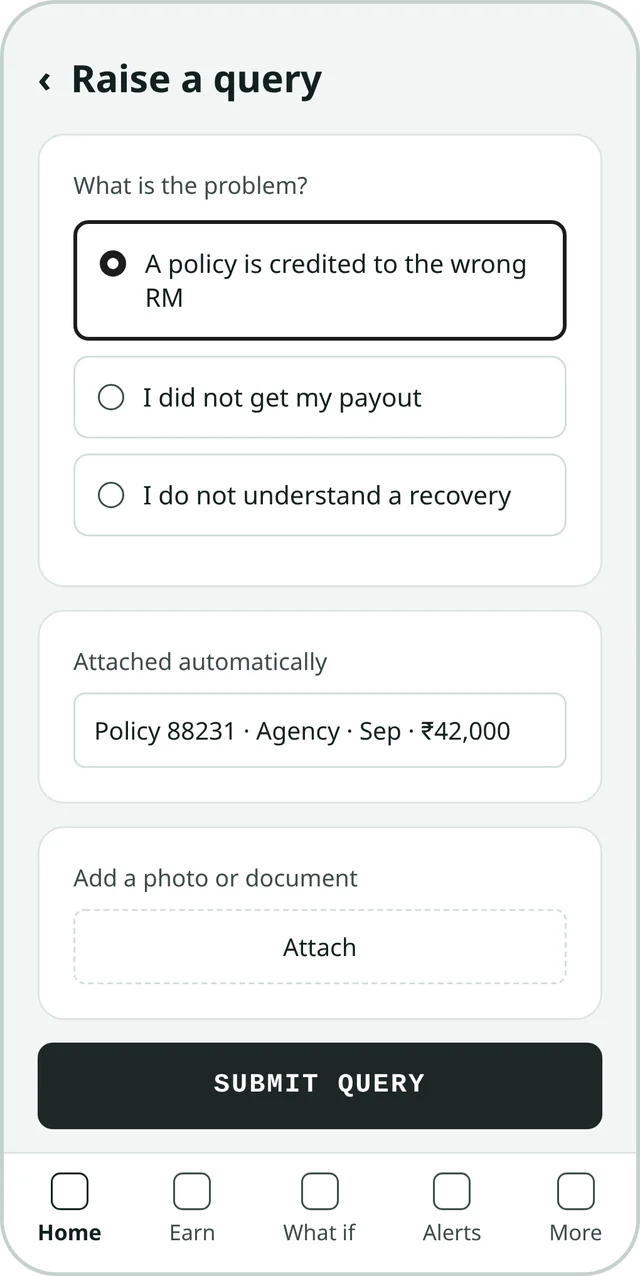
- Query and Dispute Management gives every RM and agent query a route, an owner and the policies behind the number.
- Payout files go to accounting and payroll from the same approved calculation.
Model a commission change before it ships.
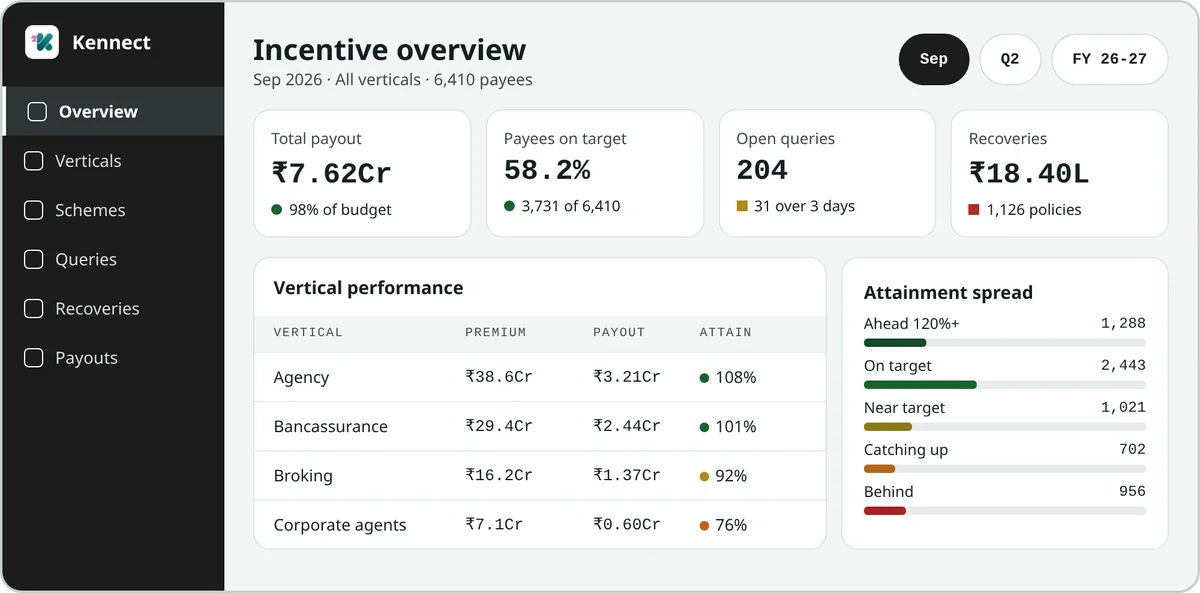
- Scheme modelling shows what a cap or rate change costs by channel and product before it takes effect.
- The management cockpit shows payout, activation and open queries by vertical and level.
- Goal sheets reach each level from one approved plan.
Show every RM the next slab.
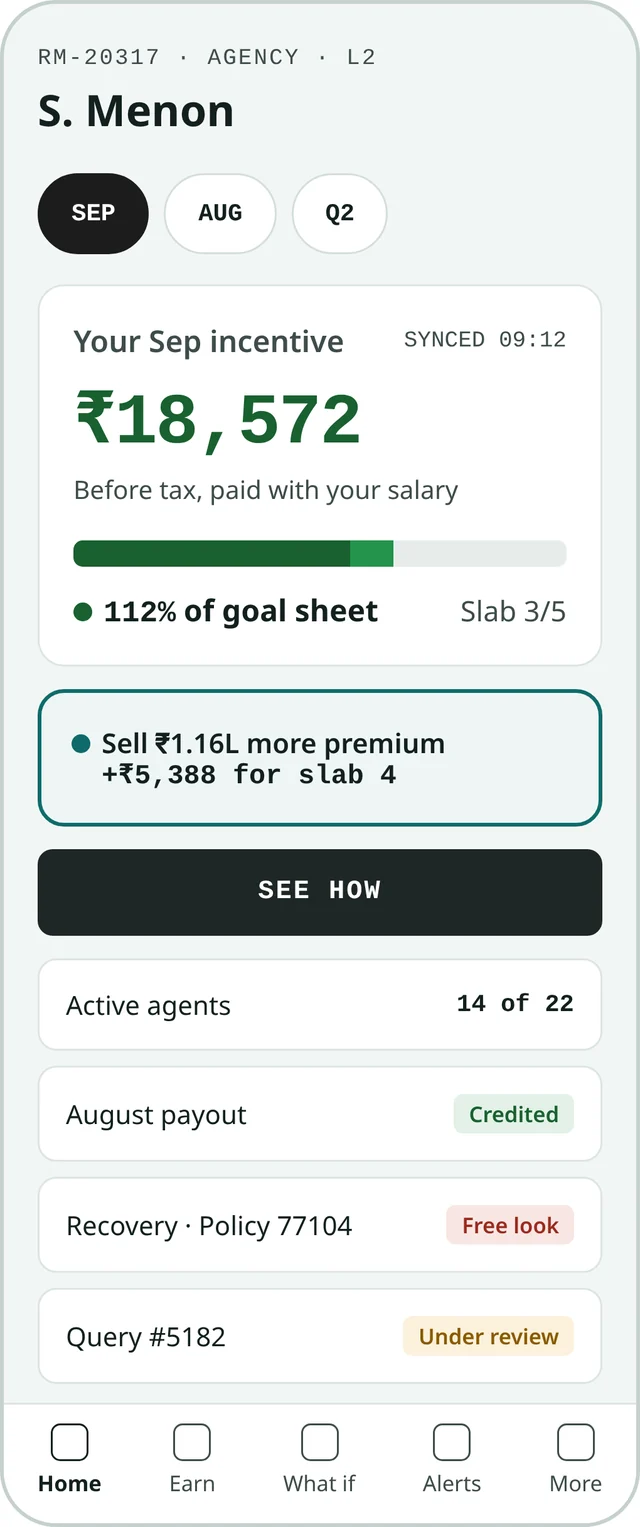
- The cockpit shows goal sheet progress, active agents and the gap to the next slab in rupees.
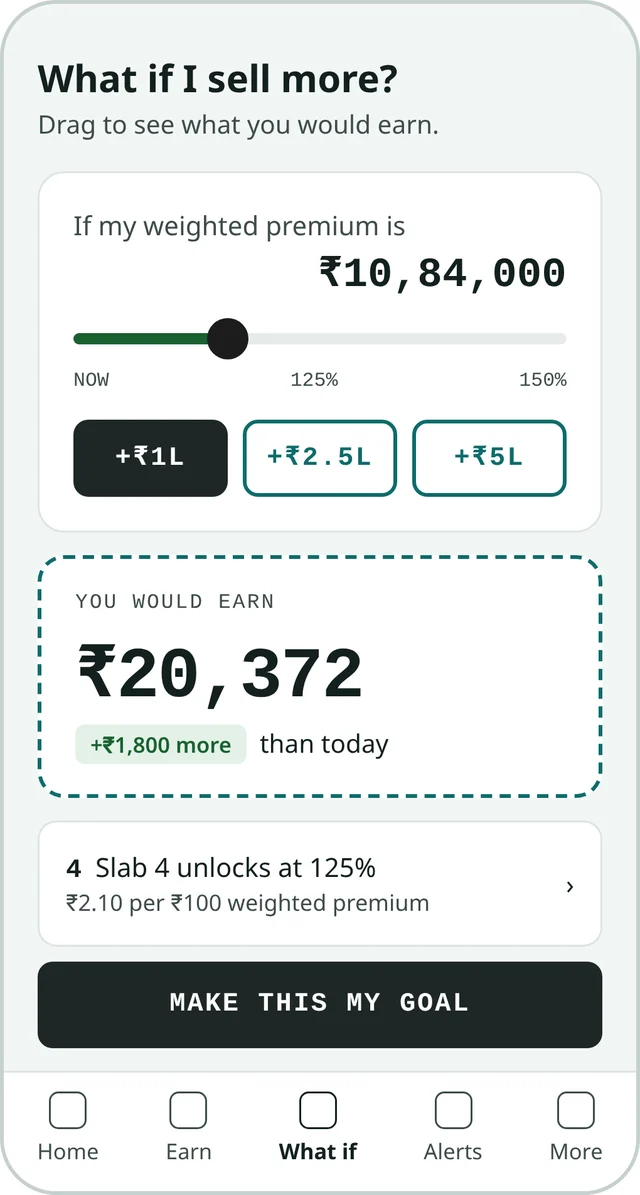
- The what-if simulator lets an RM test the payout at a higher premium or more active agents.
- AI-Powered Nudges name the gap while it can still change the month.
- An earnings summary in plain language explains the payout and any recovery.
The RM's cockpit
What the RM and the agent see.
Relationship managers already work in an RM portal. The cockpit sits inside it with single sign-on, so the payout, any recovery and every query stay where the RM already works.
HomeGoal sheet progress, active agents and the gap to the next slab.
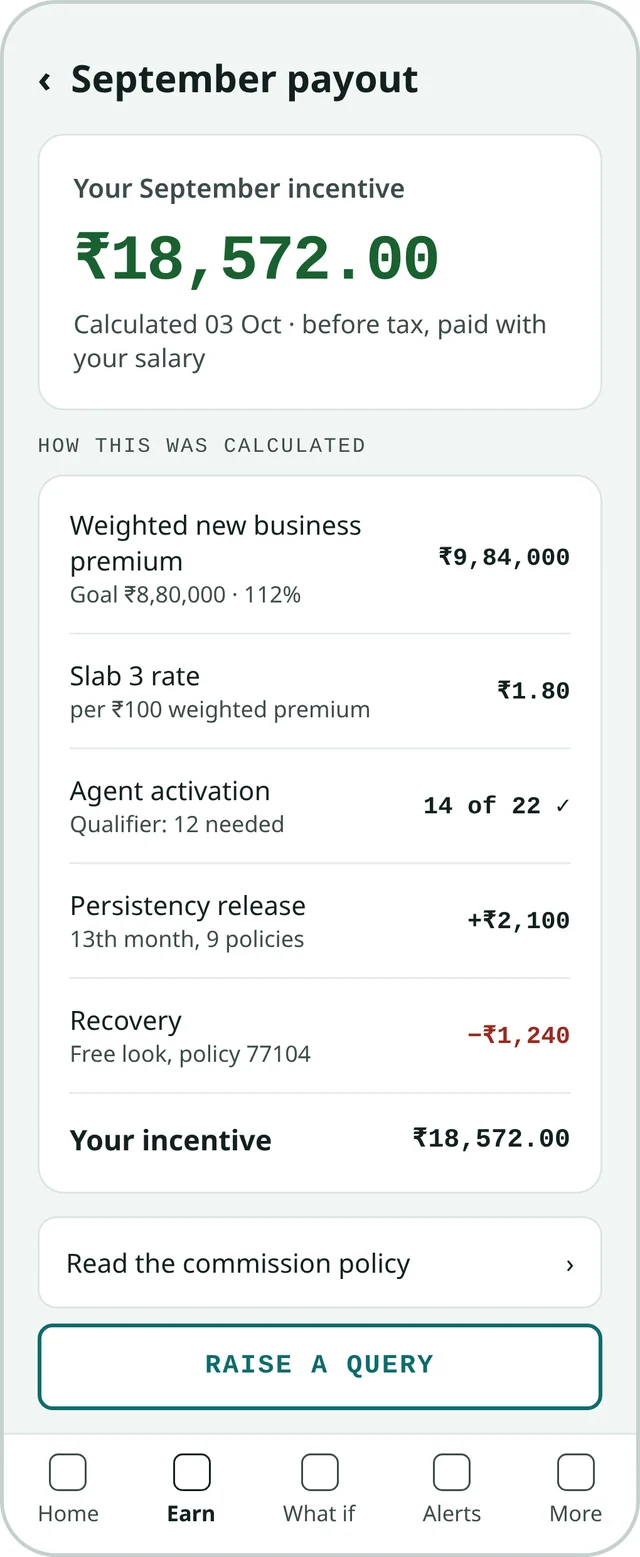
Earnings detailThe policies behind the payout, with recoveries shown line by line.
Raise a queryThe question, the policy record attached, and its status.
What ifThe payout at a higher premium.
Customer success
[Customer testimonial, 25 to 40 words, on what changed for the distribution or operations team after moving commissions onto Kennect. Pending client approval.]
[Name] · [Role] · [Insurer]
Going live
Live without moving a single policy out of the systems that hold it.
An insurer has spent years building its policy administration system, its data lake and its RM portal. Kennect leaves every one of them untouched.
We connect to the policy system or the data lake for premium, renewals and cancellations, to the RM portal for the field view, and to the HRMS for the hierarchy.
We recalculate two to three closed cycles in parallel and reconcile them to what was paid.
We go live when the numbers match.
Distribution keeps the RM portal. Operations keeps the policy system. Finance keeps accounting and payroll. The agent keeps the app they already use.
Connect
Policy system or data lake, RM portal and HRMS, by API, SFTP or file upload.
Parallel run
Two to three closed cycles recalculated and reconciled.
First live payout
8 weeks in the reference build.
By role
What each leader gets from the same number.
Channel rules that pay for persistency and activation, visible by vertical as the month runs.
Commission totals by channel, product and policy year, from the records that paid them.
Every vertical's rules on one engine, with recalculations issued as incremental advice.
Quality-based incentives for underwriting, claims and operations on the same engine.
Their payout, their recoveries and their queries, inside the portal they already use.
Questions leaders ask
Insurance commission questions, answered.
How will IRDAI's proposed commission caps change the way we calculate agent and bancassurance payouts?
IRDAI's consultation paper of 23 September 2026 proposes product-level commission caps, clawback on mis-selling and an end to volume-linked incentives for bank and NBFC staff, so payout rules would change by channel and product from 2027. Comments close on 25 October 2026, and the final rules may differ. Kennect holds each cap as a dated plan version, so a change takes effect on the date the rules set.
How should persistency be built into life insurance agent incentives?
Persistency usually enters as a gate on rewards: part of the first-year incentive is deferred and released when the policy is still in force at the 13th month, with a second check at the 25th month. One life insurer's published commission policy links rewards to persistency at both months in this way. Kennect runs both checks as rules and releases or recovers the deferred amount at each close.
What happens to an agent's commission when a policy is cancelled in the free-look period after we have already paid?
The paid commission becomes a recovery: the closed period is recalculated at the original rate, the amount nets against the agent's next payout, and both the original and the revised advice stay on record. Recovering at the original rate stops a cancelled policy from earning twice when it is sold again. Kennect runs this recovery for cancellations and free-look returns, including partial instalments.
How do we pay one sales force across agency, bancassurance and broker channels without three spreadsheets?
Run one rule engine with a rule set per channel and hierarchy level: agency, banker and broking business carry different weightages and qualifiers, but they credit the same policy record and roll up one L1 to L4 hierarchy. Kennect holds each vertical's rules as a separate plan on one engine, so a policy credits once and every level sees the same number.
Can incentive software also pay underwriting, claims and operations teams on quality?
Yes, support teams can be paid on quality parameters such as turnaround time and error rate through the same scheme rules, provided each parameter has a measured source and a target for the period. Kennect runs these plans beside the sales plans, with the same approvals and the same audit pack.
How do we show our commission payouts stay within IRDAI's expense of management limits?
Each insurer reports commission against its board-approved commission policy and the limits in IRDAI's 2024 expense of management regulations, so payouts need tagging by channel, product and policy year, totalled from the same records that paid them. Kennect produces those totals from the payout records for every period.
Why do our insurance incentive queries spike right after payout day?
Queries spike when a payee sees a total built from a base sheet they cannot trace: an unfiled mapping change moves credit to the wrong RM, and the correction arrives after the payout is released. Kennect shows each RM the policies behind the payout and lets them raise a query against a specific record, so a mapping error surfaces before the next close.
How do we track agent activation as an incentive criterion for relationship managers?
Agent activation counts how many of an RM's mapped agents sourced at least one policy above a minimum premium in the period, so the plan needs the agent-to-RM mapping by month and a premium threshold written into it. Kennect reads both from the hierarchy and policy data and applies activation as a qualifier before the payout computes.
Start with one goal sheet
Send one goal sheet and see it calculated.
Share a goal sheet and one month of policy data. We will run the close in Kennect and walk the distribution and operations teams through every payout it produced.