Decision intelligence answers four questions sales leaders ask
November 24, 2026
Pralok Chhajed
Pralok Chhajed
Key Insights
81% of leaders say AI has sped up decisions, yet only 25% are using it to transform how the business runs (Deloitte, 2026).
In this blog:
Why sales dashboards stop short of a decision
The four questions decision intelligence should answer
Why incentive data explains what CRM data misses
What to test before trusting AI with sales decisions
I've sat through quarterly reviews where every chart on the screen was right and we still walked out without deciding anything. We knew what had happened. Nobody could say why, at least not with any confidence. Finance had its number, sales ops had a slightly different one, and the incentive plan was sitting in a spreadsheet nobody had opened since April. These days I ask one plain question of any analytics spend: does it get leadership to a decision faster?
Ask your head of sales operations before the next review: which decision did our dashboards change this quarter?
Table Of Content
Why sales dashboards stop short of a decision
A dashboard gives you a number. To decide anything, you need a reason and a choice, and in plenty of companies a meeting, a spreadsheet and an argument sit between the two.
So the review hour goes on reconciling figures. What to change gets ten minutes at the end, if that. Multiply it by every region and every quarter and it's a real cost in senior time.
Deloitte's 2026 survey puts numbers on it. Of 3,500 leaders across 25 countries, 81% said AI had made their decisions and execution faster. Only a quarter said they were using it to change how the business actually works. Faster, yes. Better? Not obviously.
Customers feel it as well. In McKinsey's 2026 B2B Pulse Survey of nearly 4,000 buyers and sellers in 13 countries, buyers said inconsistent information from different teams was their top reason for switching suppliers. When finance and sales can't agree internally, the customer usually notices.
Putting AI on top of scattered data doesn't fix that. It just produces the confusion quicker, which McKinsey's July 2026 sales report warns about too.
If no decision changed because of a dashboard, it was a report.
The four questions decision intelligence should answer
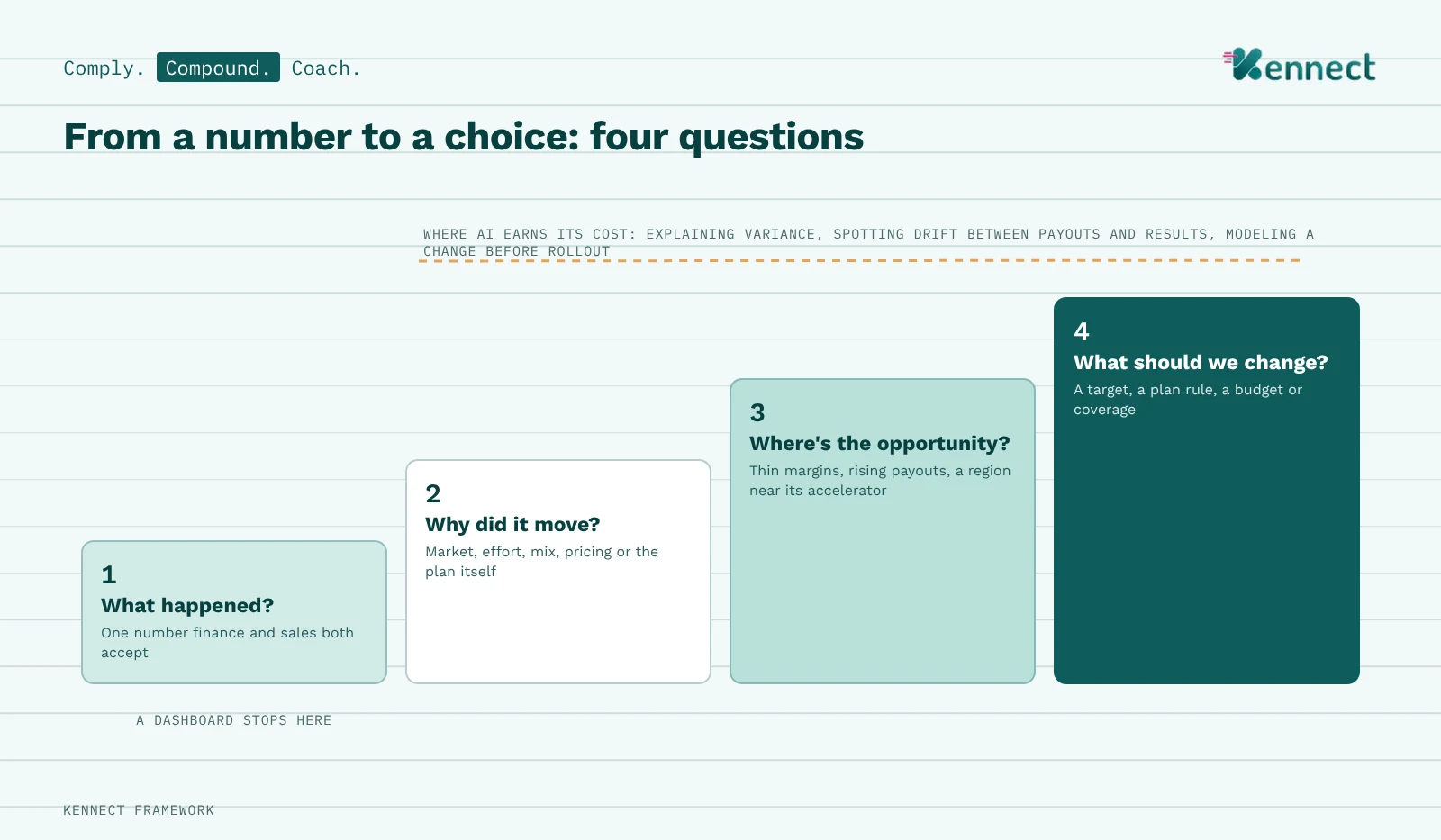
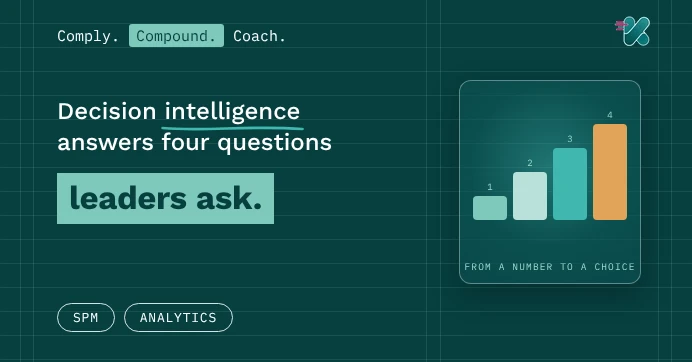
"Decision intelligence" sounds like jargon, but the idea is simple. Data should take a leader from a number to a choice. In sales performance, I find it comes down to four questions.
What happened? One number that finance and sales both accept, by region, team, product and period. Nothing else gets settled until this one is.
Why did it move? Was it the market, effort, mix, pricing or the plan itself? Each one calls for a different fix.
Where's the opportunity? Maybe a product selling more at a thinner margin, a team whose payouts are climbing faster than its results, or a region sitting just short of its next accelerator.
What should we change? Usually a target, a plan rule, a budget or who covers what.
Dashboards are fine at the first question. The other three are where AI has to justify what it costs.
Here's a made-up example. Novara, a consumer goods company, sees its West region close Q2 at 91% of target. The dashboard flags the miss in red and stops there.
What it doesn't show is that, back in May, the plan team announced a richer accelerator for Q3. Reps did the sensible thing and held orders back. Roughly ₹1.2 crore of West's business turned up in the first week of July. That's a plan-design timing problem, and it belongs on the plan owner's desk.
Illustrative example, not client data.
Treat it as an effort problem instead and you get the wrong answer. Leadership leans on activity targets, and three months later the same plan creates the same dip.
"What happened" is the easy part. The money is in why, where and what next.
Why incentive data explains what CRM data misses
CRM data tells you what reps did and what's in the pipeline. Incentive data tells you what you paid them to do, which is often the more revealing of the two.
Sellers follow the plan as it's written. What the plan designer intended barely comes into it. An accelerator pulls effort toward whatever it rewards. A cap quietly slows people down once their earnings flatten. A threshold makes deals bunch up in the last week of the period.
So when performance moves, the plan is one of the first places to look. It almost never gets looked at in the review, mainly because it lives in a different system from everything else on the screen.
Deloitte's 2026 advice is to tie AI to specific commercial levers like pricing, conversion and retention. I'd put the incentive plan on that list. McKinsey's July 2026 report heads the same way, describing a cockpit that links behaviors to leading indicators and on to results, with incentives designed for teams where people and AI work side by side.
A CFO will recognize the logic straight away. Incentive spend is one of the few controllable costs of sales, and performance is what you get back for it. Keep them in separate systems and nobody can see whether the spend is working.
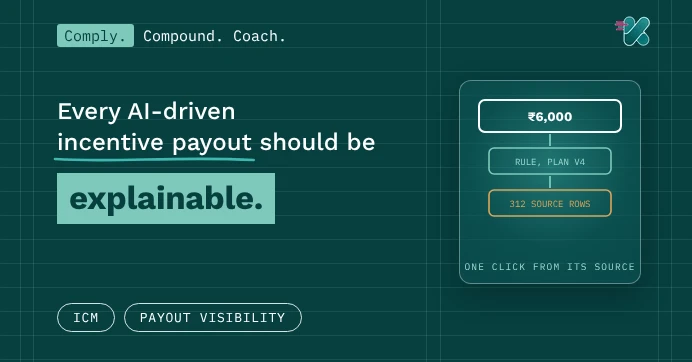
A quick test of whether incentive data is actually in the room: can leadership see payout next to performance? Can someone trace a payout back to its rule and source rows? Can you try a plan change before it goes live? If any answer is no, the review is working half-blind. For how to test whether a scheme moved sales at all, see proving incentive effectiveness.
Want to know why the numbers moved? Look at what you paid for.
Where AI helps leadership decide, and where judgment stays
Gartner's May 2026 research is often quoted here. Organizations that gave sellers AI-recommended next actions were 2.6 times likelier to achieve commercial growth, and those that prioritized AI upskilling were 2.4 times likelier to see strong revenue growth.
I'd read it with care, though. It's a correlation. Faster-growing companies may simply spend more on AI. And it's about guidance for sellers. Decisions at leadership level are a different animal.
Where AI does help leaders is fairly specific. It can explain a variance in plain words and show the data behind it. It can model a target or a plan rule before anyone commits to it. And it can spot the places where results and payouts start drifting apart.
The trade-offs don't move, though. Margin or volume? Retention or cost? Speed or control? AI can lay the evidence out. The CRO, CSO and CFO still have to make the call and live with it.
And many companies are earlier in this than the hype suggests. McKinsey's State of AI 2025 found that in any single business function, no more than 10% of organizations were scaling AI agents. Picking one decision you make every month and starting there is a perfectly respectable plan. For where saved time should go, see AI sales productivity.
Source: McKinsey and Company, The state of AI in 2025, November 2025, as cited in The future of B2B sales, July 2026
Let AI bring the evidence. Keep the decision with the people who'll answer for it.
How KAI supports sales decision intelligence
Kennect is an AI-led sales performance and incentive compensation management platform, and the part that matters here is simple: incentive and performance data sit in the same place, so they can be read together.
Compound: KAI Insights. Leadership asks questions of payout outcomes in plain language and gets the analysis on demand. See AI performance insights.
Compound: KAI Simulations. A plan designer describes a plan change in words, and KAI Simulations models its effect on payouts and cost before rollout.
Compound: management cockpit. Performance, attainment and payout by region, team and period.
Compound: target setting. Quotas are planned, set and shared in one platform, so target changes can be read against results.
KAI in practice. Novara's CFO asks KAI Insights why incentive cost outpaced Q2 revenue. KAI Insights breaks the gap down by region and plan rule. The CSO then asks KAI Simulations to model a revised accelerator, and both leaders review the cost effect before approving it.
The point is answers you can check before the next review starts.
What to test before trusting AI with sales decisions
Before you trust any AI tool with these decisions, I'd check five things. Otherwise you've just bolted a chat window onto a dashboard.
Using performance and incentive data to get from a number to a decision. In practice, it means answering what happened, why, where the opportunity is and what to change.
A dashboard shows what happened. Good AI analytics tells you why, in plain language, shows the data behind the answer and lets you test a change on payouts and cost before you make it.
Because reps follow the plan as written. Accelerators, caps and thresholds all bend behavior in predictable ways, so putting payout next to performance often shows the plan was behind a swing everyone blamed on the market.
They're linked with it. Gartner's May 2026 survey found these organizations 2.6 times likelier to achieve commercial growth. Whether AI drives the growth, or growing firms just buy more AI, is still an open question.
Whether every answer traces back to source rows, the plan version and the period. Whether finance and sales are looking at the same number. And whether a scenario shows its effect on payouts and cost as well as revenue.