AI sales productivity drives growth when saved time has a job
November 20, 2026
Pralok Chhajed
Pralok Chhajed
Key Insights
AI saves sellers 4.8 hours a week, yet 72% of sales organizations reinvest little of it (Gartner, 2026).
In this blog:
Why AI sales productivity does not become revenue on its own
Where to reinvest the time AI saves
How to measure the path from saved hours to growth
Why coaching decides whether the gains hold
In enterprise sales, I have watched productivity turn into a technology metric. Reporting gets automated. Workflows get simpler. Admin shrinks. Then the freed hours fill up again. More admin, more meetings, more accounts. Nobody decided that. Nobody decided anything else either. The gain is real. What happens to it is a leadership choice.
Ask your sales ops head this week: where did last month's saved time go?
Table Of Content
Why AI sales productivity does not become revenue on its own
Sales teams now use AI to research accounts and draft proposals. It summarizes meetings. It updates CRM records too. The time savings are real.
Gartner surveyed 210 CSOs and senior sales leaders in early 2026. They put the average saving at 4.8 hours per seller per week. Yet 72% reported low reinvestment of that time in high-value selling.
The upside is large when it does go back. Teams that reinvested saved time were 2.2 times likelier to beat customer growth goals. They were 3.1 times likelier to beat lead-to-opportunity conversion goals.
Pressure on that time is rising too. BCG surveyed 398 revenue leaders across 23 countries, India among them. 91% expect per-seller quotas or productivity targets to rise. Yet only 14% report improved conversion as a top AI impact so far. Just 13% report better win rates, and 8% higher quota attainment.
So where do the saved hours go? Picture a rep who gets two hours back. Three things tend to happen. The rep fills them with more internal reporting. The manager adds a review. Or the company assigns more accounts. Each one soaks up the gain. None of them guarantees a better customer conversation.
Three habits keep the gain from reaching revenue.
1. Teams measure efficiency and stop there
Many AI programs start with operating goals. Think less processing time and faster reports. Those numbers prove the tool works. They say nothing about new opportunities or closed business.
A two-minute CRM update that once took ten is an efficiency gain. A customer meeting that surfaces an expansion deal is commercial value. Both matter. The second one shows up in revenue.
2. The workflow around the tool stays the same
AI tends to automate single tasks. The week around those tasks stays put. Reps still sit in internal meetings and answer routine requests. Managers still stitch reports together by hand. Gartner's analysts put it plainly: productivity stalls because the system quietly caps sellers.
3. Reps get time without direction
Extra hours need a target. Which customers need a call? Which deals are cooling? Which accounts could buy more? Which products are lagging? Without answers, spare capacity drifts.
Saved hours become revenue only when the business decides where they go.
Where to reinvest the time AI saves
Saved time should build relationships, move deals or lift field performance. Four areas earn it.
Customer engagement
Reps can reconnect with lapsed customers and learn what has changed. They can chase pending decisions and explore cross-sell. Count quality over volume. More calls rarely mean more business on their own. Track real conversations, follow-ups and new opportunities.
Opportunity management
Deals stall on late follow-ups and unclear next steps. With research automated, reps can spend that time with stakeholders and on objections. Managers can see which deals need help. Watch opportunity aging, stage conversion, slippage, pipeline coverage and win rate.
Manager coaching
Managers shape how reps use their capacity. Yet many still spend hours building reports. Automating that work frees time for coaching on real gaps.
High-potential customers and products
Some accounts deserve more time than others. Point reps to customers buying less often. Add accounts with room for more products. Add deals near a decision and products below plan. Reps close to an incentive milestone belong on this list too. A rep who sees the next slab knows where an hour pays.
Give every saved hour a named customer, deal or coaching goal.
How to measure the path from saved hours to growth
Measurement needs care here. Gartner found 25% of teams report AI returns of 50% or more. Another 20% report a negative return of 50% or more. The difference lies in what happens around the tool. Gartner also looked at how productivity is measured. Teams measuring it by customer segment or market were 2.5 times likelier to beat revenue goals.
Start with a baseline. Split today's week into three parts. Admin, customer time and development, such as coaching. Without that split, nobody can prove the week changed.
Then give every productivity gain a reinvestment target.
Productivity gain
Reinvestment priority
Expected indicator
Faster CRM updates
Customer engagement
Real customer conversations
Automated account research
Opportunity development
Qualified opportunities
Faster performance reporting
Manager coaching
Coaching frequency
Automated summaries
Opportunity reviews
Deal progression
Faster data analysis
Account prioritization
Conversion and account growth
Targets should fit the sales model. A pharma field force may track doctor coverage and brand-level results. An enterprise B2B team may track deal progression, buying-group engagement and conversion.
Measure in layers, so adoption never stands in for results.
Compare like periods, by customer segment or market. Adjust for seasonality, market shifts and changes in coverage. Otherwise AI gets credit for everything that went right.
What the capacity looks like
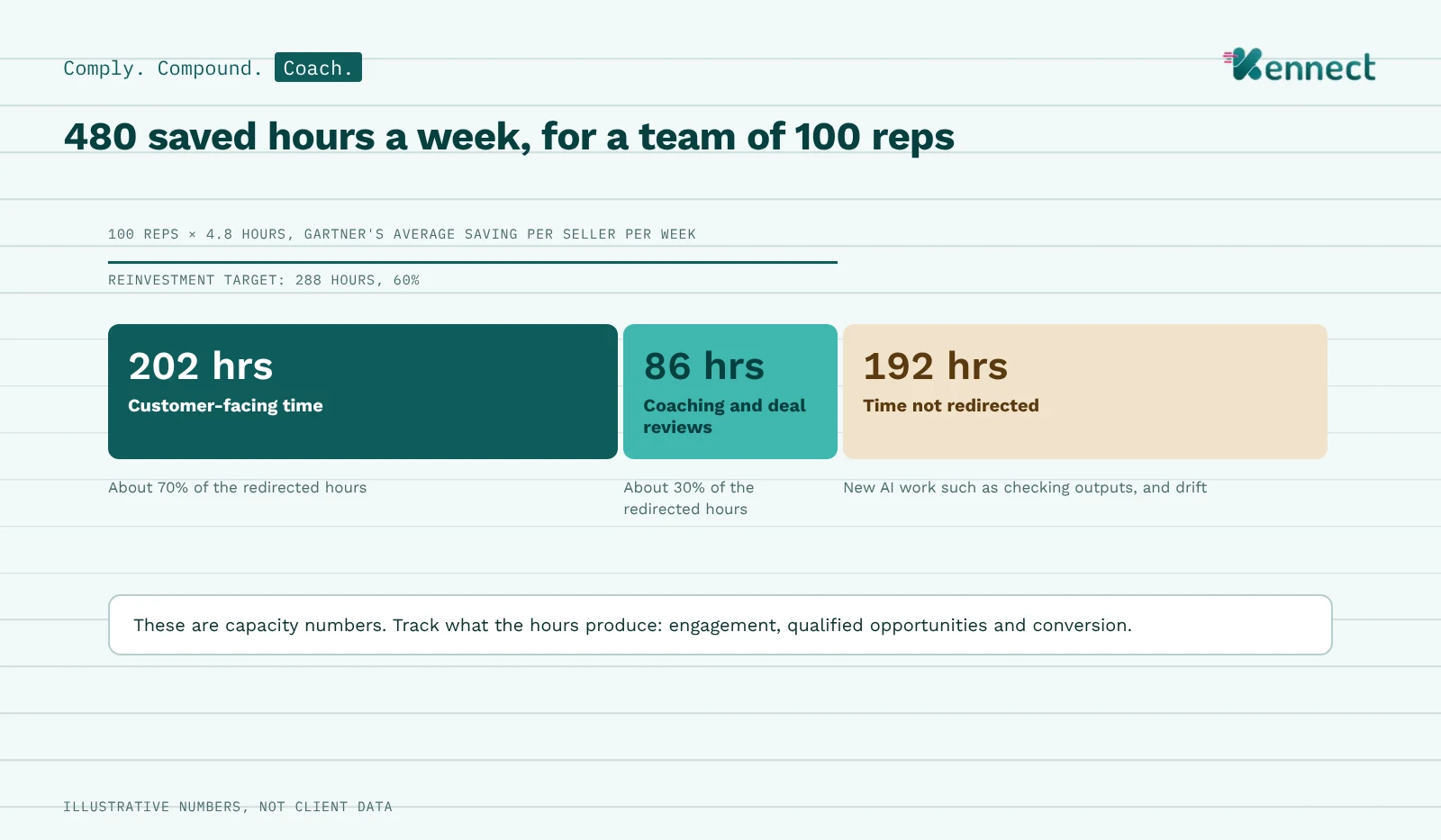
Take an illustrative team of 100 reps. Each saves Gartner's average of 4.8 hours a week.
Metric
Calculation
Result
Reps
Assumption
100
Hours saved per rep per week
Gartner average
4.8
Weekly capacity created
100 × 4.8
480 hours
Reinvestment target
60% of 480
288 hours
Time not redirected
480 minus 288
192 hours
Illustrative numbers, not client data.
Of the 288 redirected hours, say 70% goes to customers. That is about 202 extra customer-facing hours a week. The other 30% goes to coaching and deal reviews.
The 192 hours left over are partly expected. Some will absorb new work AI creates, like checking outputs. Some will drift. A 60% target is ambitious, given Gartner's 72% figure.
These are capacity numbers. Revenue is a separate question. Leadership still has to track what the hours produce. Did engagement rise? Did qualified opportunities grow? Did conversion improve? A separate model should turn verified gains into revenue and margin. See how to analyze sales performance data.
Track adoption, reinvestment and outcome separately, or AI takes credit it did not earn.
Why coaching decides whether the gains hold
Technology creates capacity. Managers decide how well it gets used.
Take a pharma company that rolls out AI to cut reporting work. Reps spend less time on internal updates. Managers still run reviews from monthly summary reports. By the time a gap shows, weeks have passed. A rep may have missed doctors or under-pushed priority brands. The admin time came back. The coaching rhythm stayed the same.
Good coaching answers three questions. What is happening in this rep's numbers? What might be causing the gap? What should happen next?
Say a rep is at 78% of the monthly target. The manager sees that results come from one product. Two other priority products lag. Now the conversation has a subject. Product knowledge, doctor coverage and next week's focus. Telling a rep to sell more gives them nothing to act on. A conversation built on their own numbers does.
This needs information that arrives in time. A rep near a milestone should see the gap while it can close. A manager should see a slide in performance as it starts. A sales leader should see a product slipping before quarter close. See how targets, payouts and coaching connect.
AI productivity holds when managers spend saved time coaching on real gaps.
How Kennect connects performance data to field action
Kennect is AI-led sales performance management software. It covers every variable payout, including dealer schemes, distributor claims and channel rebates. One rule engine runs every payee type.
Kennect's 3C framework connects performance data to what the field does next.
Comply: the number is right. Payouts are calculated on approved rules, with payout visibility and audit trails. KAI Exceptions validates inputs and calculations before release. It traces the root cause when a number looks wrong.
Compound: the number is aimed. KAI Insights answers leadership's questions on payout outcomes, on demand. KAI Simulations models a plan change's effect on payouts and cost before rollout.
Coach: the number is acted on. Reps see achievement, current slab and earned payout in a personal cockpit. Managers see which reps are near a slab and which have slipped.
KAI in practice. A sales head asks which reps sit within 10% of their next slab. KAI Insights lists them by manager. Each manager now knows where a saved hour of coaching pays first.
Comply proves the number is right. Compound aims it. Coach gets the field to act on it.
AI creates the selling time.
Leadership decides whether it turns into growth. See reps' next slab, and where managers should coach.
It fails when saved time is not redirected to revenue-generating work. In Gartner's May 2026 release, 72% of sales organizations reported low reinvestment of saved time. The freed hours drift back into admin, meetings and extra accounts.
Gartner's survey of 210 sales leaders put it at 4.8 hours per seller per week. That is the leaders' estimate across their teams. Actual savings depend on workflows, adoption and how much gets automated.
Measure five layers separately: adoption, hours saved, hours reinvested, sales execution and commercial outcome. Compare by customer segment or market. Gartner found teams that reinvest saved time beat conversion goals 3.1 times more often.
AI shows managers where a rep's numbers diverge, so coaching starts from a real gap. A rep at 78% of target with two weak products needs a specific talk. A rep with no pipeline needs another. Managers still supply the judgment.
AI productivity measures how efficiently sales work gets done. AI-driven growth measures what changes commercially, such as conversion, revenue and account expansion. In BCG's October 2026 survey, only 14% named improved conversion as a top AI impact.