Every AI-driven incentive payout should be explainable
November 23, 2026
Pralok Chhajed
Pralok Chhajed
Key Insights
About 80% of organizations lack mature governance for agentic AI, such as clear limits on what agents decide alone (Deloitte, 2026).
In this blog:
Why incentive payouts are a high-stakes place for AI
Five ways AI can break trust in a payout
How much autonomy AI should get in the payout cycle
What a governed AI payout process looks like
I've seen one wrong payout undo a year of goodwill. The rep rarely remembers the slab. They remember being told the system calculated it, and that nobody could show how. AI makes that answer easier to give and harder to defend. I'm not against AI in payouts. I'm against payouts nobody can explain.
Ask your finance controller this week: if a rep disputes a payout, how fast can we show the math?
Table Of Content
Why incentive payouts are a high-stakes place for AI
A payout is a promise with a number on it. Reps plan around it. Finance books it as a cost. Auditors test it.
That puts payouts in a stricter class than a forecast. A wrong forecast gets revised next month. A wrong payout lands in someone's bank account.
Autonomy is also growing faster than accountability. Deloitte surveyed 3,500 leaders across 25 countries in mid-2026. 40% let AI execute decisions without human approval, at least moderately, and 23% say ownership of a bad outcome is unclear. Its earlier 2026 report found about 80% of organizations lacked mature governance for agentic AI.
For a CFO, an unowned payout error is a controls gap, and it surfaces in internal financial controls testing. For a CHRO, it's a trust problem in the field. Both show up at period close. For the wider question of who owns an agent's actions, see AI agent governance.
Payouts need a named owner before AI touches them.
Five ways AI can break trust in a payout
Trust in a payout breaks in five predictable places:
Bad input data. A missing transaction, a wrong reporting line or a stale product master. AI repeats these errors at speed.
Unexplained numbers. The rep sees a figure, but not how it was built.
Calculation drift. An AI-drafted rule differs from the approved plan version.
Uneven outcomes. Results quietly disadvantage one region, channel or team.
No way to challenge. The rep has no route to dispute, and nobody can override.
NIST treats valid and reliable output as the base of trustworthy AI. Everything else sits on top of it.
NIST also splits explanation into three questions. Transparency answers what happened. Explainability answers how. Interpretability answers why. A payout line should answer all three, and here's what that looks like for one rep:
Question
What the payout line shows
What happened
₹6,000 paid for October, at the 90% slab
How
312 source rows, plan version 4 effective 1 October, focus-brand weight 40%
Why
Achievement reached 91%, so the 90% slab applied. The coverage gate passed at 52%
Illustrative example, not client data.
The framework also asks for ways to report problems and to appeal and override outcomes after deployment. For payouts, that means a dispute process with a named owner.
A number nobody can explain is a number someone will dispute.
How much autonomy AI should get in the payout cycle
Deloitte's 2026 guidance is direct: match governance to the autonomy AI is actually given. Set approvals by what each system can recommend, execute or decide.
The World Economic Forum makes a similar point for AI agents. Its May 2026 playbook with Capgemini defines an authorization profile for each agent, so that delegated actions stay auditable and accountable.
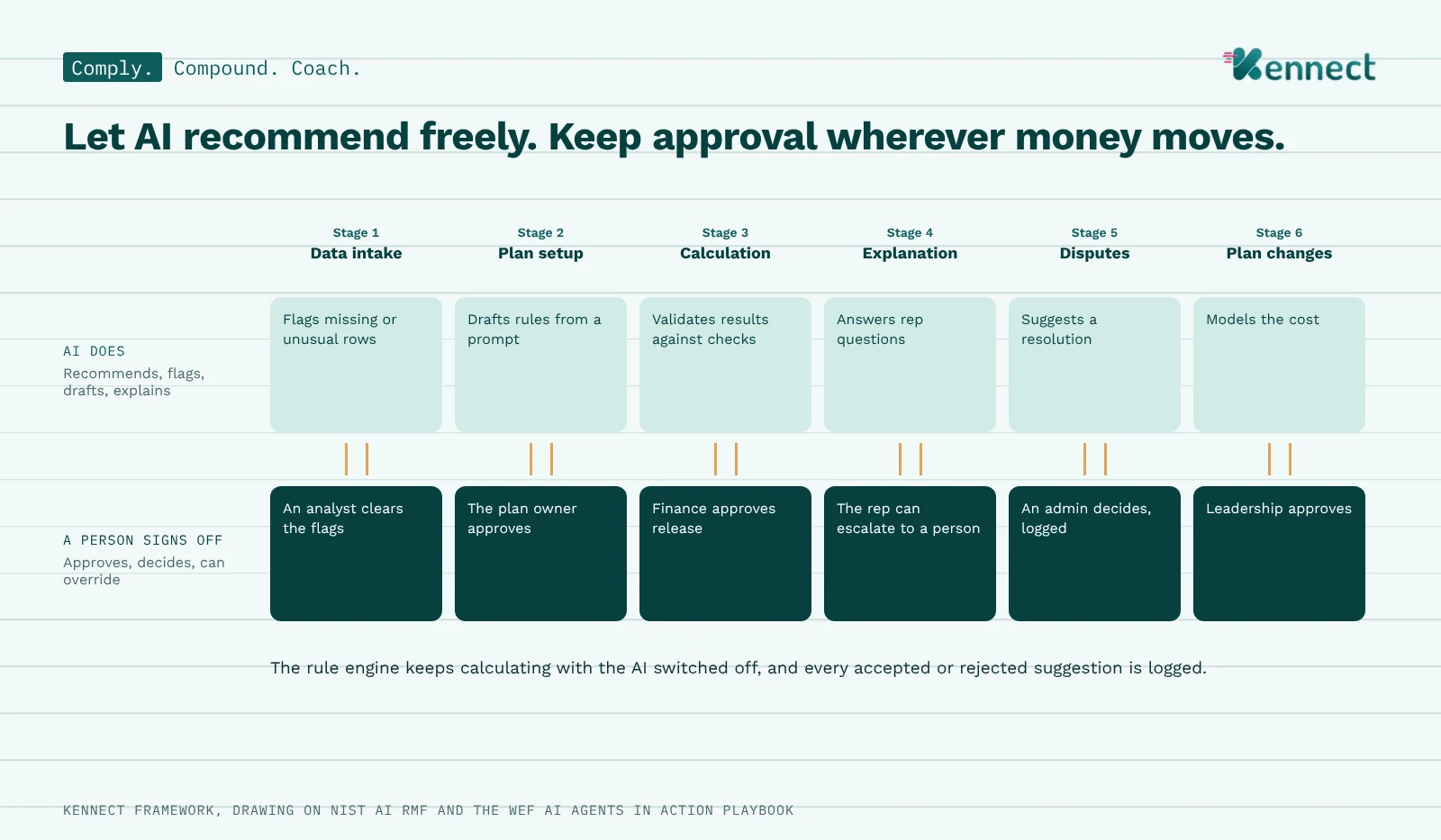
Applied to a payout cycle, the split could look like this:
Payout stage
What AI does
Where a person signs off
Data intake
Flags missing or unusual rows
An analyst clears the flags
Plan setup
Drafts rules from a plain-language prompt
The plan owner approves before go-live
Calculation
Validates results against checks
Finance approves before release
Payout explanation
Answers rep questions and traces each line
The rep can escalate to a person
Disputes
Suggests a resolution
An admin decides, and the decision is logged
Plan changes
Models the cost of a change
Leadership approves
India's rules point the same way. MeitY's AI Governance Guidelines of November 2025 add no new law. They ask for accountability graded to risk, with human oversight and audit trails where the stakes are high.
Let AI recommend freely, and keep approval wherever money moves.
What a governed AI payout process looks like
A governed process leaves evidence at every step. Six controls cover it:
Every payout traces to its source rows, plan version and rule.
Plan versions are effective-dated, and AI reads the version in force.
Approval gates sit before each payout release.
An audit trail logs each change, including AI suggestions that were accepted or rejected.
Disputes have an owner, a status and a closing date.
Outcomes get reviewed by region and team every period.
NIST's framework also asks for a way to supersede, disengage or deactivate an AI component that misbehaves. In payouts, that means the rule engine keeps calculating with the AI switched off. For how disputes should run, see incentive dispute management.
Governed AI leaves a trail an auditor can follow alone.
How Kennect governs payouts today
Kennect is an AI-led sales performance and incentive compensation management platform. One rule engine calculates every payout type, from field incentives to dealer schemes.
Comply: calculation. Payouts run on the approved plan rules and source data.
Comply: audit trails and plan versioning. Every change to a plan is logged and dated.
Comply: security. Kennect holds ISO 27001 certification and a SOC 2 Type II report, and is GDPR compliant.
Coach: payout visibility. Reps see how each payout line was built.
Coach: query and dispute management. Reps raise a query, and admins resolve it on record. See query management.
Explainable payouts start with governed data. The AI comes second.
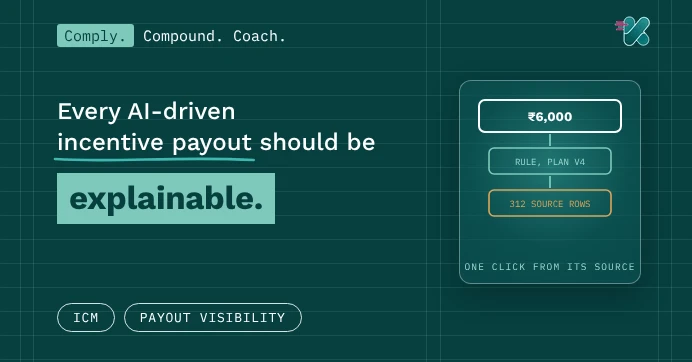
Every payout should sit one click from its source.
See how Kennect traces each payout to its source data.
Yes, when every result traces to approved rules and data, and a person approves each release. NIST lists valid and reliable output as the base of trustworthy AI.
People should approve plan changes, release payouts and decide disputes. In Deloitte's 2026 survey, 23% of leaders lacked a clear owner for bad AI outcomes. Named approvers close that gap.
Log every AI suggestion with its inputs, plan version and approver. NIST asks for ways to appeal and override AI outcomes. An auditor should be able to replay any payout from the log.
The NIST AI Risk Management Framework is a common starting point, built on four functions: govern, map, measure and manage. The WEF's May 2026 playbook adds authorization profiles for AI agents. In India, MeitY's November 2025 guidelines set the direction.