A pharma incentive payout cycle should close in days
November 23, 2026
Pulkit Agarwal
Pulkit Agarwal
Key Insights
Even after careful development, spreadsheets carry errors in 1% or more of formula cells (Panko, University of Hawaii, 2008).
In this blog:
Why payout timing matters to an MR
Where the days go in a pharma payout cycle
How long each stage should take
Five decisions that shorten the payout cycle
I hear a familiar story from pharma sales heads. The month closes, and the MR waits. Sales data comes in late. Someone rebuilds the sheet. Finance asks for one more check. By the time the payout lands, the MR has moved on. The amount may be right. The moment has passed.
Speed alone isn't the goal. A fast payout that's wrong costs more trust than a slow one. The aim is a cycle that's quick because every step is clear. That means a fixed data cut-off, one set of rules and a known path for exceptions.
Ask your sales operations head this week: how many days did last month's payout take, and where did they go?
Table Of Content
Why payout timing matters to an MR
An MR's incentive pays for a month of calls, coverage and brand sales. The payout tells the MR whether that effort worked.
When the payout arrives soon after the month, the MR can adjust. A missed gate or a weak brand gets fixed next month. When it arrives months later, the signal blurs. The MR is already two or three cycles ahead. The link between effort and pay gets weaker.
Late payouts also invite questions. An MR who waits too long starts to doubt the number. Doubt turns into queries. Queries pull managers and sales operations away from the field. We set out that path in incentive dispute management.
Timing matters to finance too. A long cycle keeps the period open longer. Late corrections then reach into months already closed.
A payout soon after the month keeps effort and reward linked.
Where the days go in a pharma payout cycle
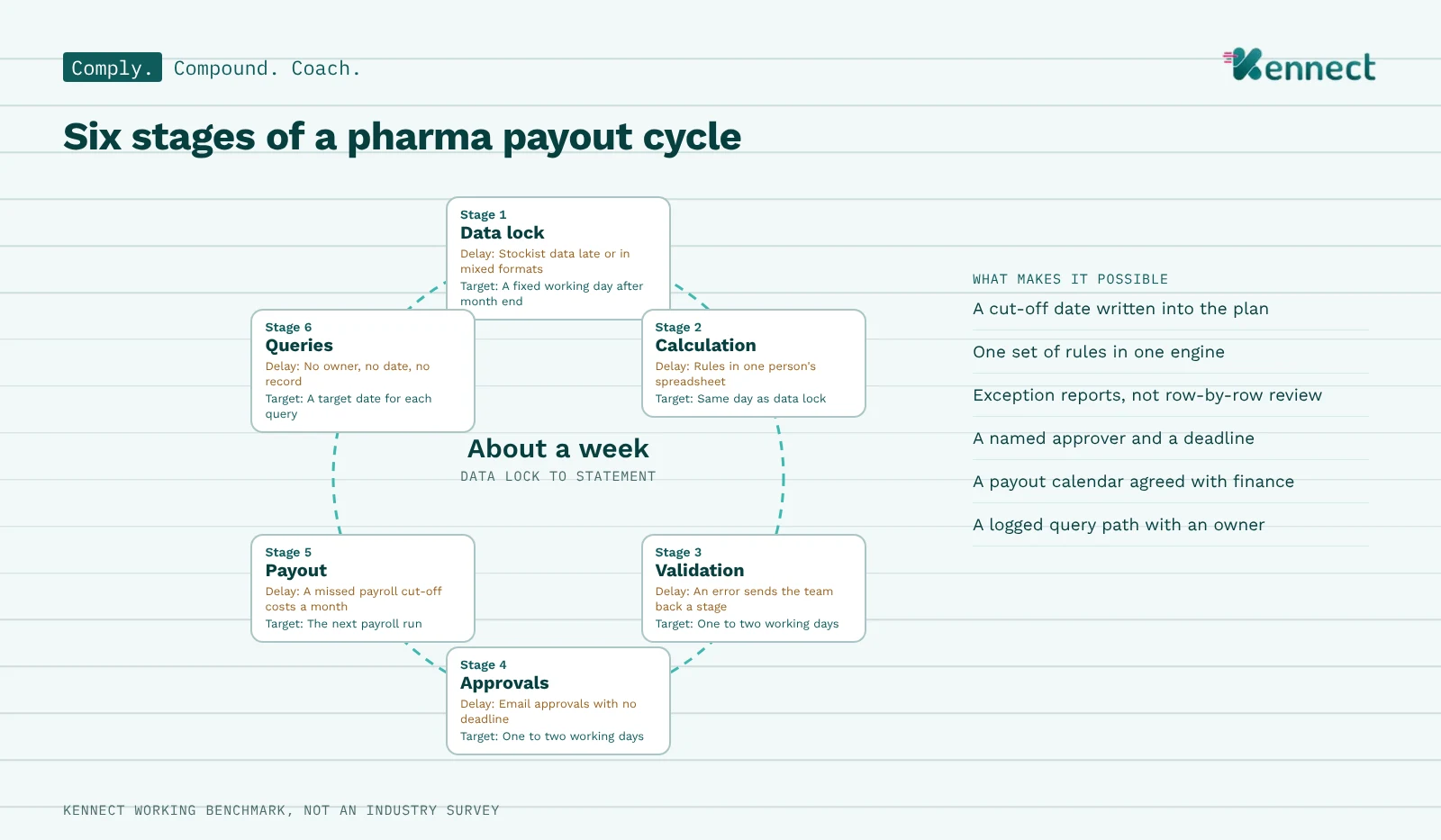
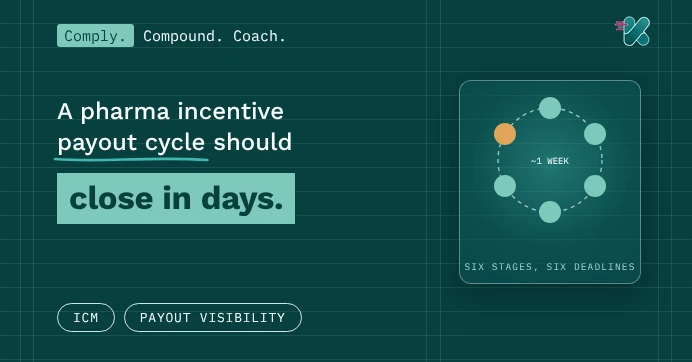
A pharma incentive payout cycle has six stages. Each stage can add days.
Stage
What happens
Where delays start
1. Data lock
Primary and secondary sales, SFA call data and the HR hierarchy arrive
Stockist data arrives late or in different formats
2. Calculation
Brand targets, weights, slabs and gates are applied
Rules sit in spreadsheets that one person maintains
3. Validation
Sales operations checks outliers and errors
An error found here sends the team back to stage 2
4. Exceptions and approvals
Sales and finance sign off adjustments and totals
Approvals move over email with no deadline
5. Payout
Finance releases the amount through payroll
A missed payroll cut-off moves the payout a month
6. Queries
MRs ask how their number was built
No owner, no date and no record
The arithmetic itself is quick. The days go in the handoffs. Data moves from file to file. Each handoff adds a check, and each check adds a day. Small slips compound too: Panko's review of spreadsheet studies found errors in 1% or more of formula cells.
Source: Raymond R. Panko, "What We Know About Spreadsheet Errors," University of Hawaii, revised 2008
Multi-division companies feel this hardest. A spreadsheet built for one division gets copied for the next. When a rule changes, every copy needs the same edit. One missed edit starts the loop again. See why multi-division pharma incentives need one engine.
We've seen how long this can run. One mid-sized Indian pharma company with more than 1,000 MRs took 2 to 3 months to close each cycle before automation.
The days are lost in handoffs. The arithmetic takes minutes.
How long each stage should take
There's no single industry standard for this. So here is a working benchmark for a monthly cycle. Use it to test your own calendar.
Stage
Working benchmark
What makes it possible
Data lock
A fixed working day after month end
A cut-off date written into the plan
Calculation
Same day as data lock
One set of rules in one engine
Validation
One to two working days
Exception reports instead of row-by-row review
Approvals
One to two working days
A named approver and a deadline
Payout
The next payroll run
A payout calendar agreed with finance
Queries
A target date for each query
A logged path with an owner
Illustrative benchmark from our view of pharma payout cycles. It is not an industry survey.
Add these up. About a week from data lock to statement is realistic, and it holds at scale. The 1,000-MR company above now closes in about 5 days.
The clock starts at data lock. Stockist data often arrives days after month end, so write the lock day around when secondary data is usually final. For finance's view of the same close, see how pharma finance closes payouts in five days.
Cadence is a separate choice. Pay on the cadence the plan measures. If the plan measures monthly, close monthly. If it pays quarterly, still show progress every month. The MR should never wait a quarter to learn where they stand.
With a deadline for each stage, a week to statement is fair.
Five decisions that shorten the payout cycle
Each decision below removes a handoff. None needs a new plan design.
Fix a data cut-off in the plan. Name the working day data locks. Data after it moves to the next cycle, as a labeled adjustment. The method is in retrospective incentive calculation.
Keep one set of rules in one place. One master per rule, dated by version, covers every division. A rule change then happens once.
Review the exceptions first. Set thresholds that flag outliers. Sales operations checks those, and the rest moves on.
Give every approval an owner and a deadline. Name who signs each step. Agree what happens when a deadline passes.
Give every query a path. The MR raises it against one payout line. An owner answers by a date, citing the rule and the data.
One more habit helps. Show MRs their progress during the month. Then the payout confirms a number they already expect. Fewer surprises mean fewer queries.
Each decision removes a handoff that used to cost days.
How Kennect shortens the pharma payout cycle
Kennect is an AI-led sales performance and incentive compensation management platform. It runs incentives for more than 60,000 MRs in India. In those deployments, the same handoffs slow every cycle, so the platform is built to remove them.
Comply: connected data. Kennect connects to HRMS, CRM, SFA and ERP systems such as SAP through their APIs. Data lands in one place, ready to calculate.
Comply: one calculation engine. Rules for every division run in one engine. Each plan is a dated version. The audit trail records who changed what, and when.
Comply: recompute and carry-forward. When late data arrives, the cycle recomputes. The difference carries into the next payout with its reason.
Coach: queries in one place. MRs raise a query against a payout line. Query management routes it to an owner with a date.
Coach: the MR's app. Each MR sees a personal cockpit and slab view during the month.
For the 1,000-MR company above, the cycle now closes in about 5 days, down from 2 to 3 months. Payout queries fell 80% once MRs could see how each payout was built. The team saves more than 200 admin hours a month.
KAI in practice. An MR asks why his payout came in lower than last month. KAI Exceptions explains it in plain language, from the plan and KPIs behind it, and logs the query. An admin can trace the same payout back to its source rows.
Connected data, one engine and a query path turn months into days.
What to fix before FY 2027-28 plans
FY 2027-28 plans get designed from January to March 2027. That's the right time to write the payout calendar in.
Start with last month's cycle. Count the days from month end to payout. Mark which stage took longest. Then write a cut-off, approvers and a query path into the plan.
Payouts usually slip in the handoffs between data, calculation, validation and approval. Late stockist data, rules kept in spreadsheets and approvals with no deadline each add days. A fixed data cut-off, one rule engine and named approvers remove much of that wait.
Pay on the cadence the plan measures, and show progress every month either way. A monthly plan should close monthly. A quarterly plan can still give MRs a monthly view of achievement, slab and gates.
A fixed working day after month end, written into the plan document. Pick it around when secondary data is usually final. Data arriving after the cut-off moves to the next cycle as a labeled adjustment.
Move the rules out of spreadsheets into one calculation engine fed by connected data. Review exceptions first, and set approval deadlines. In one Kennect deployment of more than 1,000 MRs, the close fell to about 5 days from 2 to 3 months.
Recompute the affected period and carry the difference into the next payout as a labeled line. The line should name the period and the reason. Set a fixed window for how far back recomputation may reach, and apply it to every MR.