Retrospective incentive calculation needs the hierarchy at sale.
October 14, 2026
Pralok Chhajed
Pralok Chhajed
Key Insights
A call I hear often from sales operations heads starts in September and is about July. A corrected invoice has come in, July has to be rerun, and the numbers that come out do not match what anyone remembers. A rep who moved territories in mid-July now has a July sale sitting under his new manager. The old manager has lost achievement for a month he has already closed.
Nothing in the calculation is wrong. It has read September's organization against July's sales.
Retrospective incentive calculation works when the rerun reads the hierarchy, the target and the plan version that applied to each sale. That means keeping those inputs as dated records, writing the proration and recovery rules into the plan, and carrying any difference forward as a labeled line. The need is constant: Aon recorded average attrition of 16.2% across Indian companies in 2025, and every exit changes the hierarchy.
A question worth asking the head of sales operations this week: if July were rerun today, whose hierarchy would it read?
A call I hear often from sales operations heads starts in September and is about July. A corrected invoice has come in, July has to be rerun, and the numbers that come out do not match what anyone remembers. A rep who moved territories in mid-July now has a July sale sitting under his new manager. The old manager has lost achievement for a month he has already closed.
Nothing in the calculation is wrong. It has read September's organization against July's sales.
Retrospective incentive calculation works when the rerun reads the hierarchy, the target and the plan version that applied to each sale. That means keeping those inputs as dated records, writing the proration and recovery rules into the plan, and carrying any difference forward as a labeled line. The need is constant: Aon recorded average attrition of 16.2% across Indian companies in 2025, and every exit changes the hierarchy.
A question worth asking the head of sales operations this week: if July were rerun today, whose hierarchy would it read?
Table Of Content
How often the hierarchy changes inside a period
Aon's Annual Salary Increase and Turnover Survey 2025-26 recorded attrition of 16.2% across Indian companies in 2025, down from 17.7% in 2024. The survey covered more than 1,400 organizations across 45 industries.
The figure is an average across industries and roles, and it counts exits alone. Each exit changes the sales hierarchy, and so does each joiner, promotion, transfer and territory split. Even at the average rate, a field force of 2,000 people would see more than 25 exits in a month, before any internal moves.
Source: Aon, Annual Salary Increase and Turnover Survey 2025-26 India, released 24 February 2026 · more than 1,400 organizations across 45 industries
The hierarchy behind an incentive changes month to month, so a rerun of a closed period can meet a different organization from the one that earned it.
What a retrospective calculation is
A retrospective calculation reruns a period that has already closed, and often one that has already been paid. Four things trigger one.
Late or corrected sales data. A return, a cancellation or a corrected invoice arrives after the close.
A changed rule. A target or slab is revised and applied to a past period, which a mid-year incentive plan change should avoid where it can.
A hierarchy update entered late. A transfer dated 18 July is entered in the system in September.
A recovery. A cancellation or clawback reverses credit that was already paid.
Each trigger is legitimate. The question is what the rerun reads when it runs.
A rerun of a closed period is normal, and it is fair when it reads the inputs that were true for that period.
Why the rerun has to read the hierarchy at sale
HR systems are built to show the organization as it stands today. Many keep dated history, but the file an incentive team receives each month is usually the current view, and a rerun that reads it uses today's reporting lines. An incentive pays for a sale made on a date, by a person in a role, under a manager, in a territory, so it needs the view that applied to that sale.
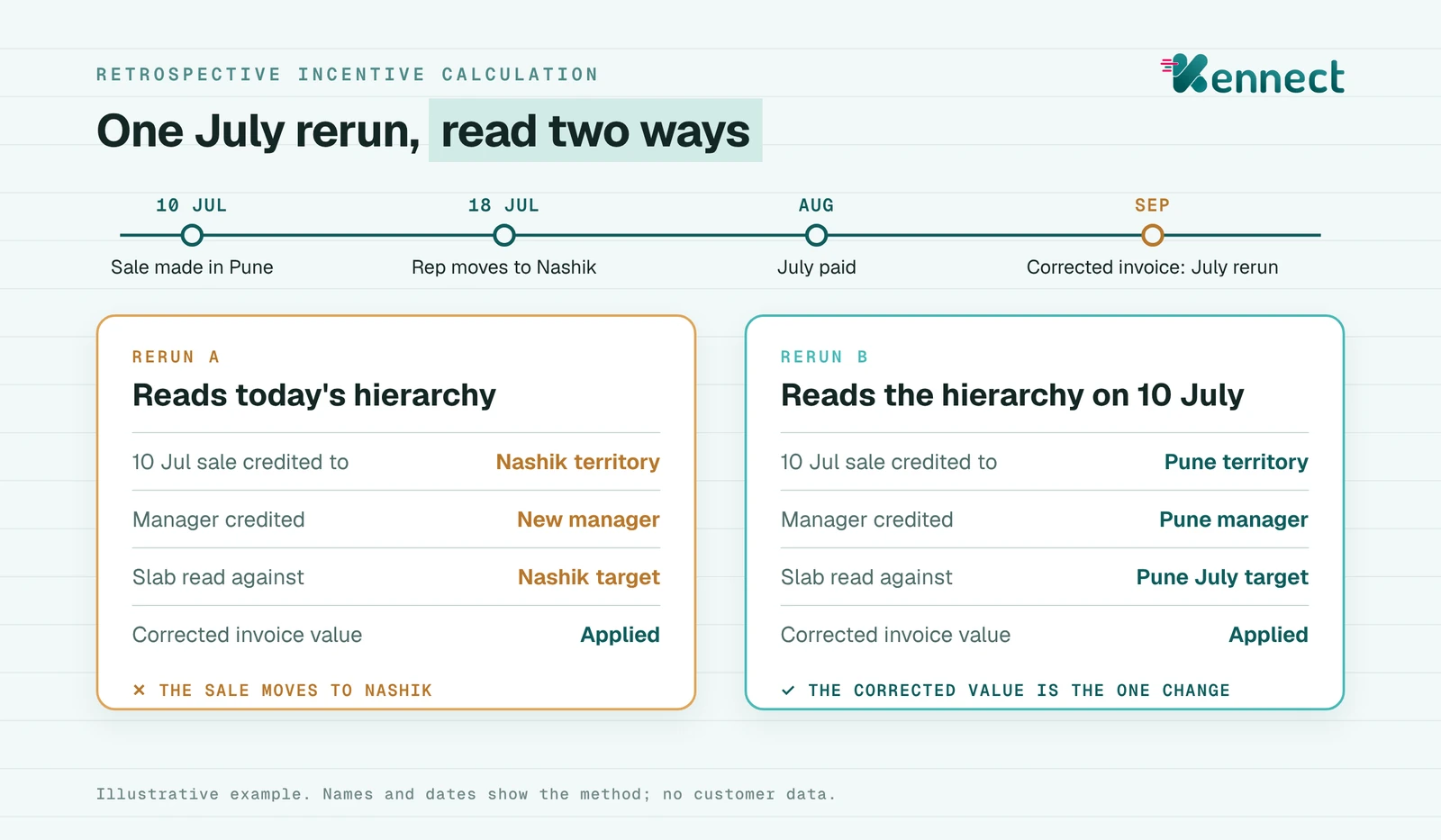
Take a rep who moves from the Pune territory to Nashik on 18 July. July is paid in August. In September, a corrected invoice from 10 July arrives and July is rerun.
If the rerun reads today's hierarchy, the 10 July sale is credited to Nashik, to the new manager and to the new target. The Pune manager loses achievement on a sale made in Pune. The rep's July slab is read against the Nashik target. Neither result matches what happened.
If the rerun reads the hierarchy as it stood on 10 July, the sale stays with Pune. The corrected value is the one thing that changes.
Some companies freeze the territory alignment for a whole quarter and apply any change from the next one. In that case the alignment frozen for the quarter is the hierarchy that applied to the sale. Either rule works when the plan states it and every rerun follows it.
One July rerun, read two ways. The sale belongs to the hierarchy on the day it was made.
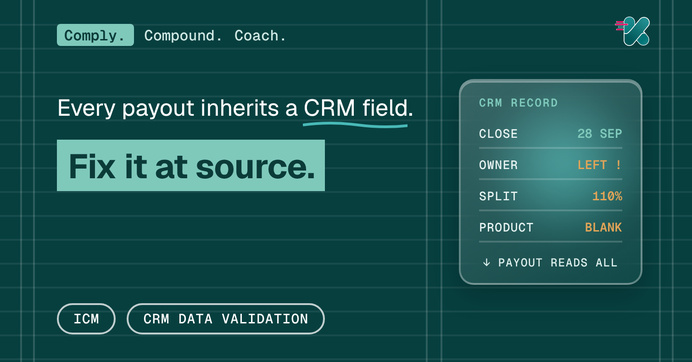
The same applies to the other inputs. The CRM owner field on a deal, one of the CRM fields that decide a payout, may have been reassigned since the sale. The plan version may have changed. A rerun has to read each of them as dated records.
A retrospective calculation pays fairly when the hierarchy, the owner and the plan are read as the plan says they applied to each sale.
Four inputs to keep as dated records
A rerun can read what was kept, and nothing more. Four inputs need a dated history, with the date each change took effect and the date it was entered.
Four inputs a retrospective calculation reads, and the history each one needs
Input
What changes
What to keep
What goes wrong without it
Reporting hierarchy
Manager, zone, territory, division
Each person's position with an effective-from date
A past sale is credited to today's manager and territory
Role and target
Role, grade, target, product basket
The target and basket assigned for each period
A past period is read against today's target
Plan version
Slabs, rates, qualifiers, caps
Each version with the periods it governs
Today's rule calculates a past sale
Deal ownership
CRM owner, split shares
Owner and shares at the date of sale
A reassigned deal pays the new owner
A late entry needs both dates. A transfer effective 18 July and entered on 9 September should apply from 18 July in the rerun, and the record should show that it was entered in September.
Effective dates and entry dates together let a rerun place every change in the right period, and let an auditor see when it was recorded.
Proration when someone joins, moves or leaves
A person who changes role inside a period earns under two sets of rules in one month. The plan has to say how the period is divided before it happens.
Joiners. A rep who joins on the 12th can have a prorated target for the days in role, or a qualifying period before incentives start. The plan names which.
Transfers and promotions. Sales before the effective date are read against the old role and target. Sales after it are read against the new ones. The plan says whether the slab is assessed on each part or on the combined period, and whether the rep's target is adjusted for the days in each role.
Exits. The plan states whether a leaver is paid for the period they exit in, at what date the eligibility ends, and how a later recovery is handled once they have gone.
Write these rules into the plan document before the period opens, and apply them the same way in every rerun.
Proration is a policy choice, and a rerun applies it consistently when the plan has written it down.
When the rerun changes a payout already made
A rerun of a paid period produces a difference. That difference is either an arrear owed to the payee or a recovery owed by them. Three rules keep it fair.
Carry the difference forward with its reason
Show the difference as a separate line in the next payout, labeled with the period and the cause, such as a corrected invoice from 10 July. A payee who sees the reason raises fewer queries than one who sees a changed total. Unexplained adjustments are one of the commission calculation errors that repeat every cycle.
Reverse every share
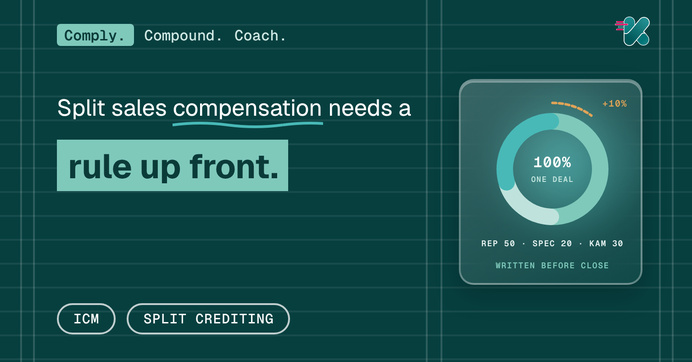
When the rerun reverses a sale that two people shared, the recovery reaches both of them, in proportion to the shares recorded at the time of sale. The principle is set out in split sales compensation.
Set a window
Decide how many periods back a rerun may reach for recoveries, for example three months, and apply it to every payee. A window gives finance a point after which the accrual is final, and gives the field a point after which a payout will not be reduced. Take legal advice before applying the same limit to arrears owed to a payee.
Write the rerun window, the proration rules and the recovery method into the plan document, so every adjustment follows a rule the payee could read in advance. A recovery from an employee's pay is a deduction. Check the plan wording, the applicable labor law and the tax treatment of the recovery with your legal and payroll teams before the first one.
An adjustment that arrives as a labeled line, inside a known window, reads to the payee as a correction they can check.
How Kennect handles a retrospective calculation
In our conversations with sales and incentive teams, retrospective changes come up often, usually after a transfer or a late invoice. So we treat the rerun as a normal part of the cycle.
Hierarchy changes in Kennect take effect from a dated point, and the hierarchy is kept month by month even when the HR system's own view is overwritten. When a past period is recomputed, the new result is compared with the payout ledger. The difference for each payee is carried into the next payout with the reason attached.
Administrators set how many periods back a recomputation may reach. Every change is logged with who made it and when. Payees see the adjustment against the period it belongs to, in their own view.
Dated records and a payout ledger turn a rerun of July into a line on the September statement that explains itself.
What this means for the next transfer
Transfers, exits and late corrections will keep arriving after periods close. The calculation that follows each one depends on the history it can read. A team that keeps the hierarchy that applied to each sale can rerun a closed period and get the answer that period earned.
Dated records and a payout ledger turn a rerun of July into a line on the September statement that explains itself.
A retrospective calculation is fair when it reads the hierarchy, the target and the plan in force on the date of each sale, and shows the difference with its reason.
See how incentive compensation management recomputes past periods against dated records.