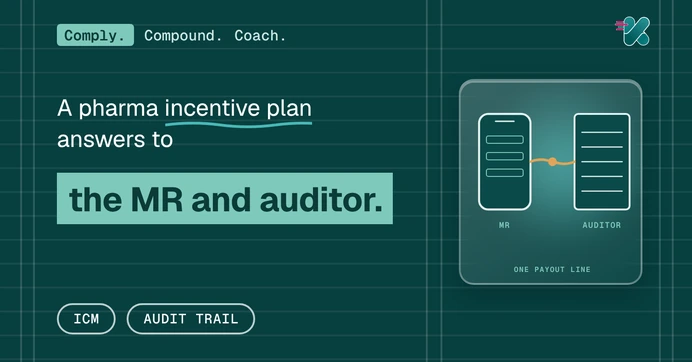
A pharma sales incentive plan answers to the MR and the auditor.
October 28, 2026
Pulkit Agarwal
Pulkit Agarwal
Key Insights
Hindustan Times puts India's pharma field force at about six lakh people.
In this blog:
What the MR needs to see in the payout
What the auditor needs under the Companies Act
Where the plan meets UCPMP 2024 and the Supreme Court
Five plan components that serve both readers
I spend a lot of time with pharma CFOs and sales heads. They tend to read the same plan for different reasons. The sales head asks whether MRs will chase it. The CFO asks whether it will pass audit.
Both questions have the same answer. Each payout line should trace to a dated plan and its data. When an MR can see that trail, queries fall. When an auditor can test it, the control holds.
This year the timing is tight. The Supreme Court hears the Centre on 29 January 2027. FY 2027-28 plans are designed in the same weeks.
A question worth asking the CFO this week: can we trace one MR's payout?
Table Of Content
The numbers behind an MR's payout
India's pharma market is large. Its field force is large too.
Pharmarack sized the market at ₹2,40,672 crore in 2025. Value grew 8.1% that year. Hindustan Times puts the pharma field force at about six lakh people. Each MR is paid partly on an incentive plan.
Kennect runs incentives for more than 60,000 of those MRs. That is about 10% of the field force. More than ₹1,200 crore in annual incentives runs through Kennect.
Those payouts land in two places. One is the MR's phone. The other is the company's books. A plan has to make sense in both.
Sources: Pharmarack Indian Pharma Industry Performance report, January 2026, as reported by ANI in The Tribune · Hindustan Times, field force estimate · Kennect claim register, 60,000+ MRs and ₹1,200+ crore a year across India pharma deployments
Six lakh MRs earn on incentive plans, and each payout enters the books.
What the MR needs to see
An MR reads the plan to answer one question. What do I earn if I do this?
That needs five facts, in plain words, during the month.
The target on each focus brand.
Achievement so far against each target.
The slab reached and the next one.
Whether call average and coverage gates are met.
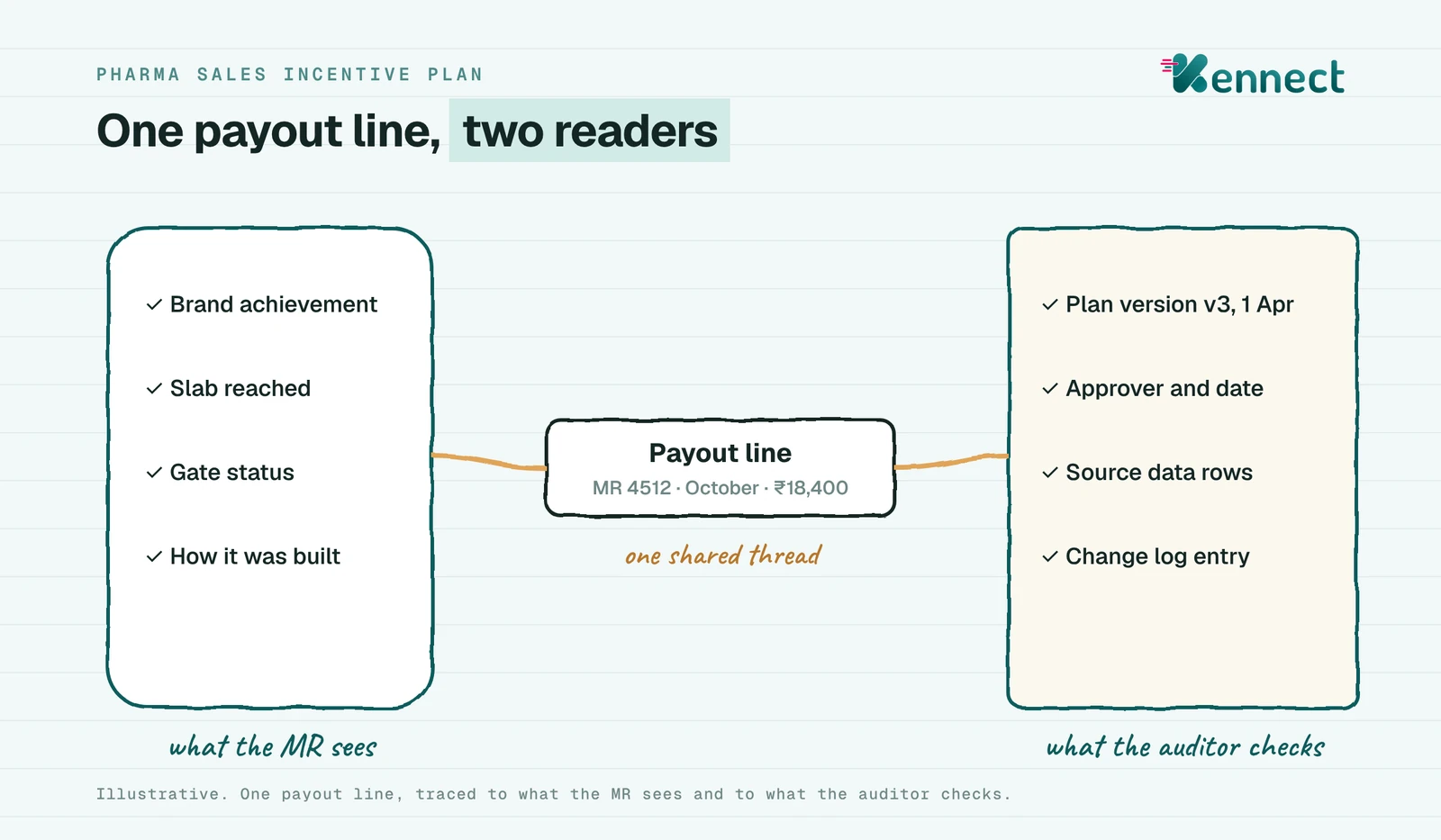
How the final payout was built, line by line.
When these facts are missing, queries rise. An MR who cannot trace a number asks the manager. The manager asks sales operations. Sales operations opens a spreadsheet. The payout waits.
Queries also shape trust. An MR who doubts the number sells against the doubt. A query log with owners and dates helps. We set that out in incentive dispute management.
An MR who can trace each payout line trusts the plan more.
What the auditor needs to see
The auditor reads the same payout from the other side. Two sections of the Companies Act 2013 frame that reading.
Section 143(3)(i) concerns internal financial controls. The auditor reports on them. The report covers whether adequate controls exist and operate effectively. ICAI notes this applies from financial years starting 1 April 2014.
Section 134(5)(e) covers listed companies. Directors must state they laid down internal financial controls. They must state the controls are adequate and operating effectively. The Act's definition includes preventing and detecting fraud. It also covers accurate and complete accounting records.
For a large field force, incentives are a material expense. So the auditor tests it line by line.
One payout, read by the MR and by the auditor
Plan element
What the MR asks
What the auditor asks
Target
Is my target fair
Who approved it, and when
Measures and weights
What moves my payout
Do weights match the approved plan
Slabs and gates
How close am I
Were rules applied the same way to all
Exceptions
Why was mine changed
Who approved it, and why
Payout line
How was this built
Does it trace to plan and data
The auditor looks for evidence. That means dated plan versions, approvals and a change log. It also means a link from each payout to source data.
Sources: ICAI announcement on Section 143(3)(i), 20 June 2014 · Companies Act 2013, Section 134(5)(e) and its Explanation, as published by the Income Tax Department · confirm current text and applicability with your auditor
The auditor reads each payout as a control, with a dated record.
Where the plan meets UCPMP 2024 and the Supreme Court
The Department of Pharmaceuticals notified UCPMP 2024 on 12 March 2024. It governs what a company offers doctors. It also reaches the MR.
Under the code, MRs must keep a high standard of ethical conduct. They must not use inducement or subterfuge to gain an interview. Companies should put a compliance clause in MR contracts. Gifts for doctors are prohibited, and so are travel and hospitality unless the doctor attends as a speaker. The executive head submits a self-declaration of adherence.
The Supreme Court has now put the code in view. On 8 October 2026, it heard a petition. Justices Vikram Nath and Sandeep Mehta sat on the bench. The petitioner was the MRs' national union, FMRAI. The court directed the Centre to constitute an expert committee. It will examine whether pharma marketing needs an enforceable framework. The Centre reports back on 29 January 2027.
The incentive plan sits between these rules and the field. A target set beyond a territory's reach builds pressure. That pressure travels down the line to the MR. More on this in what the pharma marketing order means for MR incentives.
Sources: KPMG India, Navigating the new regulatory terrain, March 2024, a summary of UCPMP 2024 · The Week, 8 October 2026, Federation of Medical and Sales Representatives Associations of India v. Union of India · read the code and the order text, and take legal advice before changing a plan
The plan shapes field conduct, so compliance should read it before launch.
Five components of a pharma sales incentive plan
A pharma sales incentive plan that serves both readers has five parts. Each part needs a record.
Focus brands. Pay on a few brands per cycle, with weights. Put the rest in a basket. Date each cycle's brand list.
Gates. Use call average and doctor coverage as gates. Gates open the payout. Set them from territory data.
Slabs. Step payout up at set achievement levels. Publish the slab table with the plan.
Quarterly and annual layers. A quarterly payout keeps the MR on pace. An annual layer rewards the full year. Define how quarters roll into the year.
Exceptions. Log every adjustment with reason, approver and date. An exception agreed on a call leaves no record.
Illustrative. One payout line, traced to what the MR sees and to what the auditor checks.
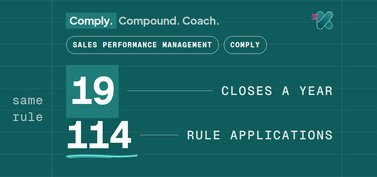
Cadence matters as much as design. A cycle that closes in days links pay to effort. A cycle that closes in months breaks it. Late corrections then pile up. Put recalculation rules in the plan. See retrospective incentive calculation.
Data rules matter too. An incentive system holds MR personal data. Performance, hierarchy and payout details all sit there. MeitY's DPDP Rules were notified on 13 November 2025. Remaining substantive obligations apply from May 2027. They cover notice, security safeguards, breach notification and data retention.
Source: AZB and Partners, Digital Personal Data Protection Act phased rollout, 14 November 2025 · Rules notified 13 November 2025, remaining substantive rules after 18 months · confirm obligations with counsel
Who owns each part
Four teams share the plan. Settle who owns what before April.
Sales leadership and sales operations set targets, weights and slabs.
Compliance reads the plan for conduct risk under UCPMP 2024.
Finance approves the cost, runs the payout and answers the auditor.
HR holds the hierarchy, joining and exit dates.
Each owner signs a dated version. A change by any owner creates a new version. Review the plan each quarter against what it paid for. The method is set out in a quarterly incentive plan review.
How disputes close
A dispute is a request to see the build of a number. Give it a clear path.
The MR raises a query against one payout line.
An owner is named, with a target date.
The answer cites the plan rule and the data row.
Any correction is recomputed and dated.
A dispute closed this way leaves evidence. The auditor can test it later.
Each component serves both readers when it carries a dated record.
How Kennect helps pharma teams run an audit-ready plan
In pharma deployments, we hear the same two asks. The MR wants to know how the payout was built. Finance wants proof the rules were applied. So we keep one record for both.
Dated plans and an audit trail. Every plan and target is a dated version. The audit trail and change log record who changed what, and when. Finance and compliance can export it. More on this at finance and compliance.
Connected data. Connectors pull from HRMS, CRM, SFA and ERP, including SAP. HR stays in the HRMS. Finance stays in SAP. Fill the white spaces, do not disrupt the foundation.
The MR's app. Each MR sees a personal cockpit, slab view and what-if simulator. Leaderboards show standing within the team.
Queries in one place. MRs raise a query against a payout line. Kennect query management routes it to an owner with a date.
Recompute and carry-forward. When late data arrives, the cycle recomputes. Differences carry forward to the next payout.
Teams comparing life sciences sales compensation software can test for these records.
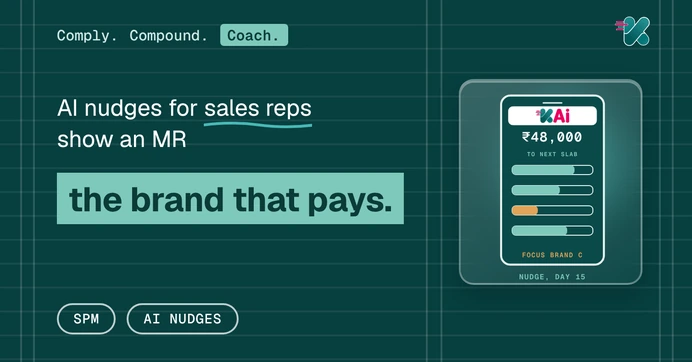
Kai, Kennect's AI: Kai explains each payout to the MR in plain language. Admins trace any payout to the plan and KPIs behind it. Tracing to source data follows by end of December 2026. Kai also helps resolve MR and manager payout queries. Each MR gets an earnings summary every cycle.
Take one mid-sized Indian pharma deployment. It covers 1,000+ MRs. Payout queries fell 80% once MRs could see each payout's build. The cycle now closes in about 5 days. It used to take 2 to 3 months. The team saved 200+ admin hours a month.
Source: Kennect claim register · one mid-sized Indian pharma deployment, 1,000+ medical representatives · 80% fewer payout queries, close to payout in 5 days against 2 to 3 months, 200+ admin hours a month, 7 to 10 spreadsheets per cycle cut to none
One dated record serves the MR's question and the auditor's test.
What this means for FY 2027-28 plans
FY 2027-28 plans get designed from January to March 2027. The Supreme Court hearing falls on 29 January 2027. Design the plan with its records from day one. Then the MR and the auditor read the same payout.
A plan that both readers can trace is ready for April.