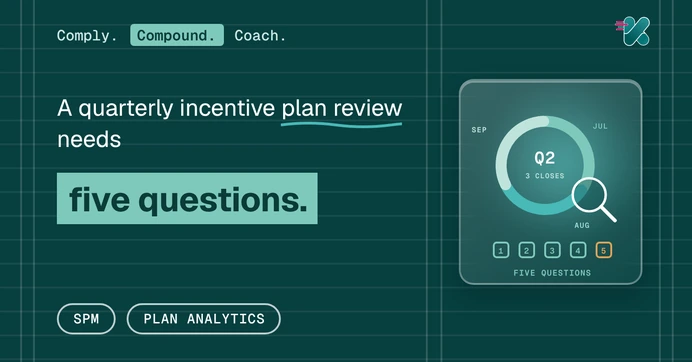
A quarterly incentive plan review needs five questions.
October 14, 2026
Puneet Gupta
Puneet Gupta
Key Insights
The plan reviews I sit in on often start with a question nobody can answer quickly: is the plan working? The quarter has closed, payouts have gone out and the field has moved on. The data exists, spread across the payout file, the target sheet and an inbox full of queries.
The annual review will ask the same question in March. By then it is too late to fix this year.
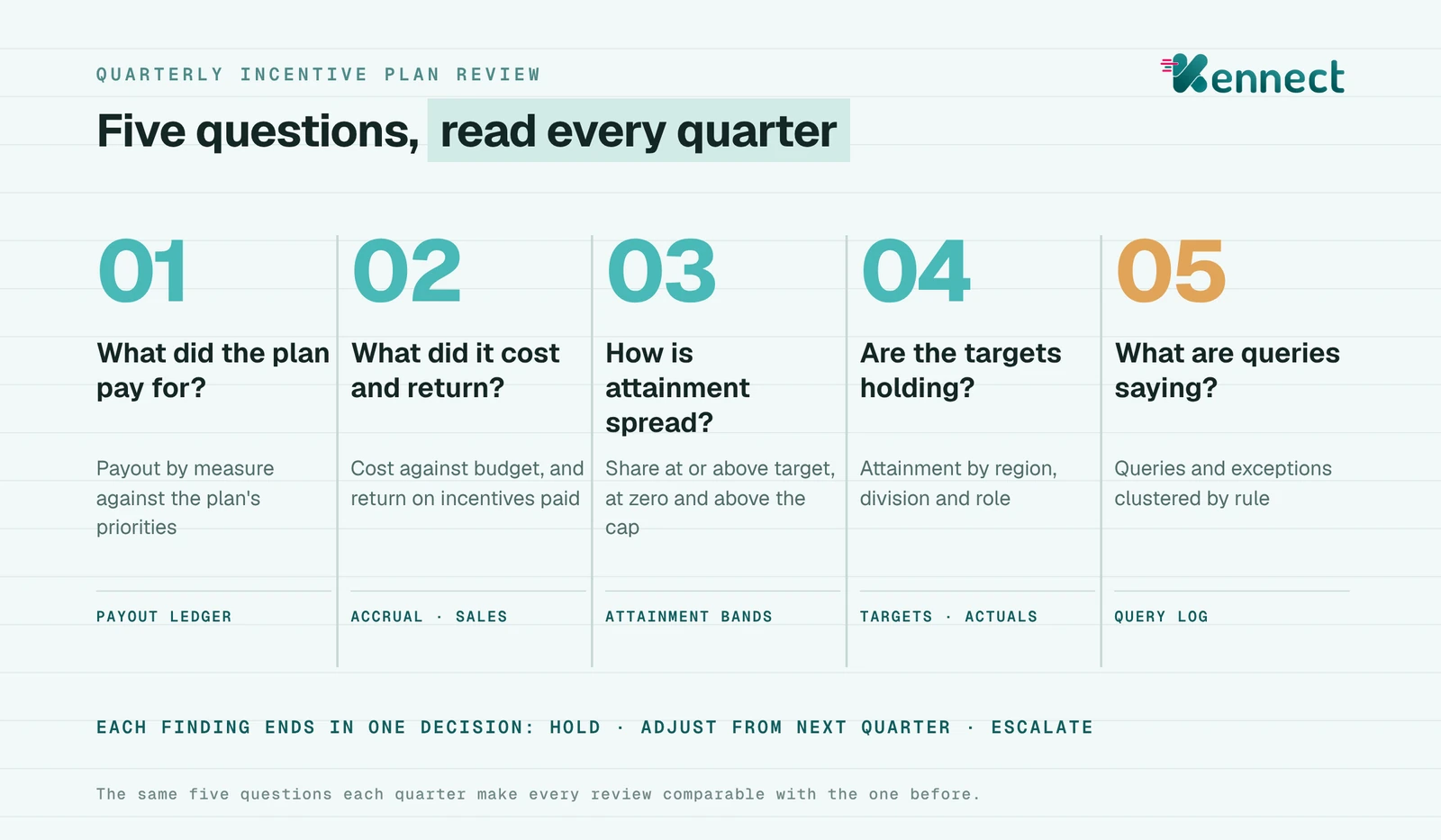
A quarterly incentive plan review works when it asks the same five questions every time. What did the plan pay for? What did it cost, and what did it return? How is attainment spread? Are the targets holding? What are queries and exceptions saying? Each answer comes with a data source and a point at which to act. The need is clear: 97% of companies changed their plans for 2026, and about one in five rated the previous year's plans as very effective.
A question worth asking the head of sales operations this week: for the quarter that just closed, which of the five could you answer from one report?
The plan reviews I sit in on often start with a question nobody can answer quickly: is the plan working? The quarter has closed, payouts have gone out and the field has moved on. The data exists, spread across the payout file, the target sheet and an inbox full of queries.
The annual review will ask the same question in March. By then it is too late to fix this year.
A quarterly incentive plan review works when it asks the same five questions every time. What did the plan pay for? What did it cost, and what did it return? How is attainment spread? Are the targets holding? What are queries and exceptions saying? Each answer comes with a data source and a point at which to act. The need is clear: 97% of companies changed their plans for 2026, and about one in five rated the previous year's plans as very effective.
A question worth asking the head of sales operations this week: for the quarter that just closed, which of the five could you answer from one report?
Table Of Content
How often incentive plans change
Plans change every year, and many of them change because they did not work. In the Alexander Group's 2026 Sales Compensation Trends Survey, 97% of companies made changes to their 2026 plans. Ineffective plans were one of the three main reasons given. About one in five companies rated their 2025 plans as very effective, and 57% said they struggle to set accurate quotas.
Writing in WorldatWork in July 2026, Ellie Leites and Rachel Parrinello cited Alexander Group survey data on how plans are run. Fewer than 25% of companies have fully implemented effective practices for measuring whether the plan succeeded, managing change and confirming the plan matches the growth strategy.
Source: Alexander Group, 2026 Sales Compensation Trends Survey briefing; Alexander Group, "How to Analyze Your Quota Distributions" and "4 Sentinel Charts to Monitor Your Sales Comp Program"; Ellie Leites and Rachel Parrinello, "Governance and Operations Are Foundational to Sales Comp Success", WorldatWork Workspan Daily, 16 July 2026
Almost every plan changes each year, and a minority of companies have a full practice for measuring whether the plan they are changing worked.
Why a quarter is the right interval
An annual review comes too late to correct a plan in the year it runs. A monthly reading is too short, because one month of sales is noisy and one large order can move a team's attainment.
A quarter holds three closes. It shows whether a pattern repeats, and it leaves time to act inside the year. The Alexander Group recommends refreshing its sentinel charts for a sales incentive program every quarter, including the spread of quota outcomes and the link between pay and performance. The annual review still matters: the 12-point incentive audit checks the design and the governance once a year. The quarterly review reads how the plan is performing in between.
A quarterly review reads three closes of evidence and leaves time to act before the year is gone.
Five questions for the quarterly review
Each question has a reading, a data source and a point at which the answer calls for action. Keep the same five every quarter, so each review can be compared with the one before.
Five questions for a quarterly incentive plan review
Question
The reading
Where the data sits
When to act
Did the plan pay for what it was built to drive?
Payout by measure against the plan's stated priorities
Payout ledger by plan component
A priority measure earns a small share of payout
What did the quarter cost, and what did it return?
Incentive cost against budget, and return on incentives paid
Accrual, payout and sales data
Spend runs ahead of budget without a matching sales gain
Is attainment spread the way the plan expected?
Share of payees at or above target, at zero and above the cap
Attainment by payee, in 10-point bands
Fewer than about 55% or more than about 65% reach target, or more than 10% miss the threshold
Are the targets holding?
Attainment by region, division and role
Targets and actuals by unit
One unit sits far above or below the rest
What are queries and exceptions saying?
Queries by mechanic, exceptions granted, payments made outside the plan
Query log, exception log, off-plan payments
Queries or exceptions cluster on one rule
Five questions, read every quarter in the same order
Five fixed questions, read the same way each quarter, make each review comparable with the one before.
Reading each answer
What the plan paid for
A plan built to grow a new product line should pay a visible share of its incentive on that line. If the larger share of payout still comes from the legacy measure, the plan is paying for the previous year's priorities. Read payout by component, by role, and compare it with the weights in the plan document.
Cost and return
Incentive cost against budget tells finance whether the accrual is on track. Return tells the business whether the spend earned anything. Return on incentives paid compares the incremental sales a payout drove with what it cost, using a matched group as the baseline.
For schemes and contests that ran inside the quarter, read each one against its own baseline, the method set out in measuring incentive impact on revenue.
Attainment spread
The spread shows whether the plan's shape is working. The Alexander Group's guidance is that about 60% of reps should reach plan or better in a typical period. Its preferred distribution has 55% to 65% of sellers at or above target, 90% to 95% reaching the threshold and 5% to 10% reaching the excellence point. It suggests reading attainment in bands of 10 points, over at least three years where the data exists.
The same research notes that sales leaders often expect 55% to 65% of sellers to reach quota, while outcomes in its 2022 survey were closer to 50%.
A share well below that range suggests targets out of reach. A share well above it suggests targets set too low. A large group above the cap can also mean the cap stops paying for effort the business still wants.
Targets
When targets land unevenly across regions, check how they were allocated before judging the people working them. The Alexander Group finding that 57% struggle to set accurate quotas makes this a question that often needs action.
Queries and exceptions
Queries that cluster on one rule mean the rule is unclear or the data behind it is wrong. Exceptions, add-ons and contests can grow quietly. In one case the WorldatWork article describes, in-plan add-on bonuses and short-term incentives made up 32% of a medical device company's total incentive payments.
Each answer points to a part of the plan, so the review ends with a specific rule to keep, adjust or escalate.
What to do with the answers
A quarterly review should end with one of three decisions for each finding.
Hold. The plan is working as designed. Record the reading so the next quarter has a baseline.
Adjust from the next quarter. A target, a weight or a contest needs changing. Model the change on the quarter's actual data before approving it, and publish it before the quarter opens.
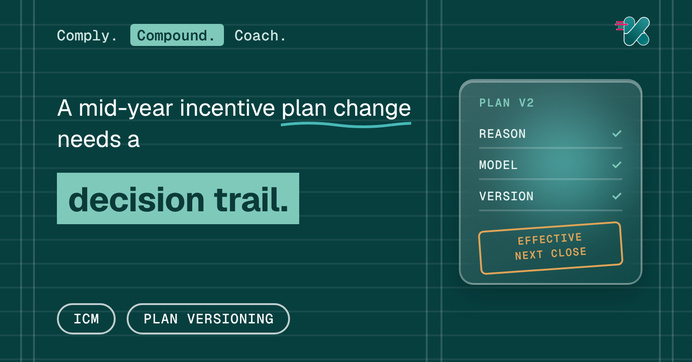
Escalate. The finding needs a change inside the current period. That is a mid-year incentive plan change, and it needs a written reason, a model and a dated plan version.
Record each finding, the decision taken and the owner. The next quarterly review starts by checking what happened to them.
A review that ends with a recorded decision for each finding builds a history the annual plan design can use.
How Kennect supports the quarterly review
In the teams we work with, payout, target and query data often sit in separate files, and the review starts by assembling them. So we keep them on the record that calculates the payout.
Payout by component and attainment by payee and unit come from the same calculation the field is paid on. Queries are raised in the system against a period, with a category, so they can be read by type. Scenario modeling runs a proposed change on historical data before it is approved.
Sales leadership reads the quarter from the numbers the field was paid on. Finance sees what the quarter paid. The incentive analyst sees each query against its period and category.
One record for payout, targets and queries lets the quarterly review start from the readings.
What this means for the next review
Plans will keep changing every year. The quarterly review is where the evidence for those changes is gathered. A team that asks the same five questions every quarter enters annual planning with four readings of how the plan performed.
One record for payout, targets and queries lets the quarterly review start from the readings.
Five questions, read every quarter, show what the plan paid for, what it cost, how attainment spread, whether targets held and where queries cluster.
See how Kennect analytics reads incentive performance by quarter.


.jpeg)