Split sales compensation needs a crediting rule up front.
December 9, 2024
Pulkit Agarwal
Pulkit Agarwal
Key Insights
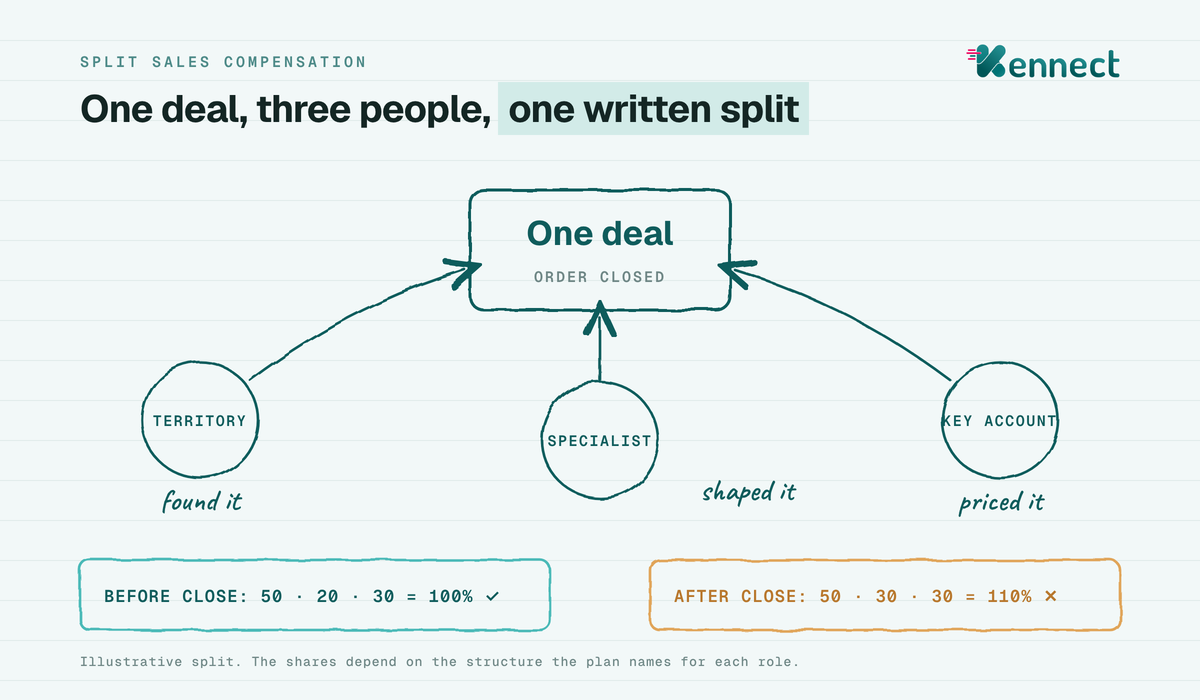
Some of the hardest conversations I have with sales leaders are not about targets. They are about one deal that three people worked. The territory rep found it, a specialist shaped the proposal, and the key account manager negotiated the price. The order lands, and each of them expects credit.
When the split is decided after the order closes, it turns into a negotiation. The person who escalates first often sets the share, and the others remember it at appraisal time. Good people stop helping on each other's deals.
Split sales compensation works when the crediting rule is written before the deal closes. That means a structure for each role, shares that add to 100%, and a record of who approved them. Shared credit is common: 58% of companies credit two or more sellers on a transaction, according to Alexander Group data.
A question worth asking the head of sales operations this week: for the largest shared deal of the previous quarter, where is the split written down, and who approved it?
Some of the hardest conversations I have with sales leaders are not about targets. They are about one deal that three people worked. The territory rep found it, a specialist shaped the proposal, and the key account manager negotiated the price. The order lands, and each of them expects credit.
When the split is decided after the order closes, it turns into a negotiation. The person who escalates first often sets the share, and the others remember it at appraisal time. Good people stop helping on each other's deals.
Split sales compensation works when the crediting rule is written before the deal closes. That means a structure for each role, shares that add to 100%, and a record of who approved them. Shared credit is common: 58% of companies credit two or more sellers on a transaction, according to Alexander Group data.
A question worth asking the head of sales operations this week: for the largest shared deal of the previous quarter, where is the split written down, and who approved it?
Table Of Content
How often one deal pays more than one person
Shared credit is normal. In Alexander Group data reported by WorldatWork, 58% of companies credit two or more sellers on a transaction, and 42% credit one. 68% give some level of duplicate credit, and 5% credit five or more sellers on the same sale.
The same research found 67% of companies apply full clawbacks on orders that are canceled or not paid. 34.5% credit a sale at invoice and 24.4% at booking.
Source: David Cichelli, "Double Sales Crediting: When and Why to Apply It", WorldatWork Workspan Daily, 23 February 2023, reporting Alexander Group survey data · sample size not stated in the article
Many deals of any size involve more than one contributor, so the crediting rule decides a large share of variable pay.
Split credit and double credit answer different questions
Split credit divides one sale between the people who worked it. A key account manager takes 40% of the credit and the territory rep takes 60%, and the two shares add to 100%.
Double credit gives full credit to more than one person. The specialist and the account owner each count the whole sale toward their own target. The total credited is more than the revenue booked.
Both are legitimate. Split credit controls cost and asks people to share. Double credit encourages collaboration and costs more. The Alexander Group's advice is to credit for persuasion, and to investigate any double credit that runs above 112% of actual revenue.
The cost of double credit can grow quietly. The Alexander Group describes one client that ended up paying more than 160 people on the same deal under its double-credit policy. Its conclusion: crediting follows job design.
Split credit shares one sale, double credit counts it more than once, and the plan should say which one applies to each role.
Four ways to write a split
Each structure suits a different kind of team. Many plans use more than one.
Four ways to split credit on one deal
Structure
How it works
Where it fits
What to write down
Proportional by role
Each role takes a fixed share, such as 60% owner and 40% specialist
Stable teams with clear roles
The share for every role, and what happens when a role is vacant
Fixed ratio per deal
The people on the deal agree a ratio before it closes
Deals that cross territories or accounts
Who approves the ratio, and the date it was agreed
Stage based
Credit follows the stage each person owned: source, qualify, close
Long cycles with handoffs
The stage definitions and the evidence each stage needs
Threshold based
A second person earns credit above a set deal size or margin
Specialists brought in for large deals
The threshold, and whether it is measured on order or invoice value
A split structure is a policy decision, and it belongs in the plan document before the first deal is credited.
Where splits go wrong
Four problems show up again and again in shared deals.
The percentages do not add to 100
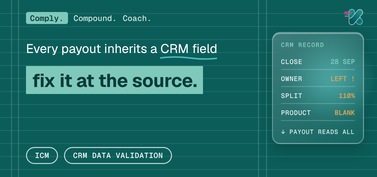
A split entered as 60% and 50% overpays by 10%. A split entered as 50% and 40% leaves credit unallocated. The split field is one of the CRM fields that decide a payout, and it is often edited by hand late in the month.
One deal, three contributors: the split written before the close and the split argued after it
The split is agreed after the deal closes
When the ratio is settled after the order lands, it becomes a negotiation. The person who asks first, or the manager who escalates hardest, sets the share. The other contributor reads the result as unfair, whatever the merits.
Double credit drifts upward
Each exception that grants a second full credit looks small. Over a year, total credited revenue climbs above booked revenue, and the cost of sales rises with it. Track the ratio of credited to booked revenue every quarter.
A clawback recovers from one person
A canceled order should reverse every share that was paid on it. When the clawback runs against the account owner alone, the specialist keeps credit for a sale that did not happen. This is one of the commission calculation errors that repeat every cycle.
Each of the four problems comes from a split that was never written down, or written down after the money moved.
Split credit in Indian sales teams
Shared credit takes specific forms in India.
Bancassurance. A policy sold at a bank branch involves branch staff, the bank's insurance desk and the insurer's relationship manager. Each has a claim to the sale.
Distributor and field rep. In FMCG and pharma, a distributor's secondary sales and a field rep's coverage both contribute to one outlet's numbers.
Key account and territory. A national account negotiated centrally and fulfilled locally credits both the key account manager and the territory rep.
Pre-sales and closer. In B2B and lending, a lead generator and a closer often share one disbursement or contract.
In each case the share should be written into the plan before the period opens, and attached to the record of the sale.
Indian sales teams share credit across banks, distributors and central accounts, and each pattern needs its own written rule.
How to set the crediting rule before the deal closes
Five steps keep shared credit out of the dispute queue.
Decide, for each role, whether it earns split credit, double credit or none.
Pick a split structure for each team and write the shares into the plan document.
Record the split on the deal before it closes, with the approver's name and the date.
Check that every split adds to 100%, or to the double credit ratio the plan allows, before the payout runs.
Reverse every share on a canceled or unpaid deal, and keep the reversal on the same record.
Record the split, the approver and the date on the deal before the order closes.
A written split, checked to 100% and stored with the sale, removes the argument before it starts.
How Kennect handles split credit
Across the deployments we run, split disputes trace back to the moment the split was recorded. So we build crediting into the calculation itself.
We hold crediting rules for each role in the plan: split shares, double credit and thresholds. We read the split from the CRM record and check that it adds up before the calculation runs. We reverse every share when an order is canceled or a payment fails, and show each person their share of every deal in their own view.
Sales operations keeps one crediting rule per role instead of one decision per deal. Finance sees credited revenue against booked revenue. Each seller sees the same split the manager sees.
One crediting rule, applied by the engine to every shared deal, replaces a monthly negotiation.
What this means for the next shared deal
Shared deals will keep growing as teams add specialists, channels and central accounts. The question for each one is the same: who earns what share, decided when, and recorded where. A plan that answers it in writing pays shared deals as cleanly as solo ones.
A written split, checked to 100% and stored with the sale, removes the argument before it starts.
Split credit and double credit are both legitimate. What decides whether a shared deal is paid fairly is a rule written before the close.
See how the ELT and calculation engine applies crediting rules to every shared deal.