The Supreme Court's pharma order reaches the MR incentive plan.
October 14, 2026
Pulkit Agarwal
Pulkit Agarwal
Key Insights
Over the years I have sat with many pharma sales heads in January, when the next year's targets are set. Many of them started as medical representatives. They remember waiting outside a clinic for a few minutes with a doctor, and knowing the molecule well enough to answer a hard question.
On 8 October 2026, the people in that waiting room were heard in the Supreme Court. The petition came from the Federation of Medical and Sales Representatives Associations of India, the union of a field force of around six lakh people. People rarely take their own industry to court unless something has stopped working for them inside it. An MR stands between a target set above and a prescription that sits with the doctor, and when a target outgrows a territory, the pressure passes through them.
The court directed the Centre to form a committee on unethical pharma marketing practices, and will review the Centre's compliance on 29 January 2027. Until then, UCPMP 2024 governs. That date falls inside incentive planning season, so plans for FY 2027-28 will be written while the rules are being decided. A medical representative incentive plan that shows how each target was set and what each payout was for gives the company a record it can stand behind, and gives the MR a number they can trust.
A question worth asking the head of sales operations this week: if an MR asked why their target went up this year, could we show them?
Over the years I have sat with many pharma sales heads in January, when the next year's targets are set. Many of them started as medical representatives. They remember waiting outside a clinic for a few minutes with a doctor, and knowing the molecule well enough to answer a hard question.
On 8 October 2026, the people in that waiting room were heard in the Supreme Court. The petition came from the Federation of Medical and Sales Representatives Associations of India, the union of a field force of around six lakh people. People rarely take their own industry to court unless something has stopped working for them inside it. An MR stands between a target set above and a prescription that sits with the doctor, and when a target outgrows a territory, the pressure passes through them.
The court directed the Centre to form a committee on unethical pharma marketing practices, and will review the Centre's compliance on 29 January 2027. Until then, UCPMP 2024 governs. That date falls inside incentive planning season, so plans for FY 2027-28 will be written while the rules are being decided. A medical representative incentive plan that shows how each target was set and what each payout was for gives the company a record it can stand behind, and gives the MR a number they can trust.
A question worth asking the head of sales operations this week: if an MR asked why their target went up this year, could we show them?
Table Of Content
What the Supreme Court ordered on 8 October
On 8 October 2026, a bench of Justices Vikram Nath and Sandeep Mehta directed the Union of India to constitute a committee on unethical marketing practices by pharmaceutical companies. The committee will consider suggestions and representations from stakeholders and give its recommendations to the government.
Three dates frame what follows.
8 September 2026. The Centre told the court it would set up a three-member panel to examine whether a binding legal framework is needed, and asked for two months.
Until a decision is taken. The Uniform Code for Pharmaceutical Marketing Practices (UCPMP) 2024 continues to govern pharma marketing.
29 January 2027. The court will consider the Centre's compliance affidavit.
The order itself creates no new obligation on pharmaceutical companies or doctors, and takes no view yet on whether a law is needed. What it sets is a timetable.
Source: Supreme Court of India, Federation of Medical & Sales Representatives Association of India v. Union of India, order of 8 October 2026, as reported by PTI via ThePrint, LawChakra and The Week
A detailed copy of the order was awaited when this was written. Read the order and the UCPMP 2024 text, and take legal advice, before changing any scheme.
The 8 October order sets a timetable, and the next date on it is 29 January 2027.
Who brought the case
The petition was filed by the Federation of Medical and Sales Representatives Associations of India (FMRAI), the national union of medical representatives. It asks for the marketing code to carry legal force, so that companies offering inducements to doctors face consequences in the same way doctors who accept them already do under medical council rules.
The petition describes gifts, overseas trips and hospitality offered to influence prescriptions, as reported by The Week. The Centre has told the court that UCPMP 2024 works satisfactorily. The committee will now examine whether a voluntary code is enough.
The case also sits beside an earlier ruling. In Apex Laboratories (2022), the Supreme Court held that freebies given to doctors cannot be claimed as a business expense for tax purposes.
The people asking the court for clearer rules are the medical representatives who carry the targets.
Where the incentive plan meets the marketing code
UCPMP 2024 governs what a company may offer a healthcare professional. It prohibits gifts, cash and travel offered to doctors or their families, and it holds companies accountable for the conduct of their representatives.
An MR's incentive plan governs something else: what the company pays its own people for. The two meet in the field. A target, a doctor list and a monthly scheme decide where an MR spends time and what a good month looks like. When targets climb faster than a territory can grow, the pressure travels down the hierarchy, and the petitioners have described area managers making offers to doctors to close a gap.
So the plan is part of the answer to the court's question. Five parts of an MR incentive plan deserve a reading now.
Five parts of an MR incentive plan, and the record each one should keep
Plan element
Where pressure can build
What to record
Targets
A target set above what the territory can absorb
How each target was set, and the territory data behind it
Measures
Payout tied to output with no reading of how it was earned
Each measure, its weight, and the activity measures beside it
Contests and spot schemes
A scheme launched mid-month by a region, outside the plan
Approval before launch, with the approver, dates and budget
Exceptions
A payout adjusted on a call to close a gap
Every exception with its reason, approver and date
Payout lines
Amounts paid that no measure in the plan explains
A link from each payout line to the plan version and data that produced it
An MR incentive plan shapes field conduct, so it belongs inside any review of marketing practice.
The calendar between now and April
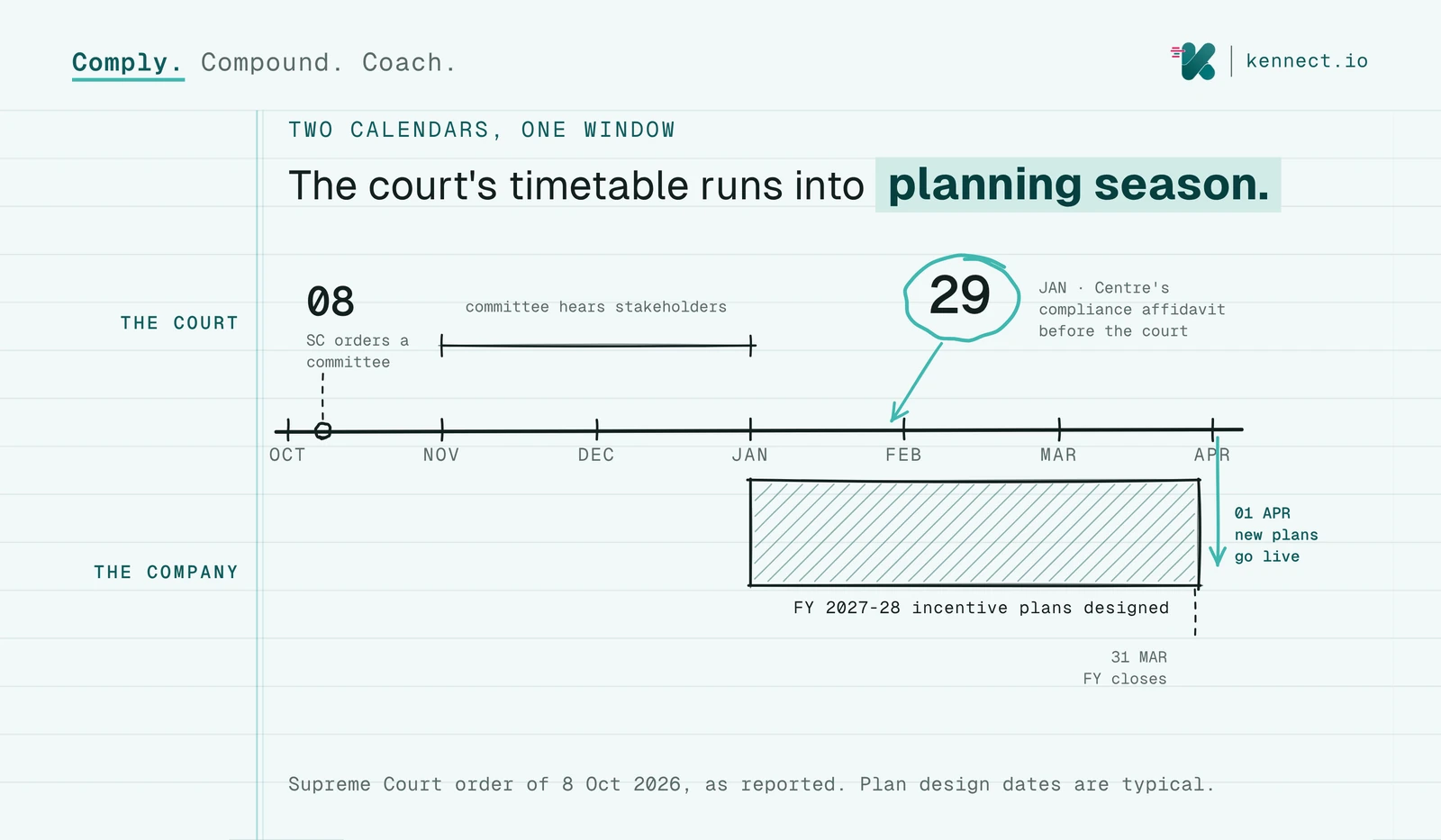
The committee's timetable runs straight into incentive planning season.
October to December 2026. The committee is constituted and hears stakeholders. The Centre asked the court for two months.
29 January 2027. The court reviews the Centre's compliance.
January to March 2027. Pharma companies design and approve incentive plans for FY 2027-28.
31 March 2027. The financial year closes, and with it the year the UCPMP self-declaration covers.
1 April 2027. New plans go live.
The committee's timetable and the incentive planning season run side by side
Plans for FY 2027-28 will be written while the committee's recommendations are being decided. A plan designed with clear records can absorb whatever the recommendations say. A plan rebuilt after them would arrive mid-year, with the cost of a mid-year incentive plan change.
The FY 2027-28 incentive plan will be designed in the same weeks the court reviews the committee.
Six checks before FY 2027-28 plans are signed
Trace every payout to the plan. Each rupee paid to an MR should map to a measure in the approved plan. Read the previous year's payout by component, the method set out in a quarterly incentive plan review.
Read targets against territories. Compare target growth with territory potential by headquarters and division. Gaps that recur in one region point to a target problem before they become a conduct problem.
Balance output with activity. Activity measures such as doctor coverage and call quality, read beside sales, show how a result was earned.
Approve contests before they run. Every regional scheme needs an approver, a budget and dates, recorded before launch.
Log exceptions. An adjustment agreed on a call cannot be shown later. A log with reason, approver and date can.
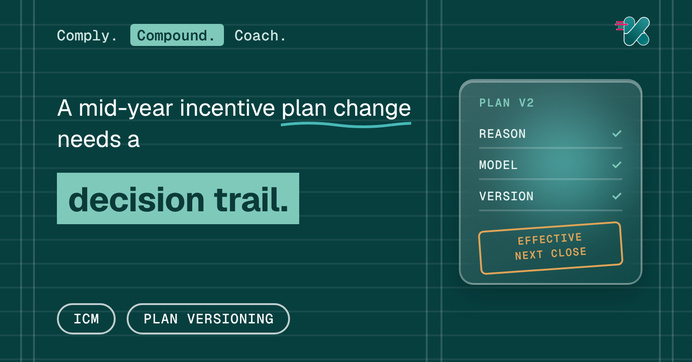
Keep plan versions dated. If a payout is questioned in 2028, the plan in force on the date of the sale should be retrievable, a principle covered in retrospective incentive calculation.
Run these six checks on the FY 2026-27 plans now, and carry the findings into FY 2027-28 design in January.
Six checks, run before January, give the plan design team a record of what the current plan paid for.
Who owns this inside a pharma company
Three groups share the work.
Sales leadership and sales operations set targets, design measures and approve schemes.
Compliance owns UCPMP adherence and the annual self-declaration, and reads incentive schemes for conduct risk.
Finance and HR run the payout, hold the exception records and answer the auditor.
Settle who approves a scheme, who approves a change and who answers an MR's query. The same questions sit behind who owns a change to sales incentives in any sales team. Queries from the field belong in one record too, as set out in incentive dispute management.
Compliance can vouch for an incentive plan when it can read the plan's records directly.
How Kennect supports pharma incentive governance
Kennect runs incentives for more than 60,000 medical representatives across India's pharma and life sciences companies. Across those deployments, the governance questions come back to the record behind each payout. So we build the cycle around that record.
We hold every plan as a dated version, with its measures, weights and slabs. We connect with SFA, ERP and HR systems to bring in sales, activity and hierarchy data. We link each payout line to the plan version and source rows that produced it. We log every contest, exception and change with who approved it and when.
Sales leadership models a proposed plan on actual data before approving it. Compliance and finance export the audit trail. Each MR sees how their number was built in the Kennect app, and raises a query against the line they want to ask about.
One dated record behind every payout lets a pharma company show what its incentive plan paid for.
What this means before 29 January
The committee will make its recommendations, the court will review them and the code may gain legal force or stay as it is. Incentive plans for April will be designed in the same window. A sales team that can trace every payout to an approved measure will be ready for either outcome, and its MRs will know what they are being paid for.
One dated record behind every payout lets a pharma company show what its incentive plan paid for.
The Supreme Court reviews the pharma marketing committee on 29 January 2027, in the weeks FY 2027-28 incentive plans are designed.
See how Kennect runs incentives for pharma and life sciences field forces.


.png)