Insurance agent commission software needs clawbacks written in.
October 8, 2026
Puneet Gupta
Puneet Gupta
Key Insights
Agency heads tell me the hardest month of the year is not the one with the biggest target. It is the month the lapse reports arrive. Commission was paid on policies sold in a strong quarter, some of those policies have now lapsed or been returned, and the recoveries start appearing on agents' statements as deductions nobody can explain line by line.
In many plans the clawback rule is written less clearly than the commission rule, so agents learn about it when money comes out of their pay.
Insurance agent commission software works when the clawback is written into the plan before the first policy lapses. Name the events, free-look cancellation, early lapse, mis-selling and premium dishonor, and record each recovery against the policy it reverses. The stakes are high: IRDAI notes that about 48% of life policies remain in force at the 61st month.
A question worth asking the head of agency this week: when a policy cancels in the free-look period, does the recovery reach every person who was paid on it?
Agency heads tell me the hardest month of the year is not the one with the biggest target. It is the month the lapse reports arrive. Commission was paid on policies sold in a strong quarter, some of those policies have now lapsed or been returned, and the recoveries start appearing on agents' statements as deductions nobody can explain line by line.
In many plans the clawback rule is written less clearly than the commission rule, so agents learn about it when money comes out of their pay.
Insurance agent commission software works when the clawback is written into the plan before the first policy lapses. Name the events, free-look cancellation, early lapse, mis-selling and premium dishonor, and record each recovery against the policy it reverses. The stakes are high: IRDAI notes that about 48% of life policies remain in force at the 61st month.
A question worth asking the head of agency this week: when a policy cancels in the free-look period, does the recovery reach every person who was paid on it?
Table Of Content
How much life business agents bring
Individual agents remain the backbone of life insurance distribution in India. In FY2025, they brought 49.44% of life insurers' new business premium, according to the IRDAI Annual Report 2024-25. For the public sector insurer, agents brought 93.86% of individual new business premium. For private insurers, the share was 22.80%, with banks and other corporate agents carrying more.
Behind each of those policies is a commission plan: first-year commission, renewal commission, persistency bonuses, contests and overrides for the agency managers above the agent.
Source: IRDAI Annual Report 2024-25, new business premium by channel, FY2025, as reported by Outlook Money
Agents bring roughly half of India's life new business, and each policy they sell starts a commission that runs for years.
When a commission is paid, and when its value shows
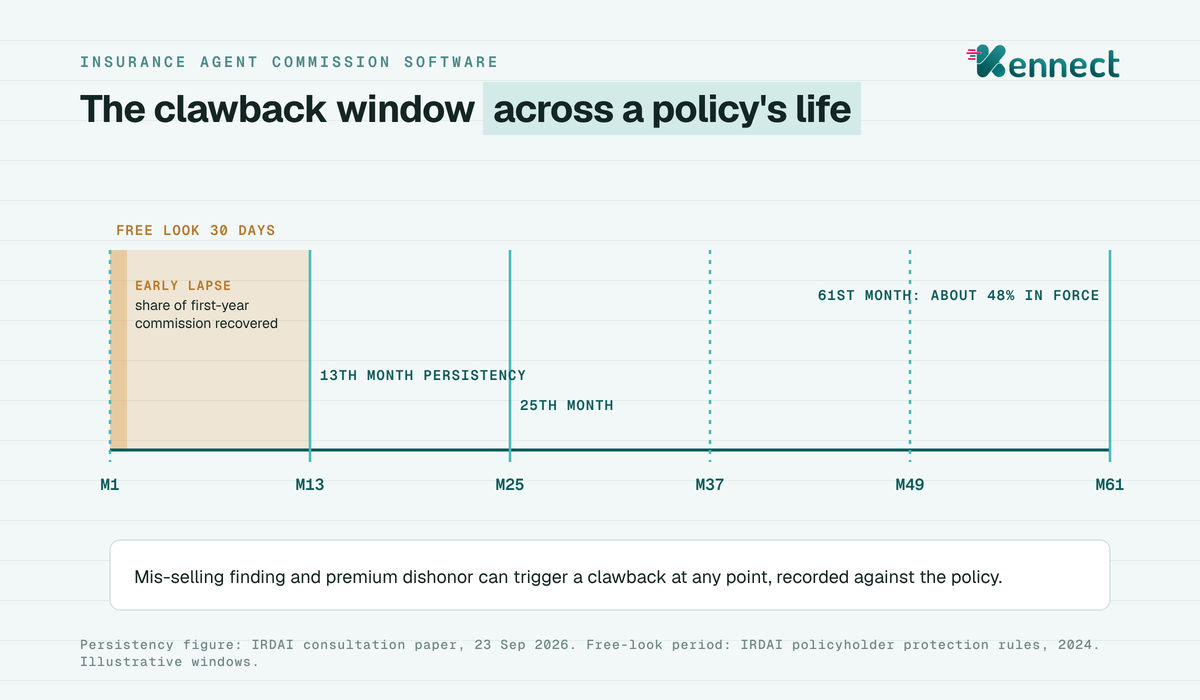
First-year commission is paid in the first months of a policy. The value of the policy to the insurer shows much later, at the 13th month, the 25th and the 61st, when the customer either renews or leaves.
IRDAI's consultation paper of 23 September 2026 notes that about 48% of life policies remain in force at the 61st month. A commission plan paid entirely on the first premium pays the same amount on the policies that stay and on the policies that lapse.
That is why commission plans carry clawbacks. A clawback recovers commission when the event it paid for does not hold: the customer cancels in the free-look period, the policy lapses early, or the sale is found to be mis-sold.
A first-year commission is paid on a promise that the policy will stay, and a clawback is the rule for when it does not.
First-year commission caps for agents, for example 25% on individual life policies with premium terms of ten years or more, 6.25% below five years, and 20% on the first sale of individual health policies.
Renewal commission on longer-term life policies that rises by 0.5 percentage points every three years from the sixth year, up to 7%.
Commission clawback where mis-selling is established.
A central identity for every salesperson, with each policy tagged to the person who sold it.
These are proposals, and the final rules may differ. Each of them changes what an agent commission plan has to calculate and record.
Read the consultation paper itself before changing any agent plan, and take legal advice on how the final rules apply.
IRDAI's proposals move more of an agent's earnings toward renewals and give clawbacks a regulatory footing.
Four clawback events to write into the agent plan
A clawback is fair when the agent knew the rule before the sale. Four events cover a typical life agency plan.
Four clawback events, what each recovers and the record it needs
Event
What is recovered
From whom
The record it needs
Free-look cancellation
The full commission on the canceled policy
The agent and every override paid on the policy
Cancellation date within the free-look period, tagged to the seller
Early lapse
A share of first-year commission, by month of lapse
The agent, and overrides as the plan states
Premium status by month from the policy system
Mis-selling finding
Commission on the policy found mis-sold
The agent and anyone else credited
The grievance or regulatory finding linked to the policy
Premium dishonor
Commission paid on a premium that did not clear
The agent
Receipt reversal from the finance system
IRDAI's 2024 policyholder protection rules set the free-look period for life policies at 30 days. A plan that pays first-year commission inside that window needs a rule for what happens when the customer returns the policy.
The life of a policy, and the clawback window at each stage
Four events, each with a named record, cover the clawbacks a life agency plan needs.
A clawback is often taken from the agent's next payout as one lump deduction. The agent sees a lower payment and no line explaining which policy it reverses. Queries rise, and the agency manager spends the month explaining deductions. This is one of the commission calculation errors that repeat every cycle.
Overrides are not reversed
When a policy cancels, the agent's commission is recovered, while the overrides paid to the agency manager and the branch head stay paid. The plan has recovered part of the cost and left the rest.
The plan changes mid-year
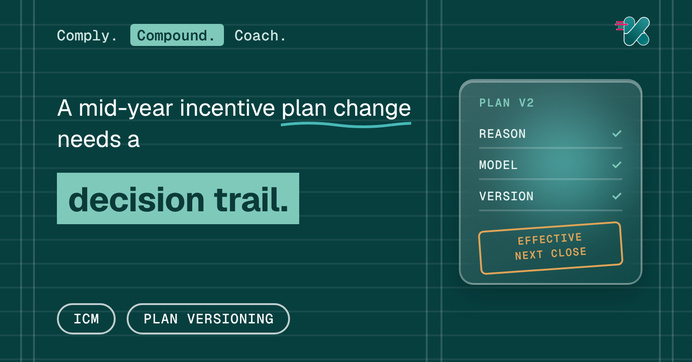
Contests and persistency bonuses are often revised mid-year. When the new rule reaches back over policies already sold, agents dispute it. The discipline behind a mid-year incentive plan change applies: a dated plan version, applied from the next period.
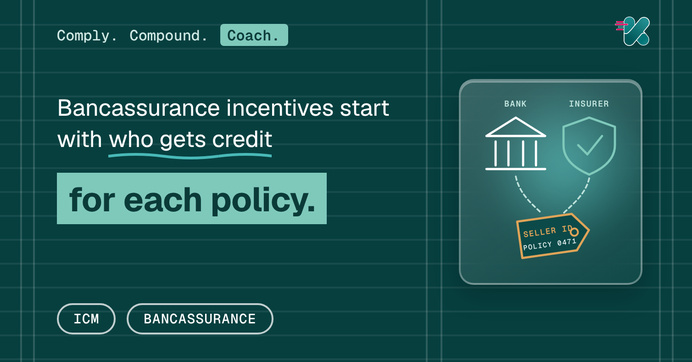
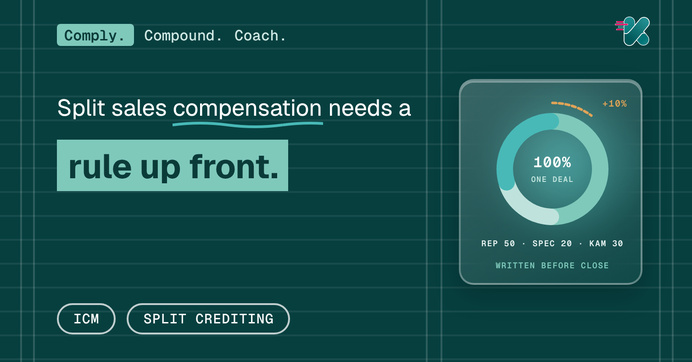
Shared credit adds a fourth layer. When an agent and a bank or a specialist share a policy, the clawback has to reach every share, as set out in split sales compensation.
Recoveries without a trail, overrides left paid and mid-year edits all turn a fair clawback into a dispute.
What insurance agent commission software has to hold
Whatever the final IRDAI rules say, insurance agent commission software has to hold six things.
Every agent's plan as a dated version, with first-year, renewal, persistency and override rules.
Every policy tagged to the agent who sold it, and to every person who earns an override or a share.
Premium, renewal, lapse and cancellation status by month, from the policy system.
The clawback rule for each event, applied to every person paid on the policy.
Each recovery shown as a line against the policy it reverses, in the agent's own statement.
An audit trail of every payout and recovery, for finance and for the regulator.
Commission software for agents is judged on the clawback as much as on the payout.
How Kennect supports agency commission
Across the BFSI deployments we run, agent disputes trace back to payouts and recoveries that cannot be matched to a policy. So we build the cycle around the policy record.
We hold each agent plan as a dated version with its first-year, renewal and override rules. We bring in policy and premium status from the systems that hold it. We calculate payouts and recoveries against each policy, and show agents every line, including the policy behind each deduction.
Finance keeps an audit trail of every payout and every reversal. Agency managers explain a statement in one view. Agents see their persistency and the effect it has on their earnings.
One record per policy, carrying the payout and any clawback, turns a deduction into an explanation.
What this means for agency heads
The consultation closes on 25 October 2026. Whatever the final caps, the direction points toward commission that follows the life of the policy, with clawbacks that rest on a recorded event. Agency plans that write the clawback rule now will be easier to adapt when the rules are final.
One record per policy, carrying the payout and any clawback, turns a deduction into an explanation.
An agent's commission is paid in month one on a policy whose value shows at month 13 and month 61. The clawback rule belongs in the plan before the first lapse.
See how incentive compensation management holds agent plans, payouts and recoveries on one record.