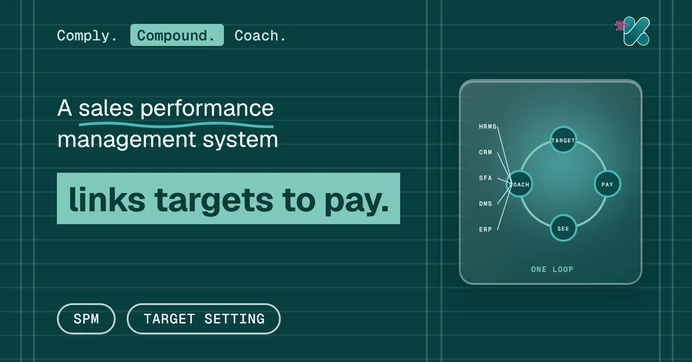
A sales performance management system links targets to pay.
October 28, 2026
Pulkit Agarwal
Pulkit Agarwal
Key Insights
Alexander Group's 2026 survey found 97% of companies changed incentive plans.
In this blog:
What the 2026 research says about plans and targets
The four parts of a sales performance management system
How the loop looks in pharma, banking, insurance and FMCG
The data feeds the system needs, and how Kennect runs the loop
Every week I meet sales heads who changed the plan again. Few can say whether the old plan worked. Targets reached the field late. Payouts were questioned. Managers coached from old numbers.
The fix is a loop. Set the target on time. Pay on the plan as written. Show each rep where they stand, every day. Then let managers coach on what they see. SalesGlobe tracked quota timing. With quotas out in month one, 54% hit quota. About 41% did when quotas slipped to month three.
The 2027-28 plan year starts on 1 April. The targets are being built now.
A question worth asking the head of sales operations this week: when will every rep see next year's target?
Table Of Content
What the 2026 research says about plans and targets
Sales plans changed almost everywhere this year. Alexander Group's 2026 survey shows the scale. 97% of companies changed their sales incentive plans. The same survey found 57% struggle to set accurate quotas. About 65% need better governance and program management. One in five rated their 2025 plans as very effective.
Timing matters as much as design. SalesGlobe's 2026 research tracked when quotas reached sellers. Some quotas went out by the end of month one. There, 54% of sellers hit quota. Where quotas slipped to month three, about 41% did. SalesGlobe also found a habit. 60% base quotas primarily on prior-year results.
Read together, the figures describe one gap. Plans change every year. Targets arrive late and rest on the previous year. One leader in five rates the plan very effective.
Sources: Alexander Group, 2026 Sales Compensation Trends Survey, published 2026, hundreds of companies across 11 industries, exact sample not disclosed · SalesGlobe, Sales Compensation: The Big Issues of 2026, 14 September 2026, two surveys of experienced practitioners, sample not disclosed · neither discloses its country mix
Plans change yearly, and late targets cost attainment early.
What a sales performance management system does
Gartner describes sales performance management, or SPM, in plain terms. SPM platforms help sales operations leaders plan and run two things. Its 2026 research names them: sales territories and incentives. Its Peer Insights listing names further required features. They include quota planning and pay-performance analytics. They also include self-service sales analytics.
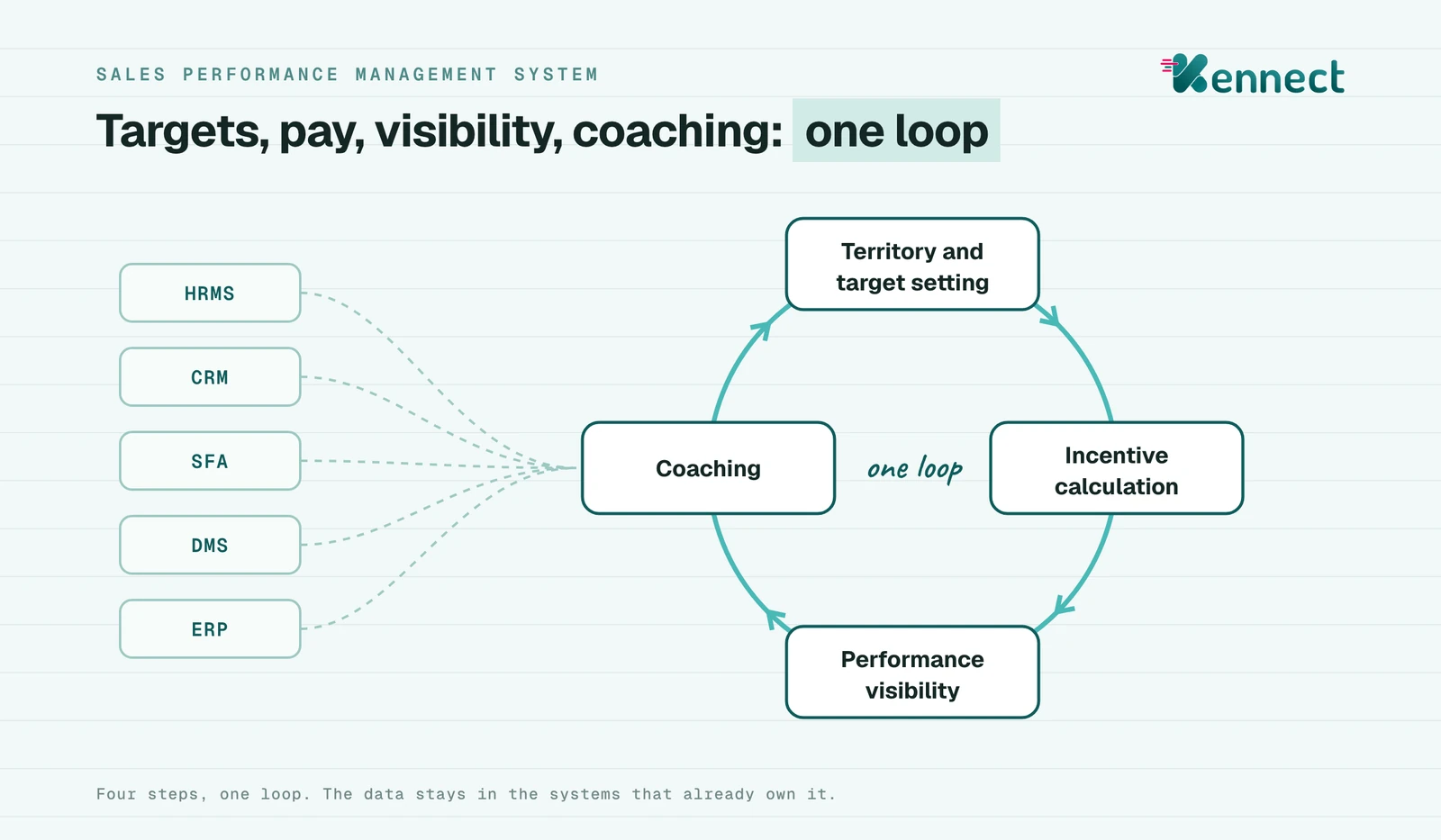
A sales performance management system joins those parts into one loop. Four steps repeat every month.
Set territories and targets. Each rep gets a fair, dated target.
Calculate incentives. Each rep is paid on the plan as written.
Show performance. Reps and managers see where they stand, daily.
Coach. Managers act on what the numbers show.
What the coaching changes feeds next month's targets and next year's plan. The loop then closes.
Four steps, one loop. The data stays in the systems that already own it.
Large companies run these four steps today. Each sits in a different tool, owned by a different team. Targets live in a planning sheet. Payouts live in a finance workbook. Visibility arrives as a monthly PDF. Coaching happens from memory.
A sales performance management system makes four jobs one loop.
The four parts, and the question each one answers
Each step answers a question a CXO already asks.
The four parts of a sales performance management system
Part
Question it answers
Main data source
Territory and targets
Is each target fair and on time?
CRM, SFA, DMS, past sales
Incentives
Was each rep paid correctly?
HRMS, ERP, plan rules
Performance visibility
Does each rep know where they stand?
All of the above, daily
Coaching
Is each manager acting on it?
Visibility data, call logs
The research behind the loop is old and broad. Edwin Locke and Gary Latham reviewed 35 years of goal-setting studies. Specific, difficult goals raised performance across more than 100 tasks. Those studies involved more than 40,000 participants. They also found feedback moderates the effect. Goals with feedback beat goals without it.
A target is the goal. Visibility and coaching are the feedback. An incentive plan without both leaves the rep guessing.
Target setting has its own craft. See how to set sales quotas for targets and quotas. Building targets from prior-year sales has a cost. That cost is target ratcheting.
Source: Locke and Latham, Building a Practically Useful Theory of Goal Setting and Task Motivation, American Psychologist, 2002, review of 35 years of studies, more than 40,000 participants in at least eight countries · laboratory and field settings, few studies on commission plans specifically
Targets set the goal, and coaching supplies the feedback.
How the loop looks in pharma, banking, insurance and FMCG
The four steps hold across industries. The inputs differ.
Pharma and life sciences
India's pharma field force is about 6,00,000 people. Targets are set by brand, territory and doctor coverage. Secondary sales from stockists drive many payouts. Visibility matters because medical representatives work alone, in the field, all day.
Banking and lending
Branch and relationship teams carry targets on several products at once. Loans, deposits, cards and cross-sell each pay differently. A sales performance management system shows each banker their mix. It also shows which product moves them to the next slab.
Insurance
Agency forces are large and turn over fast. IRDAI counted 28.95 lakh individual life agents on 31 March 2024. Insurers terminated 6.98 lakh agents in 2023-24 for failing minimum business targets. Clear targets and early feedback decide who stays.
FMCG and consumer goods
Targets run through distributors and beats. Payouts depend on secondary sales, outlet coverage and lines per call. Data arrives from the distributor management system, often late. The loop works when that data reaches the rep the next morning.
Sources: Kennect claim register · India pharma field force of about 6,00,000 as reported by Hindustan Times · IRDAI Annual Report 2024 as reported by Deccan Chronicle, 2 March 2025, all life insurers, agents terminated for failing minimum business targets
The loop holds in every industry, and the data changes by sector.
The data a sales performance management system needs
The loop runs on five feeds. Each one already exists in a large company.
HRMS for who reports to whom, joining dates and exits.
CRM for opportunities, accounts and credited deals.
SFA for calls, visits and coverage in the field.
DMS for distributor and stockist secondary sales.
ERP for invoices, collections and returns, often in SAP.
The principle is simple. Fill the white spaces, do not disrupt the foundation. HR stays in the HRMS. Sales stays in the CRM and SFA. Finance stays in SAP. The system reads from each and writes the payout back.
Where these feeds stay apart, three things break. Targets go out late. Payouts get questioned. Managers coach from old numbers. See how to manage sales incentives for a sequence.
The system reads from five systems you own and writes payouts back.
How Kennect helps run the loop
Kennect is an AI-led sales performance and incentive compensation management platform. In our field teams, the four steps rarely share one source. So we bring them into one place.
Targets. Plans and targets are held as dated versions. An audit trail and change log record each edit. Targets reach every rep on day one.
Payouts. The calculation engine credits and pays on the plan as written. It recomputes and carries forward when data changes. This is the incentive compensation management software side of the loop.
Visibility. Each rep has a personal cockpit, a slab view and a what-if simulator. Next, AI-powered nudges flag a slab within reach. Leaderboards show standing across the team.
Coaching. The management cockpit shows attainment by role. Then, AI performance insights flag slipping run rates.
Kai, Kennect's AI: Kai writes plain coaching summaries for managers. It writes earnings summaries for reps. Admins build KPIs by describing them in a prompt. Payout deep-dives for leadership are expected January to March 2027. Generative scenario modeling is expected in the same window.
One deployment had about 8,000 representatives. There, the share earning an incentive rose from 34% to 76%. In a pharma deployment, medical representatives who used the app 25 or more days a month raised attainment by 17.4%.
Source: Kennect claim register · one deployment, about 8,000 representatives, same cohort, share earning an incentive 34% to 76% · separate pharma deployment, medical representatives active 25 or more days a month, attainment 106.8% to 125.4%, a correlation from an uncontrolled comparison
When everyone reads the same numbers daily, the loop runs.
What this means for the plan year starting April 2027
The plan for 2027-28 starts on 1 April 2027. Targets for it are being built now. Three decisions can be made before January.
Fix a date by which every rep has a target.
Connect the five data feeds before the plan goes live.
Give every manager one view of the team, updated daily.