Target ratcheting is why strong performers ease off in March.
October 23, 2026
Pulkit Agarwal
Pulkit Agarwal
Key Insights
In SalesGlobe's 2026 research, 60% of companies used prior-year performance as a primary basis for quotas. Every January, I hear a sales head ask why the top reps have gone quiet. The reps, meanwhile, are asking what their target will be in April.
That is target ratcheting at work. When next year's target is built from this year's sales, every extra order in March raises a rep's own bar for twelve months. The reps who slow down are the ones who carried the year, and holding a few orders until April is a rational answer to the plan they were given.
The one field study that measured a fix, at a US contact lens maker with 87 salespeople, found revenue rose about 9% after the plan was redesigned. Five fixes make the same move: publish the target method, blend more than one year, cap the rise, pay the fourth quarter in full and credit each sale to its period.
A question worth asking the head of sales planning this week: how will next year's targets be set, and does the field know yet?
The cost has been measured once in the field. Sanjog Misra and Harikesh Nair studied 87 salespeople at a US contact lens maker whose quotas were revised on past performance. After the firm adopted a redesigned plan, revenue rose about 9%, around $0.98 million a month.
The limit matters as much as the figure. The reading comes from one firm, one product category and one country, and the new plan changed more than the ratchet.
Sources: SalesGlobe, Sales Compensation: The Big Issues of 2026, 14 September 2026, sample not disclosed · Misra and Nair, Quantitative Marketing and Economics, 2011, 87 salespeople over three years · the 9% reflects the full plan change, not ratcheting alone
Six in ten companies base quotas on the previous year, and the one field reading available puts the cost of that habit in revenue.
What target ratcheting is
Target ratcheting sets a rep's next target from their current actual sales plus a growth rate. It is simple to explain and simple to calculate, which is why it is common in pharma and FMCG plans built on growth over the previous year.
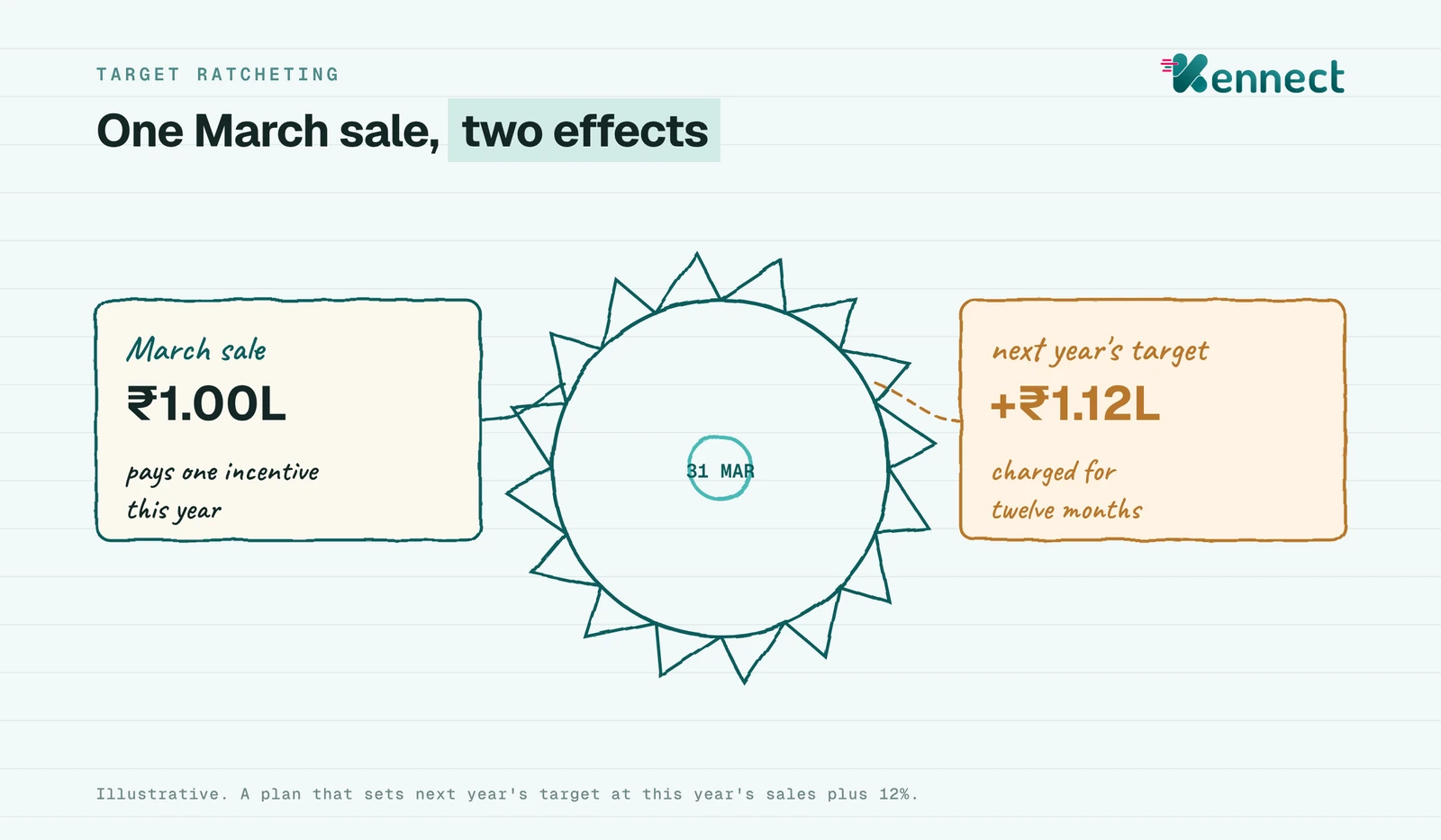
The arithmetic reaches the rep quickly. Take a rep who closes December at 115% of the year-to-date target, on a plan that sets next year's target at this year's sales plus 12%. Every ₹1.00L sold in March pays one incentive this year and adds ₹1.12L to next year's target.
Illustrative. Every extra sale in March is paid once and added to next year's target.
Research has found the response more than once. Bouwens and Kroos studied retail store managers whose targets were set from past sales. Managers who were ahead after three quarters reduced sales activity in the fourth, and met the following year's target more easily as a result.
Under a ratcheted target, every extra sale in March is paid once and charged to the rep for a year.
The three signs of a ratchet-driven slowdown
Each sign has other explanations on its own. Together they point to the plan.
High performers slow down after December
Take the reps who closed December above 110% of their year-to-date target. Compare their January to March run rate with their April to December run rate. A fall confined to this group, while the rest of the field holds steady, points to timing.
Orders cross into April
In a secondary sales plan, watch stockist billing that softens in the second half of March and recovers in the first weeks of April. In a direct or dealer plan, watch the gap between order date and invoice date around 31 March.
Target questions start in February
Reps and first-line managers begin asking how next year's target will be set. Where the answer is this year's actuals plus a growth rate, every rep can work out what an extra order costs them.
A fall confined to high performers, followed by an April recovery, is a target-setting signal.
Three conditions that predict it
Run this test on the plan that closes on 31 March 2027.
Next year's target is built from this year's actual sales, rep by rep.
No limit is set on how far one rep's target can rise in a year.
Payout flattens near the top of the plan, through a cap or a final slab.
Where the first condition holds, expect some slowdown among high performers. Where all three hold, expect it to be large and deliberate.
A plan that meets all three conditions pays its high performers to wait until April.
Five fixes to make before January
The fourth quarter of the financial year starts on 1 January 2027. Each of these fixes can be decided, costed and communicated before then.
Announce the target method early. Publish how next year's targets will be set before 1 January, in writing, with a worked example for one role.
Set targets from more than one year. Blend this year's actuals with a three-year average, the company growth plan and the territory's potential. Then cap how far any one rep's target can rise above company growth. The difference between a target and a quota is set out in how to set sales quotas.
Pay the fourth quarter in the fourth quarter. Lift or remove the cap for January to March and add an accelerator above 100%. Chung, Steenburgh and Sudhir found that salespeople do not slow down once a quota is reached when payout keeps rising. Cost the accelerator before announcing it, as for any mid-quarter scheme.
Credit each sale to the period it happened in. Fix the crediting event and a cut-off time on 31 March. Let sales above 100% in March carry into the next year as credit, and leave the carried amount out of next year's target base.
Read the fourth quarter every week. From the first week of January, compare each high performer's weekly run rate with their April to December average. Read the return by earner band using return on incentives paid.
Any change to the target method mid-year should be recorded as a mid-year incentive plan change, with its reason and effective date.
The March slowdown is decided in the plan before the quarter begins. The target method, the cap and the crediting rule set it, and all three can change before 1 January.
Each fix lowers what an extra March sale costs the rep, and that cost is what the slowdown responds to.
How Kennect helps prevent the March slowdown
In the sales teams we work with, the slowdown is usually spotted in April, after the quarter it cost. So we make the fourth quarter visible while it can still be corrected.
What the rep sees. Each rep sees the target, achievement and current earning on every parameter, the slab reached and a what-if simulator showing what one more order earns. AI-powered nudges tell a rep when the next slab is within reach, and an AI summary explains what they have earned.
What the manager and leadership see. Managers get an AI coaching summary of where each team member stands, and leadership sees attainment by role and earner band in one view. AI performance insights compare run rates across the field.
Costing the fix. Plans and targets are held as dated versions, and carried-forward credit sits in the ledger with its period. Generative scenario modeling, expected between January and March 2027, will let a plan designer describe a fourth-quarter accelerator and see its effect on payouts and cost.
In one Kennect deployment, reps active on the app 25 or more days a month raised attainment by 17.4%.
Source: Kennect claim register · reps active 25 or more days a month, attainment 106.8% to 125.4% · a correlation from an uncontrolled comparison
A fourth quarter the rep and the manager can read every week leaves no reason to hold an order until April.
What this means for the plan that closes on 31 March 2027
Target ratcheting rewards the reps who carried the year with a higher bar the following year. The companies that publish the target method, cap the rise and pay the fourth quarter in full give those reps a reason to sell through March.
The March slowdown is set in the plan before the quarter begins, and every part of it can change before 1 January.
60% of companies base quotas mainly on the previous year's results. A published target method, a capped rise and a costed fourth-quarter accelerator remove the reason to wait.
See how Kennect sets, shares and tracks targets across the field.