Why every life insurance weightage grid needs a date
November 22, 2026
Puneet Gupta
Puneet Gupta
Key Insights
IRDAI's draft caps first-year agent commission on savings plans at 6.25% to 25%, by premium-paying term (IRDAI consultation paper, September 2026).
In this blog:
What a weightage grid does
What goes wrong when grids are not dated
How to manage dated grids
Testing a grid change before launch
Weightage grids look like simple tables. In practice, they carry a life insurer's whole sales strategy. I have watched teams change them monthly to push a product or term. That flexibility is useful. The trouble starts when the old grid disappears. A cancellation arrives. Nobody can say which rate paid the original incentive. Insurers can keep changing grids. They need a clear record of every version.
Ask your sales strategy lead this week: which grid paid last March's incentives?
Table Of Content
What a weightage grid does
A weightage grid sets how much credit each sale earns toward a target. In life insurance, raw premium is rarely the measure. Insurers use weighted premium instead, often called WFYP.
WFYP stands for weighted first-year premium. It is first-year premium multiplied by a weightage. The weightage comes from the grid.
A simple grid might look like this:
Product type
Premium-paying term
Weightage
Term plan
Regular pay, 10 years or more
150%
Savings plan
Regular pay, 10 years or more
100%
Savings plan
Limited pay, under 10 years
70%
Single premium
One time
10%
Illustrative weightages, not client data. Each insurer sets its own.
With this grid, a ₹50,000 term plan counts as ₹75,000 toward target. A ₹50,000 single-premium policy counts as only ₹5,000. Sellers notice the difference quickly.
Grids can also vary by channel, role and region. An agency grid may differ from a bancassurance grid. A grid for new joiners may differ from one for experienced sellers.
A weightage grid is how an insurer tells its sellers what to sell.
Why grids change so often
In many insurers, grids change monthly. Some change mid-month. Teams we have spoken with treat new grids as routine.
The reasons are usually commercial:
Product pushes. A new product launches, or one falls behind plan.
Term mix. Leadership wants more long-term, regular-pay business.
Quarter-end boosts. A product gets extra weightage for the last few weeks.
Channel changes. A bank partner's mix needs a correction.
Regulation. Commission rules shift what each product can pay.
Regulation may soon add to this. IRDAI's September 2026 draft links first-year commission caps to premium-paying term. It also counts incentives, awards and trips inside the cap for intermediaries. A grid that drives agent contests would then sit inside that cap. Payouts to the insurer's own staff would sit inside the lower expense limits. The draft is still under consultation.
Frequent grid changes are a business tool. The process must keep up.
What goes wrong when grids are not dated
Problems usually start with one habit. The new grid is pasted over the old one. The spreadsheet looks tidy, but the history is gone.
Here is what follows:
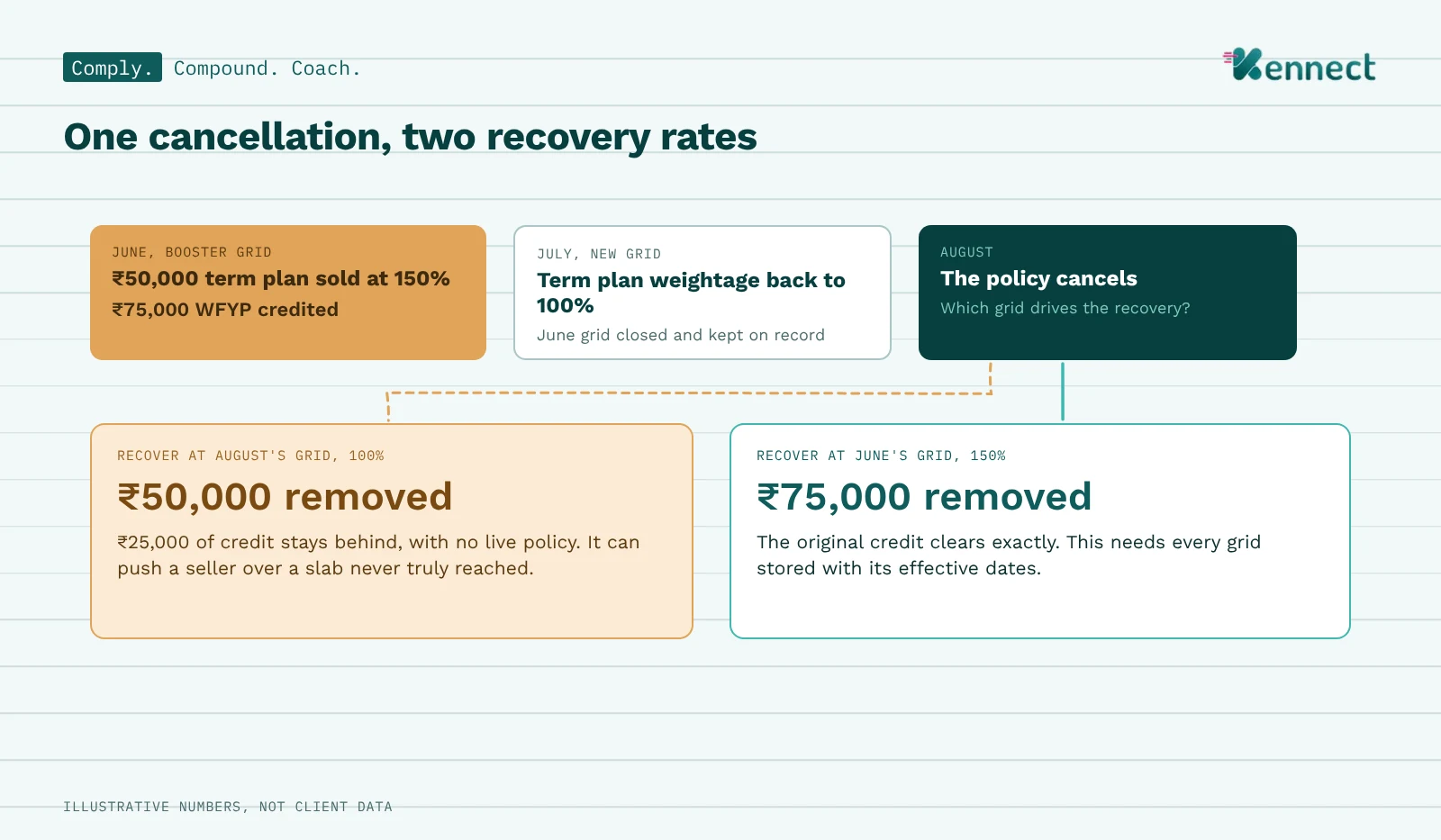
Wrong clawbacks. A policy sold in June cancels in August. The team recovers at August's rate. The original credit came from June's grid. The seller loses more, or less, than they were paid.
Wrong recalculations. Late data arrives for a past month. It gets credited at the current rate.
Late-logged policies. A policy issued on 30 June is logged on 2 July. Nobody knows which grid should apply.
Audit gaps. An auditor asks why a seller earned a certain amount. Nobody can rebuild the answer.
Lost trust. Sellers compare notes and find the numbers do not match.
Here is one case in numbers. A ₹50,000 term plan earns 150% weightage under a June booster. That credits ₹75,000 of WFYP. In July, the weightage returns to 100%. The policy cancels in August.
Dating grids takes a few firm rules, applied every time.
Give every grid an effective-from and effective-to date. A new grid ends the old one. The old grid stays on record.
Decide which date drives the grid. Choose issue date, login date or payment date. Write it down, and use it everywhere.
Keep one grid per scope. Separate grids for channel, role or region avoid hidden exceptions.
Approve before activation. A second person checks each new grid before it goes live.
Apply the original grid to every reversal. Cancellations and recalculations use the grid that paid the money.
Share the grid with sellers. Show the current weightages in the place they check their earnings.
The trigger date in the second rule settles more disputes than teams expect. Late-logged policies are common at month end. Say a June booster runs from 15 to 30 June. A policy is issued on 30 June and logged on 2 July. On an issue-date rule, it earns the booster. On a login-date rule, it does not. Either rule works if it is written down before the month starts.
A new grid should close the old one and keep it on record.
Testing a grid change before launch
A small weightage change can move payouts a lot. Testing it first avoids costly surprises.
One simple approach works well. Take last year's business for the same months. Adjust it for growth and current headcount. Then run the new grid and the old grid side by side.
Compare four things:
Total payout under each grid.
Number of earners who cross their targets.
Product and term mix each grid would reward.
Payout as a share of premium, by channel.
The last measure deserves extra attention now. IRDAI's draft proposes tighter caps and lower expense limits. A grid that pushes payout too high could breach them.
After launch, keep checking. If the mix does not shift as planned, adjust the next grid. The dated history shows exactly what each version achieved.
Test each grid on history first, then judge it by the mix it delivers.
Where Kennect fits in grid management
Spreadsheets can hold dated grids, with discipline. The strain shows when grids multiply across channels, roles and months.
Kennect is an AI-led sales performance and incentive compensation management platform. One rule engine covers every payee type, from agents to bank partners. Life insurers such as Axis Max Life run their incentives on Kennect.
Comply: period-tagged grids. Every grid carries its effective dates and is never overwritten.
Comply: grids by scope. Separate grids for channel, role, region or vintage run side by side.
Comply: approvals. New grids go through maker-checker before activation.
Comply: correct reversals. Cancellations and reruns use the grid that paid the original incentive.
Compound: simulation. KAI Simulations runs a new grid on past data before launch.
Coach: seller visibility. Sellers see current weightages and progress in the app. It can sit inside an app they already use.
KAI in practice. A seller asks why a policy earned less credit than expected. KAI Exceptions answers in plain language. It cites the grid and period that applied. Fewer of these questions reach the payout team.
Pick a system where every credit traces to a dated grid.
Your grids will keep changing.
Your history should not. See grid changes, a booster and a cancellation run on your plan.
A weightage grid sets how much credit each policy earns toward a seller's target. It assigns a percentage by product, premium-paying term, channel or role. WFYP is first-year premium multiplied by that percentage. A 150% weightage on a ₹50,000 policy credits ₹75,000.
WFYP applies product weightages to first-year premium. It reflects the mix an insurer wants. APE, or annualized premium equivalent, standardizes regular and single premiums for reporting. Single premiums count at 10% in APE. Many insurers report on APE but pay sellers on WFYP.
Pick one trigger date, such as issue or login date. Apply it consistently. It matters at month end. Policies are often logged a day or two after issue. Write the rule into the plan so sellers know it in advance.
There is no fixed rule, and many insurers change grids monthly. The safer question is whether each change is dated, approved and tested. A run on last year's data shows the effect on payout and mix.
Yes. Insurers commonly run separate grids for agency, bancassurance and direct sales. Grids can also differ by role, region or seller vintage. Each grid should carry its own effective dates, so channels can change independently.