How to handle incentive clawbacks without losing field trust
November 20, 2026
Puneet Gupta
Puneet Gupta
Key Insights
From 1 January 2027, banks must refund the full amount on any mis-sold product (RBI, June 2026).
In this blog:
Why clawbacks break trust
Five decisions behind a fair clawback policy
Running reversals every cycle
What the seller should see on a recovery
Sellers I have met accept that some business reverses. A policy cancels. A loan is foreclosed. An account closes early. What they do not accept is finding out from a smaller payout. In my experience, the anger is rarely about the amount. It is about the surprise. Payout teams feel it too. They spend days explaining numbers they did not design. A clear policy fixes much of it. Run it monthly, and show it to the seller.
Ask your payout lead this week: can every seller see why their last recovery happened?
Table Of Content
Why clawbacks break trust
A clawback recovers incentive or commission already paid. It happens when the business behind it reverses. In insurance, banking and lending, that is routine.
The principle is fair. Sellers should not keep pay for business that did not stick. Yet clawbacks are a frequent source of payout queries.
Three things usually go wrong:
The recovery arrives without context. The seller sees a lower payout and no reason.
The rule looks different from the original. Rates or grids changed in between, so the numbers do not match.
Recoveries arrive in bulk. Months of reversals land in one cycle, and a payout turns negative.
Each of these creates a query. Queries reach managers, then payout teams, then HR. Each one takes senior time away from other work.
When recoveries feel random, sellers stop trusting every number. That includes the numbers that are correct. Trust lost here shows up as slower selling and higher attrition.
Regulators are raising the stakes. RBI's final directions take effect on 1 January 2027. Banks must then seek customer feedback within 30 days of a sale. Where mis-selling is established, the bank refunds the full amount. It also compensates any loss. Bank incentive policies must not encourage mis-selling. IRDAI's September 2026 draft proposes clawback of commission on mis-sold insurance policies.
A feedback call in the first month will surface reversals earlier. Each one needs a recovery the seller can follow.
Points or revenue credit tied to the account or product
NBFC and housing finance
Loan cancellation, sanction reversed before disbursal, early foreclosure, early default
Incentive on the case, in full or in part
Source: IRDAI Master Circular on Life Insurance Products, 12 June 2024, on the 30-day free-look period
Two further sources cause as many disputes as cancellations:
Wrong attribution. A colleague logged the case, and the credit went to them.
Late hierarchy changes. A transfer or promotion was recorded after the payout.
Both need the same fix as a cancellation. Recalculate, show the difference, and recover or pay the gap.
List every reversal trigger before writing a single recovery rule.
Five decisions behind a fair clawback policy
A clawback policy is a set of choices. Make them once, write them down, and share them with the field.
1. Full or proportionate recovery?
Full recovery takes back everything paid on the case. Proportionate recovery takes back a share. For example, it could reflect how long the policy or loan ran. Some lenders recover a fixed amount instead. Choose by product, and keep it consistent.
2. Which rule applies?
Use the rule that paid the money. If a grid or rate changed since, apply the original one. The recovery then mirrors the credit exactly. This needs every grid and rate stored with its period.
3. How far back?
Set a recovery window, such as six or twelve months. Many teams skip older reversals because they take too long by hand. A skipped recovery is money lost. It is also unfair to sellers whose numbers are correct.
4. How is it recovered?
Many firms adjust against the next payout. If that payout is too small, carry a negative balance forward. Some firms also cap how much is recovered in one cycle. That protects take-home pay in a bad month. Agree on the treatment with payroll and tax teams too. Tax may already have been deducted on the original payout.
5. Who is affected?
A reversal can touch more than one person. Managers paid on team totals may also lose credit. A reassigned case moves credit from one seller to another. Partners such as DSAs, corporate agents and brokers can be affected too. Decide upfront whether these knock-on changes apply.
Write the five decisions into the plan document, and share it with every seller.
Running reversals every cycle
Many teams treat recalculation as a year-end clean-up. The backlog peaks then. Running it every cycle keeps each recovery small and easy to explain.
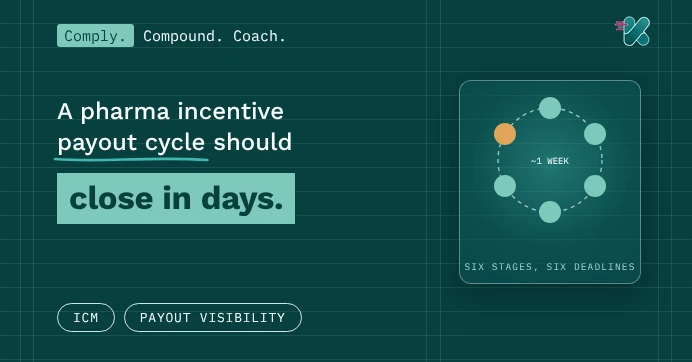
A monthly reversal cycle has six steps:
Refresh the data by key. Update records by policy number or loan ID. Whole-file replacements lose history.
Lock what was paid. Keep the original payout for every past period untouched.
Recalculate affected periods. Use the rules and hierarchy that applied at the time.
Show the difference. Compare old and new amounts per person and per case.
Approve the changes. Route recoveries through the same approvals as payouts.
Settle and carry forward. Adjust against this cycle, and roll any balance into the next.
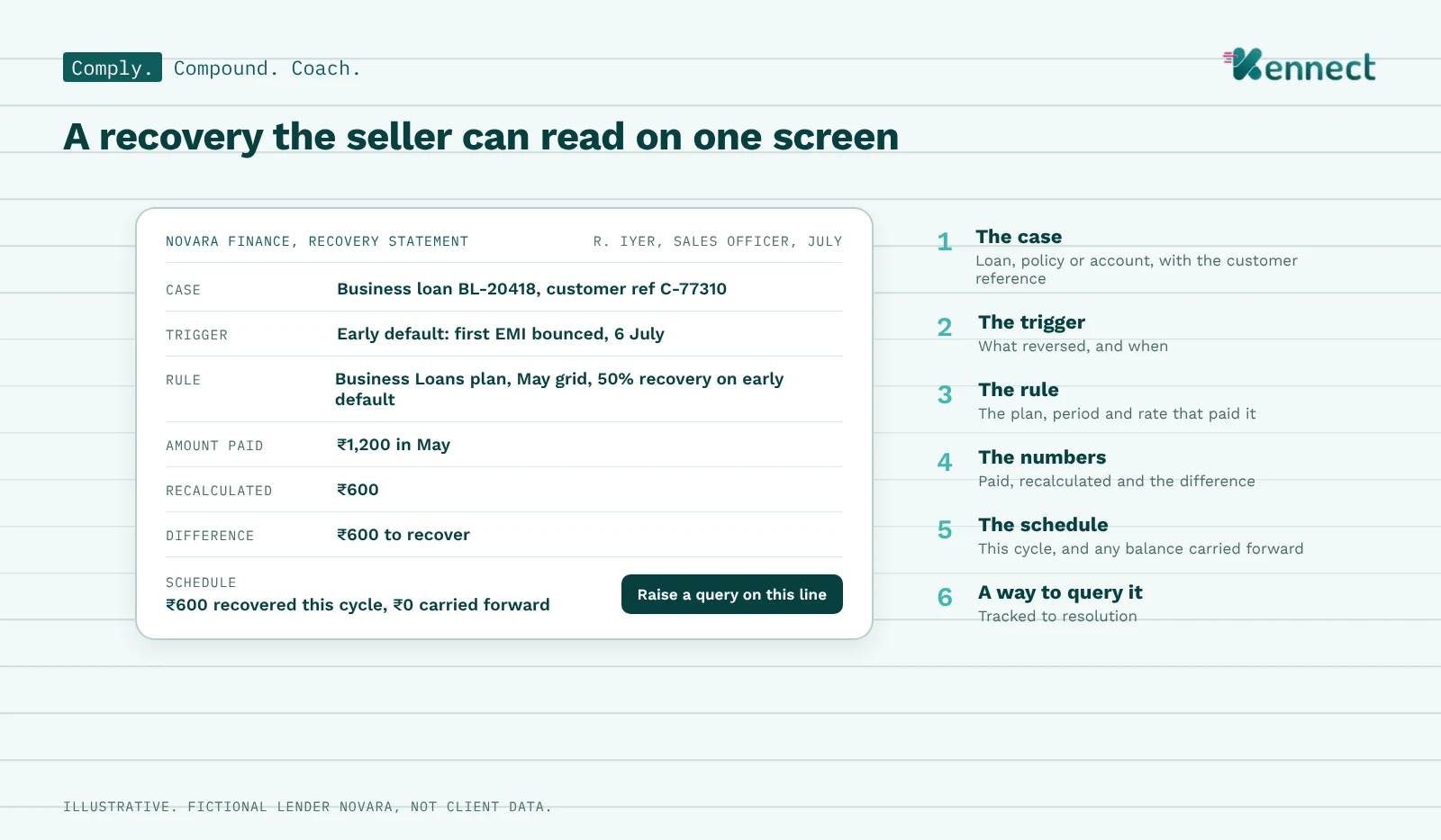
Here is an example from lending. A sales officer earns ₹1,200 on a business loan in May. The loan bounces its first EMI in July. The plan recovers half the incentive on early defaults. So ₹600 is recovered in July's cycle. The officer's statement shows the loan, the rule and the amount.
The same steps work for a reassigned case. The old seller sees a recovery. The new seller sees a credit. Both see the reason.
Small monthly recoveries are easier to accept than one large surprise.
What the seller should see on a recovery
A recovery statement answers the seller's questions before they ask. Keep it short and specific.
It should show:
The case. Policy number, loan ID or account, and the customer reference.
The trigger. Cancellation, lapse, early default or reassignment, with the date.
The rule. The plan, period and rate that originally paid the incentive.
The numbers. Amount paid, amount recalculated and the difference.
The schedule. What is recovered this cycle, and any balance carried forward.
A way to query it. A button to raise a question on that line, tracked to resolution.
Where it appears matters too. Sellers should not need a new login to find it. Place it in the app they already use. A short message works too.
Managers need a team view of the same data. They can then spot patterns. One seller may have many early cancellations. Recoveries then feed coaching as well as payroll.
A recovery a seller can read on one screen raises fewer queries.
Where Kennect fits in the clawback process
Spreadsheets can handle a few reversals a month. They struggle once recalculation spans many periods, people and plans.
Kennect is an AI-led sales performance and incentive compensation management platform. One rule engine covers every payee type. That includes employees, DSAs, agents, brokers and channel partners. Insurers such as Star Health and Axis Max Life run incentives and commissions on Kennect.
For clawbacks, the platform covers each step above:
Comply: period-tagged rules. Every grid and rate is stored with its period. Recoveries use the original rule.
Comply: hierarchy history. Reporting lines are stored month by month, with effective dates.
Comply: locked payouts and reruns. Past payouts stay locked. Reruns show the difference per person and per case.
Comply: configurable recovery rules. Full, proportionate or fixed recoveries, with negative balances carried forward.
Comply: approvals and audit. Recoveries go through the same approvals as payouts. Every change is logged.
Coach: seller statements. Recoveries appear in the Kennect app. They can also sit inside an app the seller already uses. Questions go through Query and Dispute Management.
KAI in practice. A seller asks why their payout dropped. KAI Exceptions explains the recovery case by case. It traces each one to source data. A sales head asks which teams or products drive reversals. KAI Insights answers by team and product.
Choose a system that explains every recovery as clearly as it calculates it.
Reversals will keep coming.
The surprises do not have to. Run a cancellation, a reassignment and an early default through one of your plans on Kennect.
An incentive clawback recovers pay already given when the business behind it reverses. Common triggers include a free-look cancellation within 30 days. Loans cancelled before disbursal and early defaults count too. The recovery is usually adjusted against the seller's next payout.
It depends on the product. Either way, write the choice into the plan. Full recovery suits cancellations within a short window, such as free-look cancellations. Proportionate or fixed recoveries suit later reversals, such as an early loan default. Applying one approach consistently matters more than which one is chosen.
The unrecovered amount is usually carried forward as a negative balance. It is then adjusted against future payouts until it is cleared. Some firms cap the recovery in a single cycle. The cap is often a share of that month's earnings.
Many plans set a fixed recovery window, often six to twelve months. Running recalculation every month keeps each recovery small. It also avoids a year-end backlog that teams tend to skip.
Reassign the case, recalculate both people's payouts and show each of them the difference. The original seller sees a recovery, and the correct seller sees a credit. Any manager paid on team totals should be recalculated too.