IRDAI commission caps change how insurers should pay for sales.
October 30, 2026
Puneet Gupta
Puneet Gupta
Key Insights
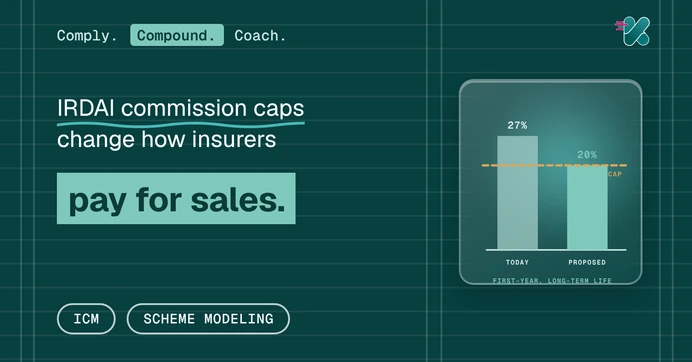
Stress-test the next incentive budget at 20%. IRDAI's consultation paper proposes that cap on first-year commission for long-term life policies through distributors, against close to 27% today.
In this blog:
The proposed caps by product and channel, and what applies today
What banks are saying about bancassurance income
The cap-ready incentive plan in five moves
What changes for life and health insurers
In my conversations with insurance CFOs, the first question is the number. What would next year cost at the cap? The second question is harder. What should that smaller budget reward? I think the answer is policies that stay on the books.
Banks see the same change from the other side. Bandhan Bank expects about ₹200 crore less third-party income a year. Canara Bank puts its hit under ₹200 crore. Central Bank of India sees bancassurance fees falling from ₹76 crore to ₹49 crore. Branches will shift to other products. RBI's conduct rules apply there too.
A question worth asking the head of distribution this week: What would next year's incentive cost look like at the proposed caps?
Stress-test the next incentive budget at 20%. IRDAI's consultation paper proposes that cap on first-year commission for long-term life policies through distributors, against close to 27% today.
In this blog:
The proposed caps by product and channel, and what applies today
What banks are saying about bancassurance income
The cap-ready incentive plan in five moves
What changes for life and health insurers
In my conversations with insurance CFOs, the first question is the number. What would next year cost at the cap? The second question is harder. What should that smaller budget reward? I think the answer is policies that stay on the books.
Banks see the same change from the other side. Bandhan Bank expects about ₹200 crore less third-party income a year. Canara Bank puts its hit under ₹200 crore. Central Bank of India sees bancassurance fees falling from ₹76 crore to ₹49 crore. Branches will shift to other products. RBI's conduct rules apply there too.
A question worth asking the head of distribution this week: What would next year's incentive cost look like at the proposed caps?
Table Of Content
IRDAI commission caps: the numbers in the consultation paper
IRDAI released a consultation paper on 23 September 2026. The paper is titled Recalibrating Economics of Insurance Distribution. Comments were first due on 25 October 2026. The window was later extended to 31 October, as Cafemutual reported.
These are proposals. The final rules may differ. No effective date has been announced. Year one of the expense glide path is FY2027-28, per Khaitan & Co's summary. That is the plan year your team is about to budget.
The IRDAI site does not allow automated access. So every figure below is as reported by secondary summaries.
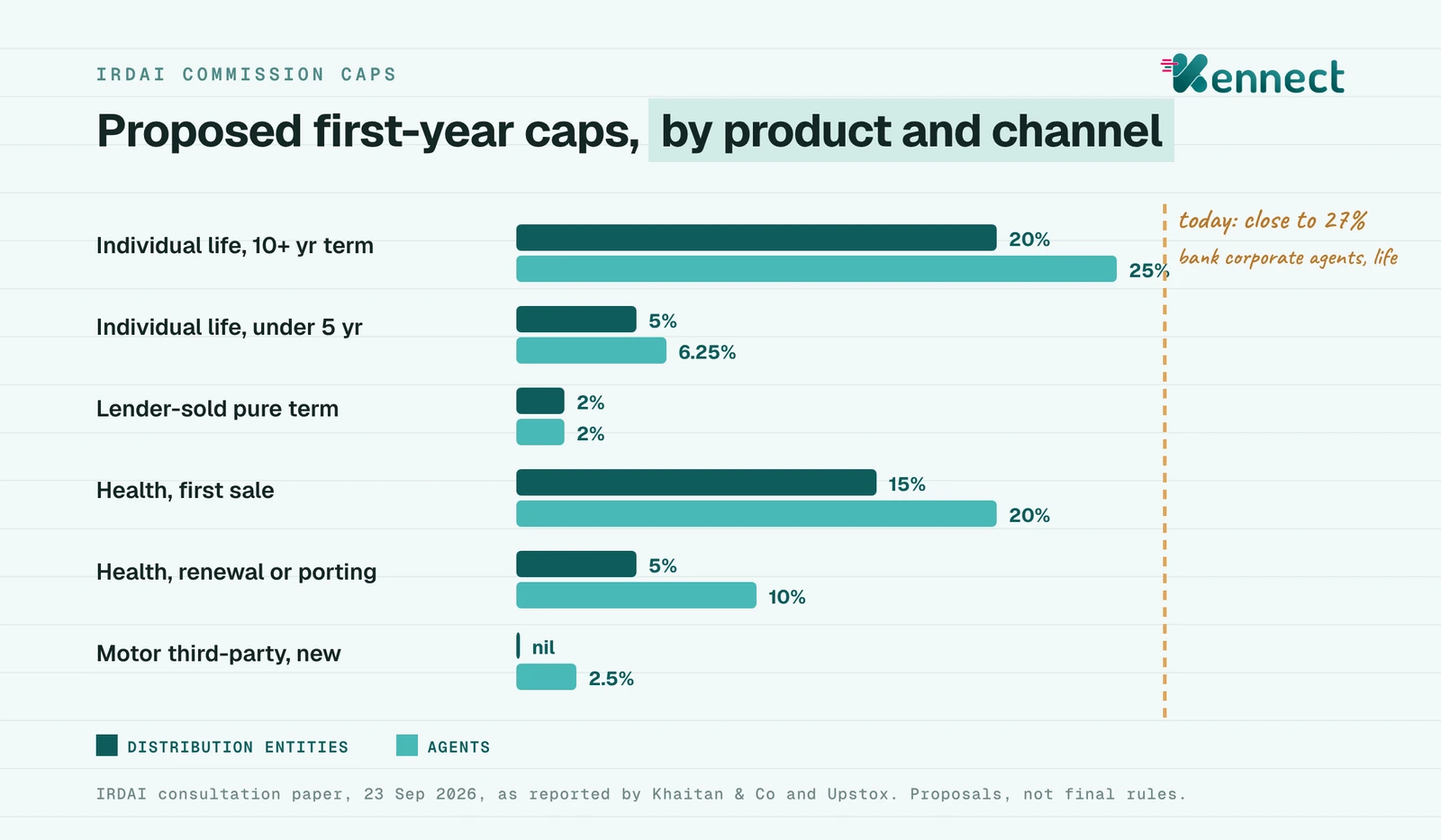
Start with what you pay today. First-year commission to bank corporate agents averages close to 27% of premium. Khaitan reports that figure. So does Upstox, in its report. Khaitan puts other corporate agents at 61%. Rewards and incentives add 30% to 60% more, per Upstox.
The proposed caps are set by product, premium term and channel.
Proposed first-year commission caps, as reported (% of premium)
Product
Distribution entities
Agents
Individual life, premium term 10 years or more
20%
25%
Individual life, premium term below 5 years
5%
6.25%
Pure term, one upfront premium, sold by a lender with a loan
2%
2%
Individual health, first sale
15%
20%
Individual health, renewal or porting
5%
10%
Motor third-party, new vehicle
Nil
2.5%
For comparison: life, bank corporate agents today
Close to 27%
-
Proposed caps as reported from IRDAI's consultation paper of 23 September 2026. The dashed line marks close to 27% today.
The caps sit inside a tighter cost ceiling. Expense of management is what insurers may spend running the business. For life insurers, the proposal is 15% of gross premium. That applies within two years. It falls to 12.5% within five. General insurers would move from 30% to 25% in two years. They reach 20% in five.
The paper also explains why. Upstox reports the numbers for life corporate agents. Their remuneration rose about 125% from FY2023 to FY2025. It went from about ₹9,580 crore to ₹21,600 crore. New business premium from them rose about 28%. It went from about ₹63,000 crore to ₹80,000 crore.
Three conduct rules travel with the caps. Bank and NBFC staff may not be given volume-linked sales targets. Commission is clawed back where mis-selling is established. Every policy carries a unique identifier for the person who sold it.
Sources: IRDAI, Recalibrating Economics of Insurance Distribution, consultation paper, 23 September 2026, as reported by Khaitan & Co (29 September 2026), Upstox (24 September 2026) and Cafemutual (27 October 2026) · the 125% and 28% growth figures also appear in SuperKalam and Insurance Business; the rupee figures appear in Upstox · the seller identifier and the folding of rewards and contests into commission are reported by SuperKalam · the IRDAI primary was not opened directly · proposals, with no effective date announced
On long-term life, 20% against close to 27% cuts first-year commission by about a quarter.
What applies today under the 2023 regulations
Until new rules are notified, the current regime stands. The current rules are the IRDAI (Payment of Commission) Regulations 2023. They were notified on 26 March 2023. They took effect on 1 April 2023.
Those rules removed product-wise commission limits. In their place, each insurer pays commission under a board-approved policy. Total commission must stay within the expense of management limit. This is set out in JSA's note on the 2023 regulations.
For three years, CFOs have had room inside one envelope. The consultation paper proposes to bring hard caps back. It also proposes to fold rewards and contests into the commission definition.
That changes how your board policy is read. A contest that sat outside base commission would count against the cap.
Source: JSA, New Regulations on payment of commission and expenses of management, 2023 · IRDAI (Payment of Commission) Regulations 2023, notified 26 March 2023, effective 1 April 2023
Today's rules ask for a board-approved policy inside one expense ceiling. The proposal adds a cap on every line.
What banks are saying about bancassurance income
Banks see the same change from the other side. Business Standard reported on 29 October 2026 how banks plan to respond.
Bandhan Bank expects about ₹200 crore less third-party income a year.
Canara Bank sees ₹120 crore to ₹145 crore a year on life distribution. It expects the overall hit to stay under ₹200 crore.
Central Bank of India expects bancassurance fees to fall about 33%. That is from ₹76 crore to ₹49 crore.
HDFC Bank called the rate cut quite high. It named persistency and lower insurance cost as factors to watch.
The offsets are named too. Banks point to mutual fund distribution, forex, trade finance and credit cards. Some expect lower premiums to lift insurance volumes.
Each offset moves branch staff toward another product. That shift needs its own incentive design. The RBI's conduct directions were issued on 15 June 2026. They take effect on 1 January 2027. Staff incentives must not lead to pressure selling or mis-selling, as Outlook Money reported. That applies to every product a branch sells.
Sources: Business Standard, How Indian banks are planning to offset Irdai's insurance commission cuts, 29 October 2026 · Bandhan figure via Moneycontrol and Central Bank figure via The Economic Times, as cited by Business Standard · public statements by bank management, not audited figures · Outlook Money, 16 June 2026, on RBI's amended directions on the sale of financial products
Banks will replace some insurance fees. RBI's conduct rules cover the new schemes too.
The cap-ready incentive plan in five moves
A cap-ready incentive plan runs at the proposed caps from day one. It also pays for the conduct the rules ask for. Five moves get you there before 1 April.
Move 1: cost four lines this quarter
Your sales incentive budget has four lines. Cost each one today and at the cap. Accrue them monthly, as set out in forecasting commission costs.
First-year commission.
Renewal commission.
Contests and rewards.
Clawback recoveries.
Line 3 matters because the paper proposes to count contests as commission. Line 4 is often missing from budgets. It belongs there once clawback becomes a rule.
Move 2: run the plan three ways
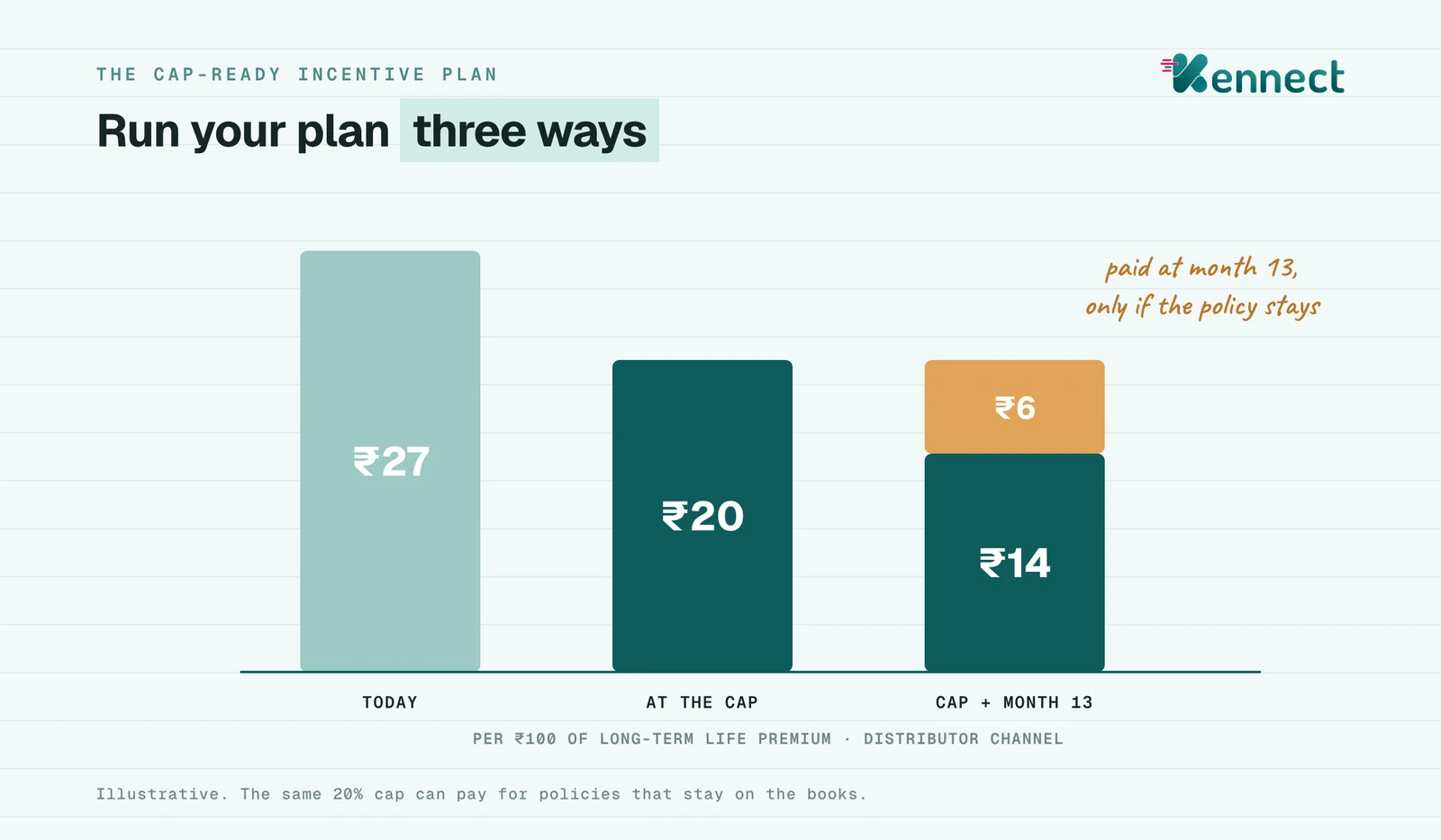
Run next year's plan three ways. Run it as it stands today. Run it at the proposed cap. Then run it at the cap, holding part to month 13.
Illustrative: first-year commission per ₹100 of long-term life premium, through a distribution entity
Scenario
Paid at sale
Paid at month 13
Total
Today
₹27
-
₹27
At the cap
₹20
-
₹20
At the cap, part held to month 13
₹14
₹6, if the policy is in force
₹20
Illustrative. The same 20% cap can be paid in a way that rewards policies that stay on the books.
The third run costs the same as the second. It pays differently. Part of the money waits for the policy's first year. See incentive plan scenario modeling for the method.
Move 3: pay for policies that stay on the books
Under a cap, a lapsed policy costs you twice. You pay to acquire it, then lose the renewal. So design every slab around retention.
Add a suitability check to each slab. A sale counts once the needs check is on file.
Measure persistency at month 13 and month 61. Tie part of the payout to each.
Write the clawback rule before the first lapse. Set separate windows for free-look, early lapse and established mis-selling.
Tag every policy with its seller. The paper proposes a unique identifier for this. Your plan should use it for crediting and clawback.
Move 4: for banks, rebuild branch incentives without volume targets
The paper proposes no volume-linked sales targets for bank and NBFC staff. RBI's directions point the same way. So rebuild the branch scheme on three measures.
Suitability of each sale.
Persistency of each policy.
Service quality after the sale.
Apply the same logic to mutual funds, cards and forex. Practical scheme designs for branches are covered in bancassurance incentive management.
Move 5: lock and version the plan before 1 April
Approve the plan before the year opens. Give it a dated version. Record who approved it and why.
The final rules may arrive after your plan is live. When they do, you will change the plan mid-year. Treat that as a mid-year incentive plan change. Give it its own effective date. A versioned plan shows which rules applied to which policy.
A cap-ready plan answers four questions. What does each line cost at the cap? How much waits for month 13? Which rule reverses a payout? Which version of the plan paid it?
The cap fixes how much you can pay. The five moves decide what that money rewards.
What changes for life and health insurers
The caps differ by channel. Agents get a higher cap than distribution entities on each line. On long-term life, the gap is 25% against 20%. On health first sales, it is 20% against 15%.
That gap is a design choice for you. An insurer with a large agency force has more headroom per policy. An insurer led by bancassurance has less.
Renewal commission changes as well. Khaitan's summary reports a renewal escalator for individual life. From the sixth policy year, renewal commission rises 0.5 points. It rises again every three years. It stops at 7%. The paper does not say if this covers distribution entities.
For health insurers, the step down is large. A first sale is capped at 15% or 20%. A renewal or a port drops to 5% or 10%. So the economics of a health book shift toward retention. See how Kennect runs insurance commission software for agents and banca.
Upstox reports one more detail. Rural and small-town sales may earn rewards above these limits. Bandhan Bank expects higher commissions in Tier-III and Tier-IV cities. Your plan can reflect that by geography. The insurer-side design detail is covered in insurance agent commission software.
Life insurers gain from renewal and persistency design. Health insurers gain from retention and porting design.
How Kennect helps finance teams plan for the caps
At insurers and banks, finance often sees commission cost after the quarter. We bring it forward to the day the plan is designed.
Dated plan versions. Every plan and target is held as a dated version. You can show which version paid which policy.
Audit trail. Every change to a plan, slab or payout is logged. The log shows who and when.
Clawback recompute and carry-forward. When a policy lapses, Kennect recomputes the payout. The recovery is carried forward against the payout it reverses.
Management cockpit. Leadership sees incentive cost by channel, product and plan in one view.
Query handling. Reps and managers raise payout questions in the app. Each query is tracked through query management.
Kai, Kennect's AI: an admin describes a 13th-month persistency KPI. Kai builds it from that prompt. This is live today. Kai explains each payout to the rep. Admins trace any payout to the plan and KPIs behind it. Tracing to source data follows by end of December 2026. Kai also helps resolve rep and manager payout queries today. Generative scenario modeling is expected January to March 2027. Finance will describe a plan change. Kai will show the effect on payouts and cost.
A versioned, traced plan shows the board how each rupee was paid.
What this means for the FY2027-28 plan
The caps are proposals today. The budget for FY2027-28 is set in the next few months. So cost the plan at today's rates and at the caps. Hold part of the payout for persistency. Write the clawback rule now. Lock the plan with a dated version before 1 April.
A plan built for 20% now needs no rebuild if the caps are confirmed.
IRDAI's consultation paper proposes a 20% cap on first-year commission for long-term life policies through distributors, against close to 27% today. A cap-ready plan costs four lines, holds part of the payout for persistency and is versioned before 1 April.
See how Kennect supports finance and compliance teams.