Forecasting commission costs in a bank starts with accrual.
October 27, 2026
Pralok Chhajed
Pralok Chhajed
Key Insights
Under Ind AS 19, short-term benefits are recognized as service is rendered.
In this blog:
What Ind AS 19 and the RBI ask of a bank
Why a bank's incentive forecast drifts
Forecasting commission costs by scheme, month by month, at three points
How Kennect helps finance accrue and forecast incentive cost
In banks, I often see the incentive line set once in March. Schemes then change every quarter. The cost shows up in the month a scheme pays. The months that earned it look cheaper than they were.
The fix is a monthly accrual, scheme by scheme. Read it at plan, at mid-month and at close. Compare it with each payout when it lands.
This matters more from 1 January 2027. The RBI's conduct directions start then. Cross-sell schemes may be redesigned, and some sales may be reversed. Each change has a cost to accrue.
A question for the financial controller this week: which schemes do we accrue monthly?
Table Of Content
What the accounting standard and the regulator now ask of a bank
Indian accounting already sets the timing. The rule sits in Ind AS 19, Employee Benefits. Short-term benefits are recognized as service is rendered. Paragraph 11 asks for the undiscounted amount expected to be paid. It is booked as an accrued expense. Anything already paid is deducted.
Paragraph 19 applies the same rule to bonus and profit-sharing payments. Two conditions apply. The entity has a present legal or constructive obligation. A reliable estimate of it can be made. Under paragraph 22, a formula in the plan meets the second test. Bank incentive schemes usually carry one.
The regulator has added a second reason to look closely. On 15 June 2026, the RBI issued new conduct directions for commercial banks. They take effect on 1 January 2027. Paragraph 85U says a bank's policies must not create incentives for mis-selling. Bank employees may take no incentive from a third-party product provider. Under paragraph 85Z, mis-selling brings a full refund to the customer.
Plans keep moving as well. The Alexander Group's 2026 survey found 97% of companies changed their plans. Incentive budgets were projected to rise 2.7%.
Sources: Ind AS 19, Employee Benefits, paragraphs 8, 11, 19 to 22, as notified under the Companies (Indian Accounting Standards) Rules, 2015 · RBI/2026-27/115, Commercial Banks Responsible Business Conduct Second Amendment Directions, 15 June 2026, effective 1 January 2027 · Alexander Group, 2026 Sales Compensation Trends Survey briefing, hundreds of companies across 11 industries, exact sample not disclosed · confirm your own accrual policy with your auditor
The standard sets when incentive cost is booked. The regulator now asks how it is earned.
Why a bank's incentive forecast drifts
A bank pays incentives across several schemes at once. Branch staff earn on deposits and CASA growth. Relationship managers earn on assets and fee income. Cross-sell schemes pay on insurance and investment products. Each scheme has its own period, slabs and payout month.
The forecast drifts for three reasons.
The budget is set once. Finance fixes an annual incentive line in March. The schemes change through the year. The line rarely does.
Cost is booked when paid. A quarterly cross-sell scheme lands in one month. The three months that earned it show nothing.
Mid-year resets go unpriced. An October target change alters every month already worked. Book the effect of a mid-year incentive plan change when it is approved.
Source: WorldatWork with OpenSymmetry, Return on Sales Expense, 13 July 2021 · 364 respondents, May 2021, across financial services, IT, pharma, manufacturing and retail · not India-specific
Booked on payment, incentive cost lands in the wrong month.
Forecasting commission costs by scheme, month by month
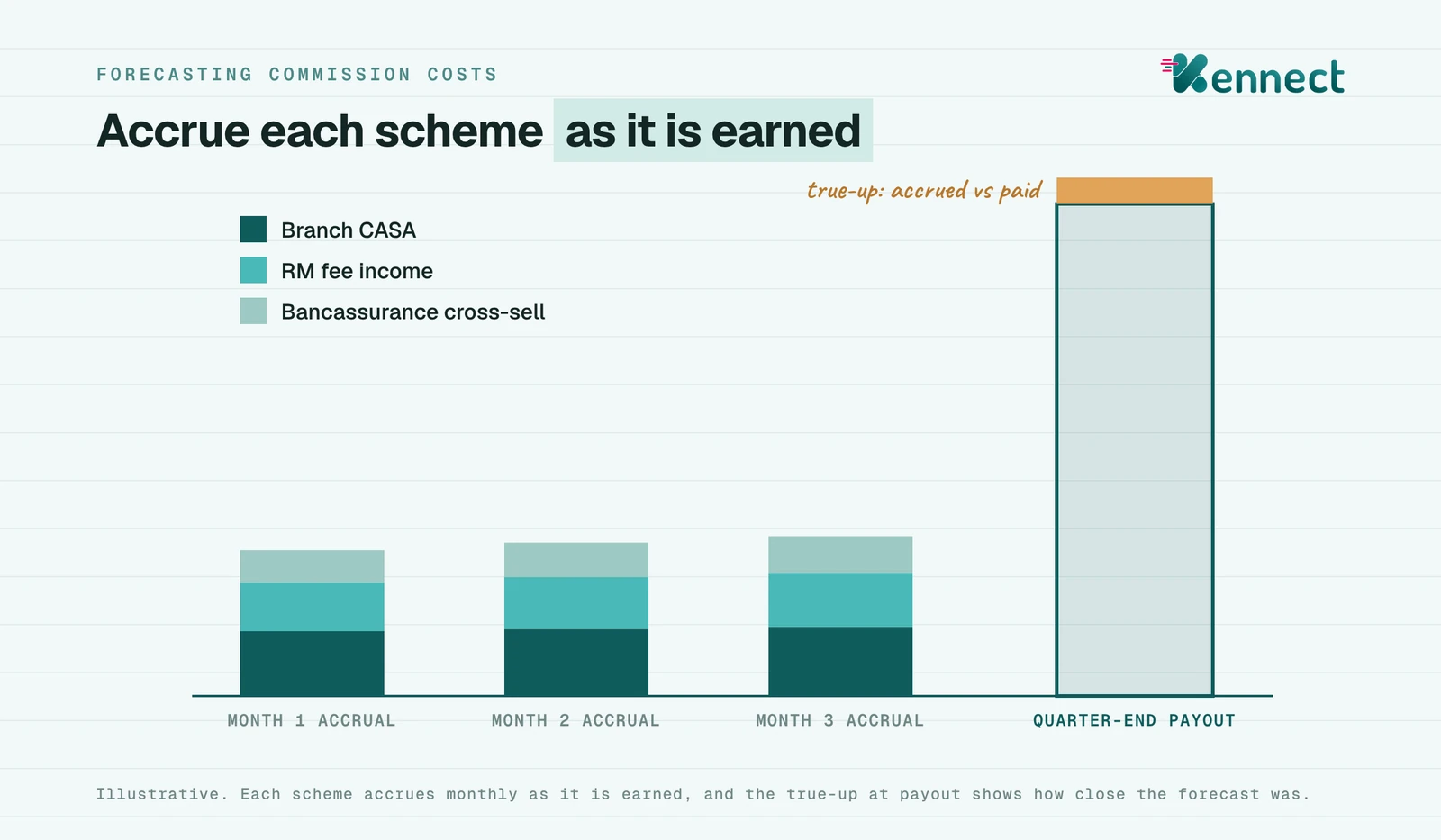
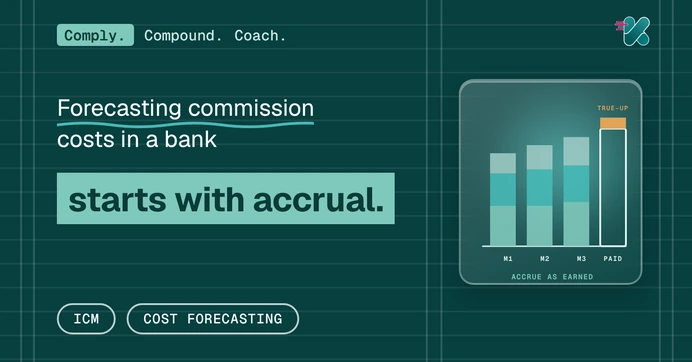
Forecasting commission costs in a bank starts with a monthly accrual. Each scheme gets its own line. Each line is accrued as the month runs, from live data.
The method has four steps.
List every live scheme. Include the branch scheme, the RM scheme and each cross-sell contest. Note the period, the payout month and the formula.
Accrue each month's share. Run the formula on month-to-date results. Book the expected payout for the service rendered so far.
Adjust for slabs. A slab plan does not accrue in a straight line. Estimate the slab each earner is likely to finish in. Revise the estimate each month.
True up at payout. When the scheme pays, compare the payout with the accrued total. Book the difference and record why it arose.
Illustrative. Each scheme accrues monthly as it is earned, and the true-up at payout shows how close the forecast was.
Add the scheme lines together. The total is the month's sales compensation cost. It reaches the P&L in the month the work was done.
Each rupee of incentive belongs in the month that earned it.
Forecast at three points: plan, mid-month and close
One forecast a year cannot track schemes that change each quarter. Three readings a month can.
Three forecast points for a bank's incentive cost
Point
When
Inputs
What finance reads
Plan
Before the period opens
Targets, slabs, headcount
Expected cost by scheme
Mid-month
Around the 15th
Month-to-date results
Run rate against plan
Close
Month end
Final month results
Accrual to book
True-up
Scheme payout month
Approved payout
Gap from accrual, with reasons
At plan. Cost every scheme before it opens. Use expected attainment by earner band, not the target alone. A new cross-sell contest is costed here, before it pays. The method for this sits in incentive plan scenario modeling.
At mid-month. Read run rate against plan by scheme and region. A cross-sell scheme running hot is visible with two weeks left.
At close. Book the accrual from the month's final results. This is the number the auditor will ask about.
Read actual against accrual every time a scheme pays. A true-up within a narrow band means the accrual method works. A wide gap points to a slab estimate or a data feed.
Three readings a month make the incentive line a forecast.
What the 2027 conduct directions change in the forecast
The RBI directions take effect on 1 January 2027. That is the start of the fourth quarter of FY 2026-27. A bank's incentive forecast for that quarter should reflect them.
Three changes are worth modeling now.
Third-party cross-sell incentives. Employees may receive no incentive from the product provider. Any incentive the bank keeps is its own. It needs its own accrual line.
Measures that reward suitability. Paragraph 85U asks that policies not create incentives for mis-selling. Schemes paid on volume alone may be redesigned. Each redesign changes the cost curve.
Refunds and reversals. Where mis-selling is established, the bank refunds the customer in full. Decide whether the incentive on that sale is reversed. If it is, forecast the reversal as a reduction in liability.
Legal and compliance teams will read the directions in full. Finance can price the options while that work runs. Banks run these schemes in one place with BFSI sales incentive software. For the plan document finance signs, see how to manage sales incentives.
Each conduct change is a plan change, with a cost to accrue.
How Kennect helps finance accrue and forecast incentive cost
In the banks we work with, finance often sees cost at payout. We aim to show it while the month runs.
Calculation from live data. The incentive engine calculates each period's liability from live data. Connectors bring in data from HRMS, CRM and ERP systems, including SAP. HR stays in the HRMS, sales in the CRM, finance in SAP. Fill the white spaces, do not disrupt the foundation.
Plans as dated versions. Every plan and target is held as a dated version. A mid-year reset shows its effective date. Its effect on prior months is visible. The audit trail and change log record who changed what, and when.
Costing before launch. Scheme modeling costs a new contest at plan. The management cockpit shows cost by scheme, region and earner band.
Reversals with a record. A reversed sale is handled by clawback, recompute and carry-forward. Query and dispute management keeps the payout queries in one place.
One Indian pharma deployment has 1,000+ medical representatives. There, close to payout fell to 5 days. Before, it took 2 to 3 months.
Source: Kennect claim register · mid-sized Indian pharma deployment, 1,000+ medical representatives · close to payout in 5 days, against 2 to 3 months before · pharma, not banking
Kai, Kennect's AI: today, admins trace any payout to its plan and KPIs. Payout deep-dives for leadership are expected January to March 2027. A CFO will ask questions of payout outcomes. Generative scenario modeling is expected in the same window. Finance will describe a scheme change. Kai will show its effect on payouts and cost.
Liability calculated from live data makes the accrual a reading.
What this means for the fourth quarter of FY 2026-27
The January to March quarter brings two changes at once. Year-end schemes pay their largest amounts. The conduct directions take effect on day one.
Accrue by scheme each month, and both effects show as they happen. Start with the scheme list and the three forecast points. Then price the conduct changes before 1 January.
Monthly accrual by scheme lets the year-end payout match the books.
Incentive cost belongs in the month that earned it, scheme by scheme.
Ind AS 19 recognizes short-term benefits as service is rendered. A monthly accrual by scheme, read at plan, mid-month and close, keeps the forecast in step.
See how Kennect gives finance a live view of incentive liability.