AI agent governance starts with a named owner for every action
November 22, 2026
Pralok Chhajed
Pralok Chhajed
Key Insights
Gartner expects over 40% of agentic AI projects to be canceled by the end of 2027 (Gartner, 2025).
In this blog:
Who is accountable when an AI agent acts
Four levels of authority for AI agents
A six-part framework for AI agent governance
What a governance failure costs in incentive operations
I've spent years around incentive calculations, and every number I've seen had an owner, even if nobody wrote the name down. If a spreadsheet broke, someone in the room knew whose it was. Agents muddy that. They act fast, across three or four systems, often while the person responsible is in a meeting. I'm not arguing against agents. I'm arguing for writing the owner's name down before the agent gets its first permission. Waiting for the first bad payout is too late.
Ask your CIO or Chief Risk Officer this week: who owns each action our AI agents are allowed to take?
Table Of Content
Who is accountable when an AI agent acts
Agents have moved past answering questions. They pull data, follow instructions, hop between applications and kick off workflows, and a few now finish the job with barely a human glance.
Say one agent approves a financial adjustment, another edits a customer record and a third fires off a payout correction. One of them gets it wrong and money goes out the door. Who takes the call from the CFO?
The team that built it? The leader who signed off? The process owner whose rules it followed? The reviewer who skimmed the output at 7 pm? If nobody can answer that before go-live, the agent isn't ready for authority.
Deloitte's numbers suggest plenty of companies haven't settled this. Of 3,500 leaders it surveyed across 25 countries in mid-2026, 40% already let AI execute decisions without human approval, at least to a moderate degree. Nearly a quarter, 23%, couldn't say who's accountable when the outcome goes bad. See what that means for incentive payouts.
There's a real difference between an agent that suggests and one that does. You can check a suggestion before acting on it. An executed action may need unwinding, reconciling or a correction in the books, which is why execution deserves heavier controls.
The agent does the work. People keep the accountability. In the companies I've worked with, it usually ends up split across about five seats:
Who
What they answer for
Business or process owner
The outcome itself, the decision policy and how much risk is acceptable
CIO, CTO or AI platform owner
Access, integrations, technical controls and keeping an eye on the system
Risk, legal and compliance
The control standards, risk limits and when things escalate
Human approver or manager
Anything that needs sign-off or falls outside the agreed limits
Data owner
Whether the data is right, who can see it, where it came from and how it gets fixed
Smaller companies often fold two or three of these into one person. That's fine, as long as each role has a name next to it.
In an incentive payout process, that might look like this: the finance head owns the policy, IT runs the system, and a controller signs off on any adjustment above a set limit. Three people, three distinct answers when something goes wrong.
And someone, by name, needs the authority to hit pause.
If an agent can act, a person's name should sit behind every action it takes.
Four levels of authority for AI agents
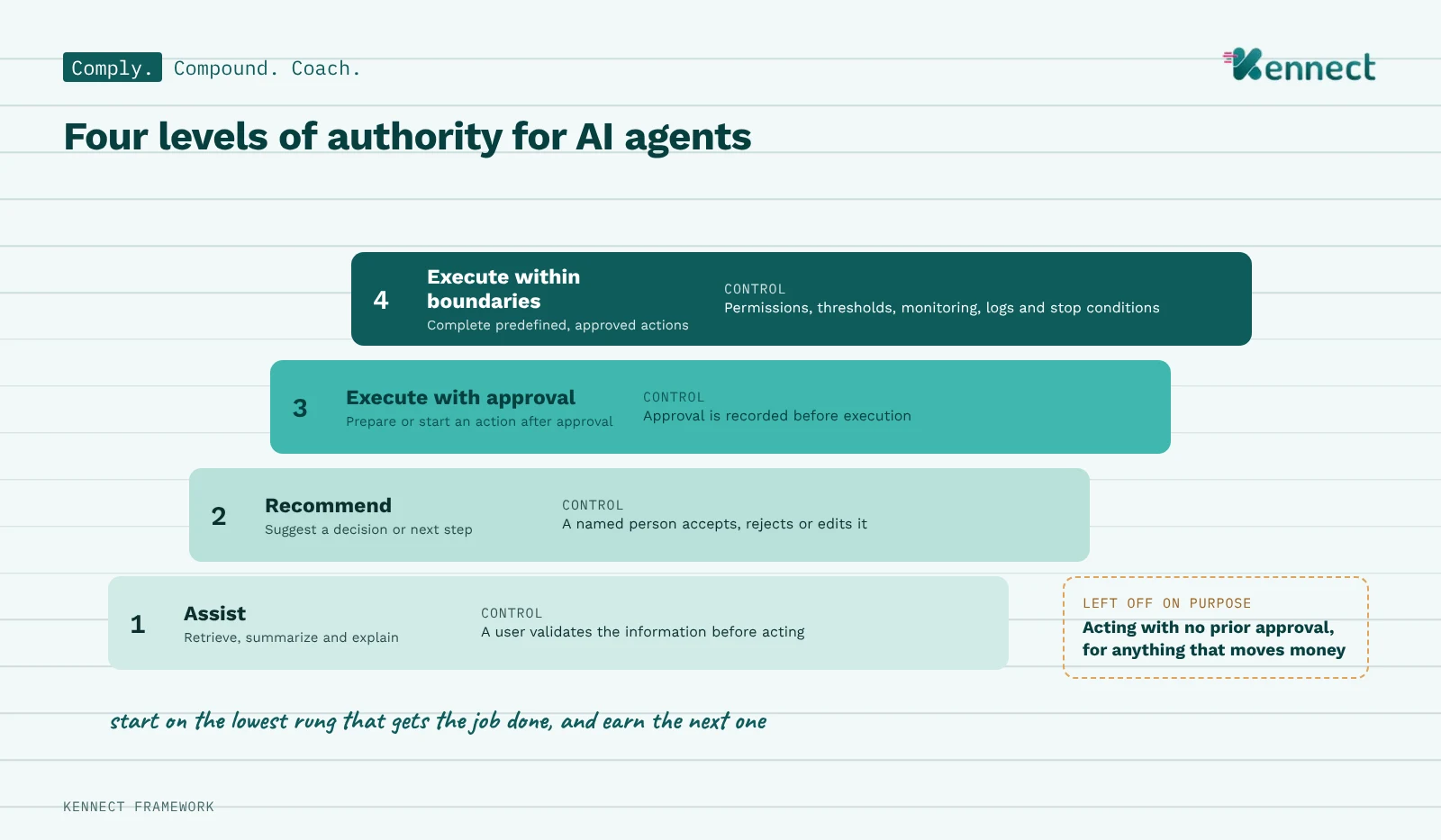
It helps to sort agents by how much they're allowed to do. Here's the ladder I'd start with:
Authority level
What the agent can do
Required control
Assist
Retrieve, summarize and explain
A user validates the information before acting
Recommend
Suggest a decision or next step
A named person accepts, rejects or edits it
Execute with approval
Prepare or start an action after approval
Approval is recorded before execution
Execute within boundaries
Complete predefined, approved actions
Permissions, thresholds, monitoring, logs and stop conditions are enforced
Deloitte's report sketches a similar ladder, but it goes one rung higher, to AI acting with no prior approval at all. I've left that rung off on purpose. For anything that moves money, I wouldn't go there yet.
Gartner's analysts make a similar point under the heading of reliability before autonomy: push for full autonomy too early and you tend to magnify both cost and failure.
That fourth rung is where the design work really sits. The boundaries have to spell out which systems, data and actions are in scope, the value limits, and what forces the agent to stop and ask.
A practical version: the agent handles adjustments under an approved value on its own. Anything above goes to finance. Odd-looking records go to a person. Conflicting rules raise an exception. And one named owner can switch the whole thing off.
Start every agent on the lowest rung that gets its job done, and make it earn the next one.
A six-part framework for AI agent governance
A governance policy on paper is a start. What matters is how the agent behaves on a Tuesday afternoon inside a live process, and that comes down to six things.
1. Define decision rights
For every type of decision the agent touches, write down who owns it, what level of authority the agent has, how much damage a mistake could do, who approves and where it escalates. Do this before the agent gets execution rights, while it's still easy.
2. Set permission boundaries
Be specific about what the agent can reach: which systems, which data, which actions, up to what value, for which users and in what time window. Least privilege isn't glamorous, but it's the cheapest insurance you'll buy.
3. Design human oversight into the workflow
Decide upfront which actions need a human sign-off and whose. The reviewers need to understand where the agent is likely to be wrong, and they need an override they're actually expected to use.
The EU AI Act is a useful yardstick here even if you don't operate in Europe. Article 14 says people overseeing high-risk systems must be able to monitor them, interpret what they produce, override them and stop them, with oversight scaled to the risk and the level of autonomy.
Not every agent falls under it. Incentive teams should look closely at Annex III, though, which covers AI used in employment, including systems that evaluate worker performance or affect terms of work. An AI driving employee incentives for an EU workforce could well qualify. After the AI Omnibus, published on 24 July 2026, those obligations kick in on 2 December 2027. It's worth getting your legal team's view early.
India has gone a gentler way. MeitY's AI Governance Guidelines, out since 5 November 2025, don't create a new AI law. They lean on existing laws and ask for accountability graded to the function and the risk. Where the stakes are high, they expect human oversight, audit trails and some way to halt the system, which lines up neatly with everything above.
If an auditor picks any AI-supported action from last quarter, someone should be able to rebuild it: what went in, which rule applied, who approved and what came out.
Record field
Why it matters
Decision or workflow ID
Connects the action to the business process
Timestamp and actor
Shows when the action occurred and who or what started it
Agent and model version
Identifies the system version behind the output
Input and source data
Shows which information the agent used
Policy or rule applied
Makes the decision constraints traceable
Recommendation and rationale
Preserves what the agent proposed and why
Human review and approval
Records the reviewer, decision and timestamp
Action and final outcome
Shows what was executed and what followed
Exception and override history
Captures intervention, correction and resolution
Plenty of systems log activity. A log that leaves out the owner, the rule or the outcome doesn't help much when the questions start.
5. Run an exception process
When data is missing, rules clash or a result looks off, the agent should stop, flag it, record why and hand it to a named person. Work picks up again after review. The one thing an agent should never do is guess its way through a rule conflict.
6. Monitor and review
Go-live is where governance starts. Watch the wrong actions, the overrides and the exception counts. Revisit permissions whenever a workflow or policy shifts, retest after every model update, and take near misses seriously while they're still cheap.
None of the six works alone. Skip one and the other five carry a gap.
What a governance failure costs in incentive operations
Here's a small, made-up case. A pharma company has 200 reps in the field. An AI workflow proposes a ₹5,000 adjustment for each of them, ₹10 lakh in all. Twenty of those records are built on bad source data or the wrong rule.
Metric
Illustrative value
Representatives
200
Proposed adjustment per representative
₹5,000
Total proposed adjustment pool
₹10,00,000
Incorrect records
20
Potentially affected amount
₹1,00,000
Illustrative example, not a Kennect customer result.
₹1 lakh is the visible part. The real bill comes later: finance rechecking source rows, sales ops fielding disputes, managers defending numbers they never built, a period close that slips by a week, and reps who quietly stop trusting the statement.
These errors rarely start with the AI itself. A typical case: the company reshuffles its sales hierarchy mid-period, so some transactions sit under the old structure and some under the new, and the HRMS and CRM carry different effective dates.
The agent works through the data without noticing. It proposes adjustments built on a mixed dataset, nothing checks the hierarchy first, and nobody is quite sure where an exception should go.
Then it unravels fast. Payouts get rerun, managers see two versions of the truth, reps raise disputes, and a closed month may have to reopen.
A better-governed workflow would have caught it early. It would have checked the hierarchy's effective dates and confirmed which plan version was live. It would have reconciled the source rows before calculating anything. When two records disagreed, it would have held just those twenty adjustments and sent them to the process owner, keeping a record of the fix and who approved it. The other 180 reps would have been paid on time.
The same checks earn their keep on split credit, clawbacks and late data too. If you want the underlying process, here's how sales performance management works.
The cheapest place to catch a rule conflict is before the money moves.
How Kennect approaches governed sales performance decisions
Kennect is an AI-led sales performance and incentive compensation management platform. Sales commissions, dealer schemes, distributor claims and channel rebates all run on the same rule engine, whoever the payee is.
We think about governance through three lenses, which we call the 3Cs. Comply is where ownership and evidence live: calculation, payout visibility, dispute handling, audit trails and plan versions. Compound is about aiming the money, through quota and sales planning and analytics, so leaders can test a plan change before rollout. Coach is the field's side of it, with personal cockpits and what-if views that show a rep how to act on the plan.
KAI, our AI layer, is built to sit inside those controls. KAI Exceptions does the heavy lifting here: it explains payouts, traces root causes and carries an exception from the first flag to its resolution. KAI Insights lets leadership ask about payout outcomes and get an answer the same day. KAI Simulations builds plans and KPIs from a plain prompt and shows what a change would do to payouts and cost. Whatever KAI does, it works within the same plan rules, approvals and audit trail as everything else on the platform.
KAI in practice. A hierarchy change lands mid-period with conflicting effective dates. KAI Exceptions flags the affected records before calculation and routes them to the named owner. Payouts for the rest of the team go ahead on time.
When owners, data and AI live in one system, an auditor's question gets a same-day answer.
Five questions before an agent gets execution authority
Before any agent gets to execute, I'd want leadership to have written answers to these:
Who owns the business outcome?
Which actions can the agent take on its own?
Which conditions need human approval or intervention?
Can we rebuild any decision from the audit trail?
Who monitors the workflow and can suspend it?
Go back to them whenever permissions or the business change. And if the first answer is still fuzzy, the agent stays at assist or recommend. No exceptions.
Write down the controls and the owners first. Hand over authority after that.
An agent can carry the work.
People still carry the accountability. See how Kennect ties every payout to its rule, data and approver.
A named business or process owner. The agent never carries accountability itself. Technology, risk, data and approval roles should be named too, and that gap is common: 23% of leaders in Deloitte's 2026 survey couldn't say who was accountable.
It's the set of rules deciding what each agent may do, who approves, what gets logged and who can stop it. Gartner expects over 40% of agentic AI projects to be scrapped by the end of 2027, and weak risk controls are one of the reasons it gives.
Whenever an action crosses an agreed risk or value threshold. A rule conflict, a sensitive decision or an open exception should send it to a person as well. For high-risk systems, Article 14 of the EU AI Act requires that people can override or stop them.
Enough to rebuild any decision from scratch: the agent and model version, the inputs, the rule applied, what it recommended and why, who approved, what happened, when, and any exceptions along the way.
No, only high-risk systems. That said, AI that evaluates worker performance or affects terms of work may count as high-risk under Annex III, with obligations from 2 December 2027.