What Happens When You Combine CRM Data With Generative AI for Commissions?
Combining CRM data with generative AI transforms commission management from manual, error-prone processes into real-time, automated systems. This integration eliminates inefficiencies like shadow accounting, reduces administrative workloads, and boosts sales productivity by 15–25%. With instant calculations, tailored incentive suggestions, and predictive insights, sales teams can focus on closing deals rather than managing spreadsheets.
Key benefits include:
- Real-time commission tracking: Sales reps see earnings immediately after closing deals, reducing disputes and delays.
- Dynamic incentive adjustments: AI analyses live data to recalibrate commission plans based on performance and market conditions.
- Automated "what-if" scenarios: Teams can simulate the financial impact of different strategies before implementation.
- Reduced admin time: AI-powered systems cut commission processing time by up to 90%.
This shift enables organisations to align sales behaviour with business goals while providing transparency and motivation for reps. For industries like pharma and BFSI, where complexity is high, generative AI delivers clarity and efficiency, making commission management a strategic advantage rather than a monthly headache.
The Role of CRM Data in Sales Commission Management
Your CRM serves as the backbone of commission management. It houses every essential detail - closed deals, quota achievements, and territory assignments - acting as the central source of truth that ensures commission calculations remain accurate and prompt.
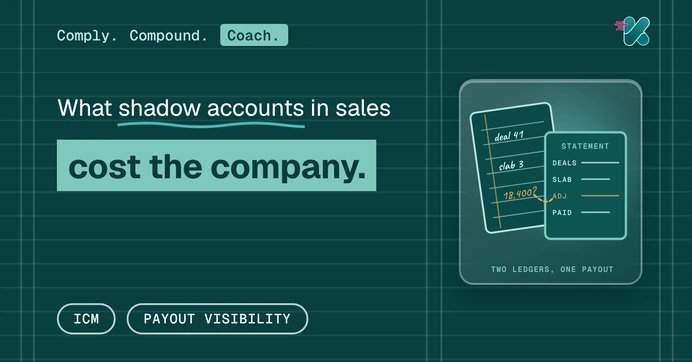
When CRM data is inaccurate, finance teams are forced to rely on spreadsheets and manual verification, which leads to inefficiencies and erodes trust. Compounding this issue, 93% of sales representatives resort to "shadow accounting" - manually recalculating their compensation statements due to a lack of trust in the system. This not only wastes time but also dampens morale within sales teams.
However, when CRM data integrates seamlessly with commission systems, the difference is transformative. The moment a deal is marked as "Closed Won" in platforms like Salesforce or HubSpot, the commission engine instantly calculates payouts, applies tiered structures, and updates the rep's dashboard. This real-time synchronisation eliminates disputes, reduces administrative headaches, and allows sales teams to focus on selling.
Core CRM Data Sources for Compensation
A reliable commission system is built on five key CRM data categories that ensure accuracy and efficiency.
- Transactional data captures critical details like deal values, close dates, order status, and product types. These details form the base for percentage-based payouts . For instance, if a pharma rep secures a ₹5 lakh deal on a high-margin product, that transaction becomes the starting point for their commission calculation.
- Performance and quota data add context by tracking individual and team quotas, attainment levels, and territory assignments. These metrics determine whether a rep qualifies for accelerators. For example, a BFSI sales manager might earn 10% commission on revenue up to ₹10 lakh, but 15% on amounts exceeding that threshold - all calculated automatically using CRM data .
- Pipeline data provides forward-looking insights by tracking deal stages and weighted forecasts. This allows reps to view potential future earnings in real-time, which is a strong motivator. In fact, 82% of reps agree that seeing potential earnings on new deals would boost their motivation.
Although these data categories provide a solid foundation, traditional systems often struggle with real-time processing and handling intricate incentive structures. Properly leveraging CRM data is key to addressing these challenges.
Challenges with Traditional CRM-Based Systems
Despite its importance, managing commissions through CRM data has its own set of challenges. A stark reality is that 60% of organisations still rely on manual spreadsheets for commission calculations. These teams export CRM data at the end of the month, manually apply formulas, and hope for error-free results.
The most glaring issue is the lack of real-time visibility. For instance, a rep who closes a deal on 15th January might not see their commission reflected until the finance team processes payroll on 5th February. This three-week gap leaves them in the dark, fostering distrust and forcing them to spend around 20% of their time on administrative tasks like tracking their own commissions instead of pursuing revenue opportunities.
Manual systems also falter under complexity. Managing various sales commission structures, territory splits, and tiered accelerators across a large, distributed team - such as 500 pharma reps across 28 states - can overwhelm spreadsheets. A single incorrect formula or misassigned territory can lead to disputes that take weeks to resolve. Automating the flow of CRM data into commission systems can reduce monthly processing time by up to 90% , enabling finance teams to shift focus from error correction to strategic initiatives.
"AI is more accurate, consistent, and relevant with more data. It learns over time. The better the data input is, the better the output." - Paul V., Principal, Deloitte Consulting
To move forward effectively, organisations must prioritise clean and integrated CRM data. It’s not just a nice-to-have - it’s the foundation for any modern commission system, especially those augmented by generative AI.
Understanding Generative AI and Its Application in Commission Management
What is Generative AI?
Generative AI is a cutting-edge tool that uses machine learning and algorithms to create entirely new outputs - whether it's text, summaries, or detailed commission reports - by processing vast amounts of CRM data. Unlike systems that simply retrieve or display existing information, generative AI actively produces insights and content based on the data it analyses.
In the realm of commission management, this translates to leveraging both structured data (like deal values and close dates) and unstructured data (such as email exchanges or meeting notes) to create actionable outputs. For instance, it can generate a customised explanation of a sales rep's commission for a specific period or summarise which deals had the biggest impact on their payout.
This technology dramatically reduces the time spent on report creation and scenario analysis - from hours to mere seconds. Salesforce's Einstein AI, which already generates over 200 billion predictions daily, serves as an example of how generative AI can power such capabilities. This sets the stage for a comparison with traditional machine learning approaches.
Generative AI vs Machine Learning
While both generative AI and traditional machine learning are part of the broader AI family, they serve different purposes in commission management. Traditional machine learning focuses on analysing patterns and making predictions. For example, it can predict whether a deal will close or if a sales rep is likely to meet their quota.
Generative AI takes things a step further by creating new solutions. Instead of just predicting that a rep might miss their target, it can craft a personalised action plan, outlining which deals to prioritise to meet or exceed goals. It can also generate compensation scenarios and actionable recommendations.
By 2025, 75% of B2B sales organisations are expected to integrate AI-guided solutions into their sales strategies. This highlights the growing importance of generative AI in shifting commission management from reactive to proactive.
AI-Powered Data Analysis for Commissions
Generative AI excels at uncovering patterns in CRM data. It can analyse historical trends, win rates, and discount behaviours to pinpoint which elements of an incentive plan drive performance and which are ineffective.
For example, if sales reps consistently achieve higher win rates when tiered accelerators are applied to high-margin products, generative AI can identify this trend and recommend reinforcing that incentive structure. It can also simulate the impact of changes to commission plans under different scenarios, such as rep turnover or entering new markets.
"Pairing commission software with AI technology can help accelerate the what-if analysis. Reps today want more visibility into what they need to do to be successful and, further, how they might go about overachieving the goal." - Paul V., Principal, Deloitte Consulting
The benefits are measurable. Companies using automated commission tools have reported a 15% boost in sales productivity. For finance teams, generative AI can forecast the total cost of sales by analysing live pipeline data against current commission structures, helping to avoid last-minute financial surprises. For sales reps, it provides real-time earnings projections and clear "path to quota" guidance, showing how closing specific deals can impact their next payout.
That said, the accuracy of generative AI depends heavily on the quality of the data it processes. It must rely on verified sources, such as internal CRM records, to avoid errors. With proper implementation, generative AI can turn commission management into a dynamic, ongoing process that delivers real-time insights and actionable guidance.
How CRM Data Integrates with Generative AI
When generative AI connects with CRM systems, it shifts the way commission management works. Instead of relying on static reports or manual calculations, this integration creates a seamless system where data flows continuously between platforms. This enables instant analysis and automated updates, reshaping how sales compensation is handled by introducing real-time adjustments.
The integration is built on three key capabilities: real-time data processing to eliminate calculation delays, dynamic commission structure adjustments to adapt to changing conditions, and automated scenario simulations to predict outcomes before making changes. Together, these features address long-standing challenges in commission management, paving the way for more efficient and responsive processes.
Real-Time Data Processing and Automation
Live CRM data feeds allow commissions to be calculated instantly as deals close. Generative AI processes both structured data (like deal values, close dates, and product categories) and unstructured data (such as email exchanges, call transcripts, and meeting notes). Using Natural Language Processing (NLP), it interprets text and updates CRM records automatically, removing the need for manual input.
For example, in July 2025, Salesforce integrated Einstein AI into its CRM platform, automating lead scoring and providing actionable recommendations. This resulted in a 25% increase in lead conversion rates and improved sales forecasting accuracy by 35% . With continuous data processing, sales teams can view updated commission projections within seconds of closing a deal.
The benefits are clear. Sales teams using AI are 1.3 times more likely to achieve revenue growth , while commission administrators save valuable time by avoiding manual data reconciliation. AI tools like Zoho's Zia further enhance accuracy by monitoring CRM data for anomalies in sales figures or deal management, ensuring commission calculations are based on verified metrics.
"To work in the enterprise, the technology has to be grounded in the data available in that organisation. Being able to blend public and private data together is what makes this a more trusted, more valuable experience." - Jayesh Govindarajan, Senior Vice President of AI and Machine Learning, Salesforce
Beyond basic calculations, machine learning analyses historical data to identify patterns in sales behaviour, attributes, and market trends. This enables proactive adjustments to commission structures . By 2025, it's projected that 80% of customer service organisations will incorporate generative AI features like automated workflows and predictive analytics.
With real-time updates as a foundation, AI also enables dynamic adjustments to commission structures.
Dynamic Commission Structure Design
Generative AI fine-tunes commission plans in real time by analysing live CRM inputs, such as sales quotas, team performance, or market conditions. It recalibrates elements like tier thresholds, accelerator rates, or bonus triggers when performance data suggests initial assumptions are outdated. This shifts commission management from a static, yearly process to a dynamic, data-driven system.
For instance, if CRM data shows that sales representatives achieve higher win rates when tiered accelerators are applied to high-margin products, generative AI can identify this trend and recommend reinforcing that incentive structure. It can also simulate the effects of changes under different scenarios, such as market expansion or sales team turnover.
In July 2025, HubSpot introduced AI-driven lead scoring and sales forecasting into its platform, leading to a 20% increase in sales-qualified leads and a 25% improvement in forecast accuracy . The system continuously adjusted scoring models based on actual conversion data, ensuring that commission plans stayed aligned with performance.
This capability allows for mid-cycle modifications without disrupting sales momentum. For example, if a pharmaceutical company needs to pivot focus from one product line to another during a quarter, generative AI can instantly recalculate incentive weights across teams and territories, clearly communicating earning potential to representatives.
Automated What-If Scenario Modelling
Using integrated CRM data, generative AI can simulate the potential financial and motivational effects of commission plan changes before they are implemented . Revenue leaders can test how plans perform under various conditions - such as market challenges, sales team changes, or new product launches - enabling data-driven decision-making.
Sales representatives can also use these tools directly within their CRM interface to explore scenarios like, "What happens if I close this deal?" or "What do I need to achieve 150% of my quota?" This not only boosts transparency but also motivates reps while reducing the administrative workload of handling commission-related queries.
For finance teams, automated scenario modelling predicts cost impacts. CFOs can assess how changes might affect margins and compensation liabilities, ensuring financial stability . For example, in July 2025, Deloitte used Intelligent Process Automation to streamline compliance audits and financial reconciliations. By integrating AI models with platforms like UiPath, Deloitte cut manual processing time by 50%, freeing up consultants to focus on strategic tasks.
Key Benefits of Generative AI CRM Integration
Generative AI CRM integration builds on advanced data processing and adaptive commission design, transforming sales compensation processes. With sales teams spending just 33% of their time selling and the rest on administrative tasks , this technology offers a way to significantly improve efficiency, incentive design, and accuracy. The urgency is clear - 78% of sales leaders worry their organisations are lagging behind in leveraging generative AI .
Switching from traditional commission systems to AI-powered platforms brings measurable improvements in three critical areas: boosting productivity by reducing admin tasks, creating tailored incentive structures, and automating manual workflows.
Increased Sales Productivity
Generative AI removes the burden of manual data entry, allowing sales teams to focus on what they do best - selling. By 2026, businesses that implement enterprise AI initiatives are projected to increase productivity by 50% . The benefits are immediate: B2B sales teams using AI-embedded tools could cut the time spent on prospecting and meeting preparation by over half by 2026 .
With clean CRM data and AI-driven insights, representatives can view their earnings in real time as deals close. This instant visibility minimises disputes and routine queries, enabling compensation teams to dedicate their time to strategic planning rather than resolving administrative issues.
AI also enhances productivity through lead prioritisation, identifying prospects with the highest likelihood to buy. This approach can increase conversion rates by 20% to 40% . Sales reps can then focus their energy on high-probability deals, driving both revenue and commission earnings. AI-generated prescriptive guidance further simplifies daily workflows by pinpointing actions that bring reps closer to their targets.
"Ultimately, the superpower of generative AI for CRM is to reduce time to value." - Vala Afshar, Chief Digital Evangelist, Salesforce
Personalised Incentive Recommendations
Generative AI analyses vast data sets, including CRM records, past performance, behaviour patterns, and market benchmarks, to recommend optimised incentive plans tailored to individual sales reps. Instead of applying generic commission structures, AI highlights the specific actions that lead to success for each rep, enabling more effective incentive strategies.
Dynamic reward suggestions are based on real-time performance data, company policies, and even sentiment analysis . For instance, AI might reveal that certain reps respond better to bonuses tied to high-margin products, while others thrive on volume-based incentives. This level of personalisation fosters a sense of recognition and boosts job satisfaction .
Companies adopting AI for sales report a 3–15% revenue increase and a 10–20% improvement in sales ROI. AI-augmented sales teams are also 1.7 times more likely to expand market share compared to those not utilising such tools . Beyond monetary rewards, AI can suggest non-cash incentives such as wellness benefits or professional development opportunities. Interestingly, 46% of employees would trade a 10% pay raise for personalised well-being perks.
AI’s "next-best action" recommendations clarify how specific behaviours impact commission payouts. This transparency builds trust and keeps motivation high, as reps can clearly see how their pipeline translates into earnings.
Elimination of Manual Workflows
Generative AI replaces spreadsheets with automated CRM integration, streamlining commission calculations and syncing sales data with payroll instantly. Organisations using automated systems report a 15% boost in sales productivity.
Generative AI empowers non-technical users to query complex commission data using simple language, reducing reliance on specialised analysts . For example, a compensation administrator can ask, "Which reps are at risk of missing their quota this quarter?" and receive immediate, actionable insights. This accessibility enables faster, more strategic adjustments without requiring technical expertise.
By automating routine tasks and inquiries, AI frees up sales leaders to focus on coaching and building relationships. The system can create meeting summaries, generate content, and produce knowledge articles within seconds. By 2026, over 50% of enterprises will realise that modernising workflows is essential for fully leveraging generative AI’s potential in sales .
"Generative CRM is the e-bike version of CRM. You could ride traditionally, but why would you ever want to go back to a traditional bike?" - Vala Afshar, Chief Digital Evangelist, Salesforce
Real-World Use Cases of Generative AI in Commission Management
Generative AI integrated with CRM systems is no longer just a concept; it’s actively reshaping commission workflows. Across industries, sales teams are seeing tangible benefits, such as improved payout accuracy, better plan alignment, and smarter decision-making. These examples highlight how generative AI is helping organisations move from reactive calculations to proactive strategies in commission management.
Performance-Based Dynamic Payouts
Generative AI leverages real-time CRM data to adjust commission payouts dynamically as deals progress . Instead of waiting until the end of the month to calculate earnings, sales representatives can track their compensation in real time, keeping them engaged and motivated.
The system continuously monitors quotas and updates payouts as thresholds are met, providing instant feedback. This real-time visibility removes uncertainty, helping sales teams stay focused throughout the performance cycle. AI-driven platforms also enable ongoing adjustments by analysing live performance data. For instance, they can rebalance territories or tweak quotas mid-cycle when discrepancies between plans and actual sales performance emerge .
These automated systems have significantly reduced commission processing times - by as much as 95% - and boosted sales productivity by 80%. By integrating CRM with Configure, Price, Quote (CPQ) tools and product usage data, AI ensures that incentives align with the entire revenue lifecycle. This includes rewarding behaviours like driving renewals and supporting usage-based pricing models .
"AI helps decode which elements of a plan are influencing behavior and which are noise." - Barika Pace, Research Lead, ISG
Multi-Plan Testing and Optimisation
Organisations are also using AI to refine their commission plans by testing multiple structures simultaneously. The technology simulates various commission designs, forecasting costs and pinpointing the most effective options .
"On the operation side of things, you can use these technologies to determine and predict the cost of sales based on various inputs, including quota, plan design, different performance scenarios, and even real-time data coming from the pipeline." - Paul V., Principal, Deloitte Consulting
This capability helps finance teams align compensation budgets with growth targets, achieving up to 20% savings on incentive costs through better automation and auditing . Additionally, simulations can identify sales representatives who might struggle under certain plan designs, allowing managers to adjust incentives or provide targeted coaching before issues escalate .
Automation also reduces the workload for operations and auditing teams by 90%, freeing up resources for more strategic tasks .
Predictive Sales Performance Insights
Generative AI doesn’t just react to performance - it predicts it. By analysing historical data such as attainment trends, discounting patterns, sales cycle durations, and win rates, it reveals which plan elements drive results . This predictive analysis provides visibility into potential compensation liabilities, margin impacts, and plan effectiveness.
The system flags sellers who are putting in high effort but risk missing earnings, highlighting potential issues with plan fairness or enablement . This early detection allows sales leaders to intervene with support or adjust plans before problems grow.
AI-powered platforms also embed these insights directly into CRM workflows, offering real-time earnings projections and actionable guidance on deal prioritisation. By 2026, more than half of enterprises are expected to modernise their processes to leverage generative AI features that enhance sales effectiveness .
"When sellers understand how their actions map to their earnings in a clear, contextualised way, motivation increases. Attrition drops. Onboarding speeds up." - Barika Pace, Research Lead, ISG
Steps to Implement Generative AI CRM Integration
Shifting from traditional commission systems to AI-driven platforms demands careful planning. Rushing through this transition can lead to data issues, user pushback, and implementation failures. Here’s a structured approach to ensure success.
Preparing CRM Data for AI Integration
The foundation of effective generative AI CRM integration lies in clean, reliable data. Start by conducting a thorough data audit to map all existing data sources - where they’re stored, how they’re connected, and where manual processes occur . This step helps identify areas for automation and reveals data silos that could hinder AI accuracy.
Statistics show that 30-40% of CRM records often have incomplete information, leading to faulty AI insights . To address this, schedule data cleansing 2-4 weeks before integration . This includes removing duplicate entries, fixing inconsistencies, and deleting invalid data like bounced emails or outdated phone numbers.
Leverage AI tools to merge duplicate records with 97% precision and standardise formats for fields like company names, addresses, and currency (₹) . Enrich your CRM further by using AI to fill in missing details such as company size, industry type, and recent funding .
Implement identity resolution to create unified customer profiles and use data masking to safeguard sensitive information. Ensure your CRM infrastructure supports both structured data (like sales opportunities) and unstructured data (such as PDFs, chat logs, and email signatures), as both are crucial for generative AI functionality . Additionally, establish "zero data retention" policies with external AI vendors to protect sensitive compensation data .
With organised and accurate data in place, you’re ready to move on to platform selection.
Selecting the Right AI Platform
Not all generative AI platforms are suitable for commission management. The right choice must balance trust, functionality, and integration depth. Security features like data masking, zero data retention policies, and audit trails should be non-negotiable .
The platform should be capable of grounding itself in your organisation’s CRM data - records, knowledge articles, and historical commission structures - to deliver accurate insights and minimise errors .
"To work in the enterprise, the technology has to be grounded in the data available in that organisation. Being able to blend public and private data together is what makes this a more trusted, more valuable experience." - Jayesh Govindarajan, Senior Vice President of AI and Machine Learning, Salesforce
Seamless integration with existing sales workflows is essential. Look for platforms that offer real-time visibility into commission impacts during quote generation . Interfaces that adapt to business logic and recommend tasks like AI-powered commission plan adjustments can further streamline operations .
Security standards should meet enterprise-grade certifications such as SOC 2 Type-II, SOC 1 Type-II, ISO 27001, GDPR, and CCPA. A no-code rule builder can empower RevOps and Finance teams to modify complex commission structures without relying on IT . Additionally, "human in the loop" capabilities allow for manual review and adjustments, ensuring accuracy and a personalised touch .
Once the platform is selected, the focus shifts to team adoption and change management.
Change Management for Sales Teams
Technical implementation is only part of the journey; overcoming resistance and building trust among users is equally critical. Closing the "AI trust gap" requires positioning AI as a supportive tool rather than a replacement . Incorporating human oversight to validate AI-generated commission outputs can significantly reduce errors and build confidence.
"Removing fear and helping everyone understand what is and isn't possible will lead to more valuable use cases, with the business and technical stakeholders working in partnership to drive innovation." - Dr. Andy Moore, Chief Data Officer, Bentley Motors
Provide ongoing training in areas like data literacy, prompt engineering, and analytical thinking . Transparent dashboards - sometimes called "achievement feeds" - can give sales representatives the ability to verify commission calculations and request corrections before month-end .
"As an SDR, transparency and trust in my commission payouts is of the utmost importance. Not only in planning my personal finances, but considering the longevity in the company I work for." - SDR from an enterprise computer software company
Define clear ethical principles - accuracy, safety, and transparency - before rolling out AI-driven commission models . Update security protocols to include measures like data masking and zero data retention to protect sensitive information . Real-time performance tracking, including earnings projections and "what-if" scenarios, can boost motivation and reduce turnover. By 2026, more than half of enterprises are expected to modernise processes to fully leverage generative AI for enhancing sales effectiveness.
The Future of Generative AI in Sales Compensation
Generative AI is set to take CRM integration to a whole new level, moving from simple automation to autonomous decision-making. By 2026, more than half of enterprises are expected to use generative AI to reshape incentive programme design fundamentally . This evolution is poised to redefine how organisations create, manage, and refine their incentive strategies.
Conversational AI for Commission Queries
One of the standout advancements is the rise of conversational AI interfaces, which are transforming how sales teams interact with commission data. Soon, sales representatives will be able to access and interpret their commission details as effortlessly as having a casual conversation. Forget clunky spreadsheets - natural language queries like, "What will my earnings look like if I close the Bangalore deal before month-end?" will generate instant, personalised answers.
AI tools like "Payee Coaches" are already offering tailored advice to individual salespeople, while "Admin Co-Pilots" assist compensation managers by diagnosing errors and simplifying complex formulas through conversational interfaces. With these tools, sales reps no longer need to depend on finance teams for straightforward commission-related queries. In fact, 82% of sales reps believe that having better visibility into potential earnings on new deals would significantly enhance their motivation.
"These AI-driven features integrate seamlessly into existing commission workflows, making managing commissions as simple as a conversation and giving your team the edge to improve performance." - CaptivateIQ
This technology also eliminates the need for redundant manual checks, where reps often maintain their own calculations to verify payouts. Real-time access to commission breakdowns through conversational AI builds trust and saves time.
Autonomous Compensation Optimisation
The traditional annual planning cycle is being replaced by a continuous approach. Future systems will shift from sales commission structures to autonomous optimisation, where AI uses real-time CRM data, market trends, and historical performance to recommend or even implement adjustments to incentive plans.
Autonomous AI, or agentic AI, can independently execute tasks, set goals, and refine workflows . For example, it can identify which elements of a commission plan genuinely drive sales behaviour and which are irrelevant by analysing data like historical attainment, sales cycle variability, and win rates. Early implementations of such systems have already improved win rates by over 30% .
The move towards prescriptive guidance means AI systems will soon recommend specific deal types and activities for sales reps to focus on to meet or exceed their targets . Additionally, AI can predict the total cost of sales by running "what-if" scenarios on various commission plan designs, helping finance teams assess potential cost implications before implementing changes.
"The planning cycle is no longer annual. It's continuous." - Barika Pace, Lead Analyst, ISG
Organisations that have adopted automated commission systems have reported a 15% rise in sales productivity, with even greater gains expected as autonomous systems evolve . This progression naturally paves the way for cross-platform AI systems that unify data across multiple tools.
Cross-Platform AI Integrations
Taking automation and dynamic commission structures further, unified platform strategies integrate CRM, ERP, and HRIS systems to ensure commission calculations align with actual financial outcomes. For instance, ERP systems like NetSuite or SAP provide real financial transaction data, as opposed to relying solely on CRM sales stages .
By harmonising data - connecting disparate systems such as data lakes, warehouses, and cloud platforms - organisations can establish a single source of truth for AI models . This enables autonomous sales assistants to handle operational tasks like scheduling follow-ups and maintaining clean data, which directly improves the accuracy of incentive calculations.
By 2025, 75% of B2B sales teams are expected to enhance their traditional sales strategies with AI-guided solutions . Companies already leveraging generative AI for sales content have reduced RFP turnaround times by up to 20%. However, 73% of employees express concerns about the risks associated with generative AI, emphasising the need for robust "trust layers" in these integrations .
"Companies are looking to AI to help them make intelligent, data-backed business decisions that help them remain competitive and innovative in the marketplace." - Paul V., Principal, Deloitte Consulting
Before scaling these integrations, organisations must streamline their RevOps processes and purge outdated or inaccurate data - sometimes up to 80% of existing content - to avoid automating inefficiencies . The reward for this effort is immense: seamless systems that work quietly in the background, continuously refining compensation strategies without manual input.
Conclusion
Integrating CRM data with generative AI shifts commission management from manual, error-prone spreadsheets to streamlined, automated systems. This transformation increases productivity by up to 80%, delivers real-time insights for finance teams, and provides instant earnings projections for sales reps, making the entire process more efficient and transparent .
By leveraging real-time adjustments and predictive sales analytics, AI-driven systems replace static planning with dynamic, adaptive compensation strategies. These systems respond instantly to changing market conditions and performance metrics. Projections suggest that by 2026, over 50% of enterprises will modernise their processes to utilise generative AI features, optimising sales effectiveness . AI also enhances incentive design by analysing past performance to recommend strategies that encourage behaviours such as multi-product selling or subscription renewals .
"Ultimately, the superpower of generative AI for CRM is to reduce time to value." - Vala Afshar, Chief Digital Evangelist, Salesforce
The benefits of these advancements are tangible. Companies adopting automated commission systems report a 95% reduction in commission processing time and a 90% reduction in operational and auditing efforts . However, as with any innovation, challenges remain. While 73% of employees view generative AI as a priority, concerns about privacy and data bias underline the need for trusted AI frameworks based on validated internal data sources .
The future lies in human-machine collaboration, where AI handles data processing, and sales professionals focus on building meaningful relationships. As Barika Pace from ISG aptly states, "Sales performance management is no longer a toolset. It is a platform capability that bridges strategy and execution". The pressing question for organisations is no longer whether to integrate CRM data with generative AI, but how quickly they can do so to maintain their competitive edge.
FAQs
How does generative AI enhance commission accuracy and transparency?
Generative AI improves commission accuracy and clarity by automating real-time calculations and ensuring data is reconciled precisely. By removing manual errors, it offers immediate insights into commission payouts, enabling sales teams to clearly understand their earnings.
Moreover, personalised incentive programs driven by AI provide tailored recommendations, aligning compensation plans with individual performance. This approach builds trust and fosters a fair, motivating atmosphere for sales professionals.
What challenges can arise when integrating CRM data with generative AI?
Integrating CRM data with generative AI comes with its fair share of hurdles, primarily revolving around data quality, system compatibility, and privacy concerns. When CRM data is plagued by issues like duplicates or incomplete entries, it can distort AI-generated insights, leading to unreliable decision-making. This makes maintaining clean, accurate data a non-negotiable starting point.
Compatibility between generative AI tools and existing CRM platforms is another sticking point. It demands thorough planning, tailored solutions, and consistent upkeep to ensure that data flows smoothly across systems, without interruptions or errors.
Then there’s the critical matter of data privacy and ethics. Handling sensitive customer data means organisations must tread carefully to remain compliant with regulations and to prevent bias in AI outputs. This requires not just technical safeguards but also a strong commitment to ethical practices.
To navigate these challenges effectively, businesses need to invest in strong data management systems, well-thought-out integration methods, and ongoing checks. These steps are essential to fully harness the capabilities of generative AI in CRM workflows.
How does generative AI create personalised incentive plans for sales representatives?
Generative AI takes incentive planning to the next level by tailoring strategies based on the unique traits of each sales representative. By analysing performance metrics, behavioural patterns, and personal preferences, it crafts incentive plans that align with individual strengths and motivational drivers. Leveraging tools like machine learning and natural language processing, it processes CRM data to deliver these personalised solutions.
For instance, generative AI can study historical sales data, track target completion rates, and assess engagement trends to suggest rewards that resonate - whether it’s a customised bonus plan or a preferred form of recognition. It also supports real-time updates and predictive modelling, enabling managers to test various incentive scenarios and identify the most impactful approach. This not only ensures fairness but also enhances productivity and motivation, seamlessly linking personal achievements with broader organisational objectives.