A stockist secondary sales incentive needs data all sides trust.
October 23, 2026
Puneet Gupta
Puneet Gupta
Key Insights
In SalesGlobe's 2026 research, 54% of sales incentive professionals named data quality a top challenge, and it was new to the top of the list. In Indian distribution, I see that number play out every month-end, in a call between a sales head and an incentive analyst about one late stockist file.
A secondary sales incentive is calculated on data the company does not own. It sits with stockists, in DMS packages and spreadsheets, and it arrives late, in mixed formats, with returns that land after the close. Each of those changes a payout the rep has already seen.
A stockist secondary sales incentive works when the data rules are written into the plan. Name the source of record, publish the cut-off, check completeness, snapshot stockist mapping and post every reversal as a labeled line. Since October 2025, a scheme credit note also depends on the distributor reversing its tax credit, so finance has a reason to want the same record.
A question worth asking the head of sales operations this week: what share of expected stockist data did the previous payout include?
Table Of Content
Why secondary sales data is now a leadership number
In Indian distribution, the data behind a field incentive sits outside the company. Redseer counts 13 to 14 million kirana stores and puts 85% to 90% of mass grocery retail through traditional trade. The FMCG distributors' federation represents more than 4.5 lakh distributors.
Primary sales sit in the company's ERP. Secondary sales sit with each stockist, in a DMS, a billing package or a spreadsheet. When the two move apart, the field incentive follows whichever one the plan reads.
Sources: SalesGlobe, Sales Compensation: The Big Issues of 2026, 14 September 2026, sample not disclosed · Redseer, 30 March 2026 · AICPDF, as reported by Outlook Business, 9 June 2026
A secondary sales incentive is calculated on data the company does not own, so the data rules decide the payout.
Where secondary sales data breaks a field payout
Five data problems account for many of the disputes in a secondary sales plan. Each one changes a payout that has already been shown to the rep.
Five secondary sales data problems and the control for each
Problem
What happens to the payout
The control
A stockist file arrives after the close
The rep is paid short and caught up a month later
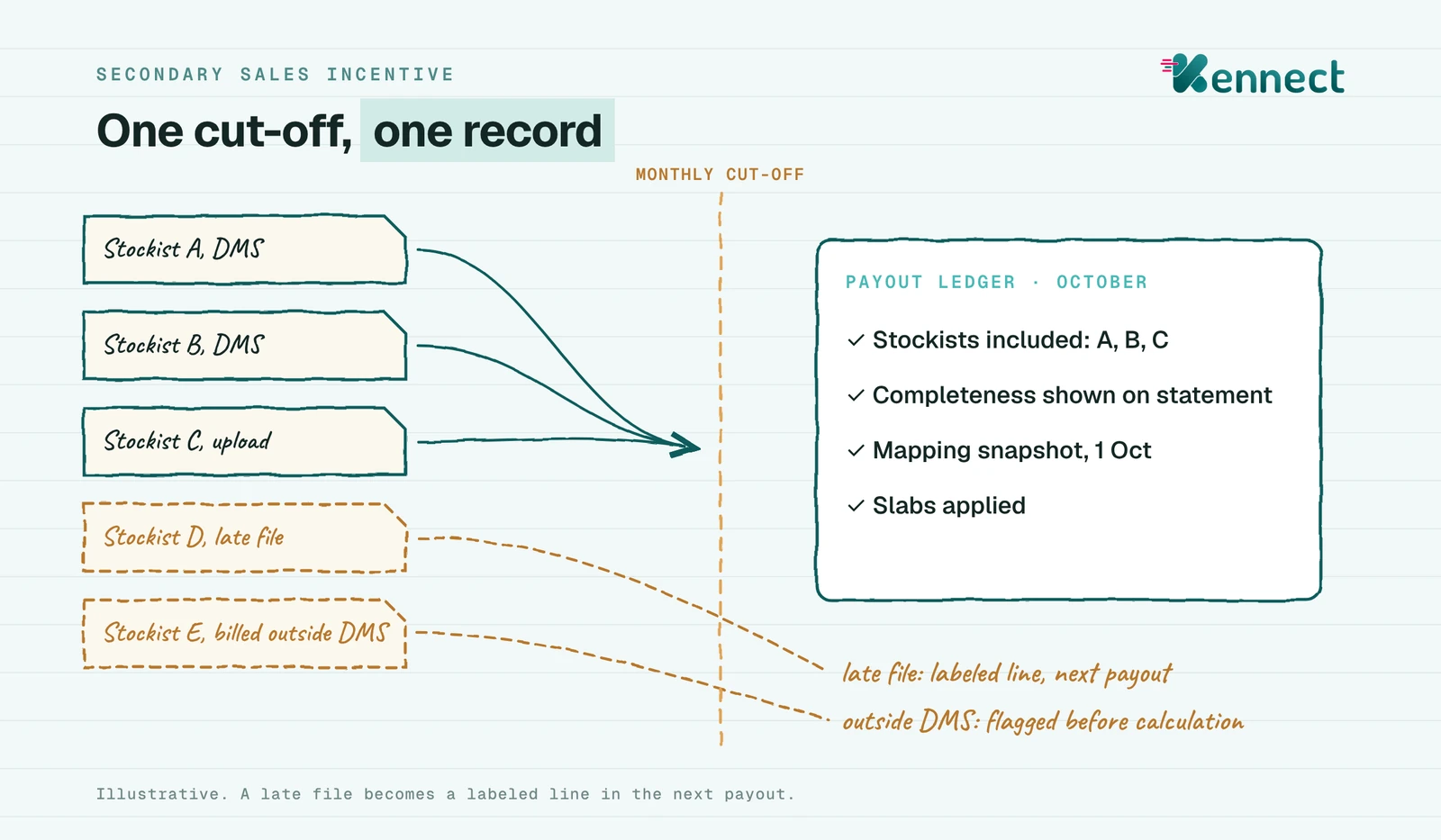
Publish the cut-off and show which stockists each payout included
A distributor bills outside the DMS
Sales the rep made never reach the calculation
Measure upload completeness by stockist before calculating
A return or reversal lands after the close
Achievement already shown is reduced next month
Post every reversal as a labeled line in the next payout
A stockist moves to another territory mid-month
Credit goes to the wrong rep
Snapshot stockist mapping each month with effective dates
A scheme claim is settled from the distributor's own sheet
The company pays on numbers it has not checked
Calculate each claim from source data inside the period
Illustrative. A late file becomes a labeled line in the next payout, rather than a gap no one can see.
Many pharma plans add a gate on top, such as a secondary-to-primary ratio of 95% before an incentive is earned. A late or missing stockist file can then cancel an incentive the rep earned in the market.
Every secondary sales dispute starts with a record the rep could not see and the company did not check.
How to calculate an incentive on secondary sales
Seven rules make a secondary sales payout something the field, finance and the stockist can each check.
Name the source of record for each measure. DMS, stockist upload or ERP, written into the plan.
Publish the cut-off. State the date and time each month closes, and what happens to a file that arrives after it.
Check completeness before calculating. Report the share of stockists that uploaded and the share of expected sales they cover.
Snapshot the mapping. Fix which stockist, beat and outlet belong to which rep at the start of each month, with effective dates for changes.
Treat reversals as ledger lines. A return reduces the next payout as a labeled line with its period and reason.
Settle claims from source data. Calculate scheme claims from billing records and keep the distributor's own claim as a cross-check, as set out for dealer incentive schemes.
Show both sides the same number. A rep and a stockist who see the calculation have no reason to keep a shadow account.
A payout calculated on 70% of expected stockist data is a partial payout. Say so on the statement, and settle the rest when the files arrive.
A secondary sales payout is fair when its source, cut-off, mapping and corrections are written down and shown to the payee.
The GST reason finance now reads the claim data
From 1 October 2025, the amended proviso to Section 34(2) of the CGST Act applies. A supplier cannot reduce its output tax through a credit note unless the recipient has reversed the input tax credit attributable to it. The change came into force through Notification 16/2025-Central Tax, dated 17 September 2025.
Distributor schemes are often settled by credit note. A scheme claim that is not reconciled with the distributor is now also a tax line the company cannot close on its own. Distributors have raised their own concerns: in October 2025, the FMCG distributors' federation said some damage claims had been pending for more than 15 months.
Sources: Finance Act 2025, Section 126, and Notification 16/2025-Central Tax, as summarized by TaxGuru · Storyboard18, 8 October 2025 · this post is not tax advice
A scheme claim settled from source data inside the period keeps the credit note, the tax reversal and the payout on one timeline.
How Kennect runs secondary sales incentives
In the FMCG and pharma teams we work with, secondary sales arrive from many stockists in many formats. So we build the calculation around the data rules first, and around the slab tables second.
Data in. We connect to SFA and DMS feeds and accept manual uploads where a stockist has no system. We snapshot the hierarchy at the start of each month. When a beat, distributor or salesman changes mid-month, sales are remapped by days in role. More detail sits on secondary sales automation.
Corrections. A DMS reversal or a late distributor file triggers a rerun. The difference posts to the recompute ledger with its reason and carries to the next payout. Admins set how far back a recompute can reach, and approved payouts stay locked.
Queries with AI. A rep who finds a missing invoice raises a query in the app with the invoice attached. AI-assisted query resolution, live today, answers many of these without an admin rebuilding the calculation. Every payout traces back to the plan and KPI behind it, and tracing to the underlying data follows by the end of December 2026.
Validation, planned. AI root-cause analysis and validations, with timing to be confirmed, will check input data and calculations before a payout is released.
Kennect calculates payouts 90 times faster than the manual cycle it replaced, so a late file becomes a rerun inside the cycle.
Source: Kennect claim register · calculation speed against the manual cycle it replaced
Secondary sales incentives hold up when the data rules sit in the engine and every correction carries its reason.
What this means for the next close
Secondary sales will keep arriving late, in mixed formats, from systems the company does not run. The companies that write the data rules into the plan, and show each payee the record, pay on numbers that the field, finance and the stockist can all defend.
A secondary sales incentive is fair when the field, finance and the stockist can all check the same record.
54% of incentive leaders name data quality a top challenge. Written data rules and a visible ledger turn late files and reversals into labeled lines.
See how Kennect runs secondary sales incentives on DMS and SFA data.