Five sales incentive trends will shape 2027 for Indian sales teams
November 20, 2026
Pralok Chhajed
Pralok Chhajed
Key Insights
80% of AI users report higher personal productivity, yet only 37% see any EBIT impact (McKinsey, 2026).
In this blog:
Payout reports give way to performance intelligence
Quality measures sit beside volume
What the five trends ask of leadership in 2027
How Kennect supports the five trends
Across the incentive plans I have reviewed, one pattern repeats. Two teams hit target and earn the same payout. One grew the right brands, opened new outlets and kept customers. The other pushed stock at quarter end. The plan could not tell them apart. Leadership noticed only when returns, lapses or complaints arrived. The plans that held up measured why a number moved. They also measured what was paid. The five trends below build on that.
Ask your CFO this week: could we explain last quarter's incentive spend by product and region in one meeting?
Table Of Content
Payout reports give way to performance intelligence
A payout report says who earned what, and who hit target. It does not say why one region grew and another stalled. Leadership now asks three questions after every cycle:
Which products drove growth, and which drew incentive spend without it?
Did the last scheme change move sales?
Where is incentive budget spent with little return?
The data to answer them usually sits in four or five places. CRM, ERP, DMS, spreadsheets and the incentive system each hold a piece. Pulling them together takes days.
AI shortens that work. McKinsey's 2026 survey found 80% of respondents say AI improved their own productivity. Half say it helps them make better decisions. Only 37% attribute any EBIT impact to AI. Faster answers matter only when they change a decision.
In practice, a sales head types a question. The answer comes from the latest data load:
Which regions spend the most on incentives per rupee of growth?
Are higher payouts linked to better results?
Which teams have missed target three months running?
What changed since the last plan version?
People still make the decision. The answer is only as good as the data behind it.
Industry
What changes in 2027
Pharma
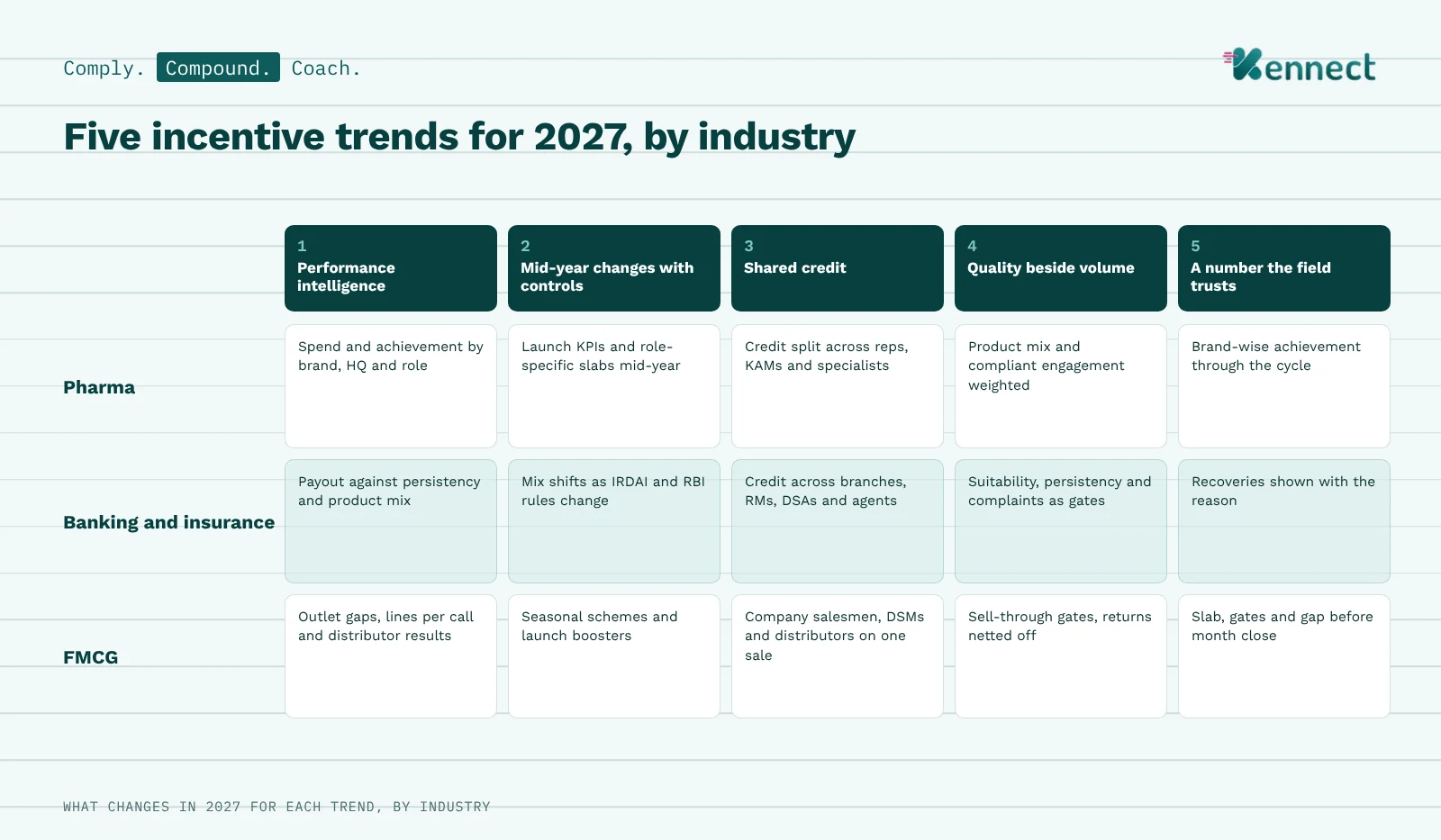
Incentive spend and achievement by brand, HQ and field role, side by side
Banking and insurance
Payout against persistency, retention and product mix, by branch and channel
FMCG
Outlet-level gaps, lines per call, product mix and distributor performance
Incentive data earns its place when it explains results to leadership.
Plans change mid-year, with controls around each change
Annual plans start with clear priorities. A launch brand, a new channel or a portfolio push. Then the year moves:
A new product launches.
A competitor changes price.
A region falls behind plan.
A regulator changes the rules.
The plan has to follow. Each change means a new KPI, eligibility rules, slabs and approvals. In spreadsheets, that takes weeks. By then, the quarter has gone.
Incentive design is also less uniform than it was. WorldatWork and CAP surveyed 580 organizations in 2026. Short-term incentives were near universal. Design varied by size, industry and ownership.
Take a pharma launch. The current plan pays on total brand sales. Leadership now wants the new brand pushed in two therapy areas. The team needs a launch KPI and the roles that qualify. It needs the slab and its weight. It also needs the cost before anyone sees the plan.
A good mid-year change process lets the team:
Build a KPI from existing plan parts.
Model the cost on past months before launch.
Route the change through review and approval.
Keep the old version on record with its dates.
Frequent changes confuse the field. The aim is to change fast when the business needs it. AI can draft the plan. Plan owners still validate rules, assumptions and cost.
Industry
What changes in 2027
Pharma
Launch KPIs, therapy area priorities and role-specific slabs added mid-year
Banking and insurance
Product mix shifts as IRDAI and RBI rules change pay for distributors and staff
FMCG
Seasonal schemes, launch boosters and coverage targets added without breaking slab tables
Model, approve and date every plan change before the field sees it.
Credit is shared across teams, channels and partners
A sale now passes through several hands. In pharma, field reps, key account managers, medical and digital teams all touch a prescriber. In banking, branch staff and relationship managers share one customer. In FMCG, the company and distributor salesmen move the same case.
BCG surveyed more than 100 biopharma and medtech leaders in 2025. 95% named low connectivity across teams as a top barrier to omnichannel success.
Individual targets still matter. The change is in what sits beside them:
Team or regional achievement.
Portfolio contribution.
Channel credit for digital and assisted sales.
Credit for specialist and support roles.
Payouts to partners outside payroll, such as distributors, DSAs and corporate agents.
That last group grows every year. Their schemes often run in separate sheets, outside the main plan. Shared credit only works when every payee sits on the same rules.
Industry
What changes in 2027
Pharma
Credit split across field reps, key account managers and specialist teams
Banking and insurance
Credit split across branches, relationship managers, DSAs and corporate agents
FMCG
Company salesmen, distributor salesmen and distributors paid on one sale
Shared credit needs one rule engine for every payee type.
Quality measures sit beside volume
Volume alone rewards the wrong sale. A bank can sell a product the customer did not need. A pharma team can chase prescriptions in ways the code bars. An FMCG team can load distributors with stock that returns next month.
Indian regulators are writing quality into the rules:
Banking. From 1 January 2027, RBI requires that bank incentive policies do not encourage mis-selling. Third-party providers cannot pay incentives to bank staff.
Insurance. IRDAI's September 2026 draft proposes commission caps, seller-level tagging and clawback for mis-selling.
Pharma. UCPMP 2024 bars gifts and personal benefits to healthcare professionals. A company's CEO self-declares compliance.
Source: RBI press release, 15 June 2026; IRDAI consultation paper, 23 September 2026; Department of Pharmaceuticals, UCPMP 2024, 12 March 2024
Executive plans are moving the same way. In 2025, just over half of large US public companies mixed financial and non-financial measures. That applied to their short-term executive plans.
For sales plans, quality measures work as gates, multipliers or deductions:
Persistency and early lapse in insurance.
Suitability, complaints and portfolio quality in banking.
Secondary sales against primary, and returns, in FMCG.
Product mix and compliant engagement in pharma.
Keep the list short. Three or four measures the field understands beat ten it ignores.
Industry
What changes in 2027
Pharma
Product mix and compliant engagement weighted beside sales
Banking and insurance
Suitability, persistency and complaints act as gates on payout
FMCG
Sell-through gates on primary slabs, and returns netted off
A plan that pays only for volume will pay for the wrong sale.
The field sees and trusts its number
A well-designed plan fails if the field cannot follow it. Salesmen ask the same questions every month:
How is my incentive calculated?
Why is it lower than I expected?
How far am I from the next slab?
Has my data been updated?
Who do I ask?
Each question lands on sales ops, HR or the payout desk. Unanswered, it turns into distrust.
A 2026 Business Horizons study surveyed employees on pay. A majority wanted to know more about how pay is set.
Source: Heisler, W., Pay transparency: How much disclosure do employees want?, Business Horizons, vol. 69, 2026
Clarity in 2027 looks like this:
Rules and eligibility visible in the app the field already uses.
Earnings and the gap to the next slab, updated with each data load.
A plain explanation of each payout and each recovery.
Routine questions answered automatically.
Exceptions raised with the right data, and tracked to resolution.
Industry
What changes in 2027
Pharma
Reps see brand-wise achievement and payout through the cycle
Banking and insurance
Branch and relationship teams see recoveries with the reason
FMCG
Salesmen see slab, gates and gap before the month closes
See how slabs and gates work for FMCG field teams.
A plan the field cannot follow will not change what it does.
What the five trends ask of leadership in 2027
Payout calculation stays essential. Around it, the function changes:
From
To
Payout reporting
Performance intelligence
Annual plans, hard to change
Mid-year changes, modeled and approved
Individual credit only
Shared credit across teams and partners
Volume only
Volume with quality gates
Manual queries
Visible numbers and automated answers
Five questions for sales, finance and payout leaders:
Can we explain incentive spend by product, region and role?
How long does a new KPI take, from idea to approved plan?
Do our plans credit everyone who moves a sale, partners included?
Which quality measures gate our payouts today?
Can every seller see their number and its reason?
Answer the five questions before the 2027 plan year opens.
How Kennect supports the five trends
Kennect is an AI-led sales performance and incentive compensation management platform. One rule engine runs every variable payout. That covers field incentives, distributor claims, dealer schemes and partner commissions. Here is how it maps to the five trends:
Compound: performance intelligence. The management cockpit shows payout and achievement by product, region and role. KAI Insights answers leadership questions on payout outcomes.
Compound: mid-year plan changes. KAI Simulations builds a plan or KPI from a plain description. Scenario modeling replays the plan on past months before launch.
Comply: shared credit. One rule engine covers every payee type, with hierarchy stored month by month.
Comply: quality gates. Gates block or reduce payout. Every plan version, change and approval is logged.
Coach: field clarity. Each seller sees slab, gates and gap. KAI Nudges sends earnings summaries and next steps.
KAI in practice. A sales head asks which region spent most per rupee of growth. KAI Insights answers from the latest data load. A rep asks why a payout dropped. KAI Exceptions traces it from plan and KPI to source data.
Kennect turns incentive data into decisions leadership can act on.
The 2027 plan year starts with this year's data.
Load one current plan into Kennect. See where it pays for quality and where it does not.
There are five. Leadership wants performance intelligence beyond payout reports. Plans change mid-year with controls. Credit is shared across teams, channels and partners. Quality measures sit beside volume. The field sees and trusts its number. From 1 January 2027, RBI's directions push quality into bank incentive plans.
AI answers leadership questions on payout data. It drafts plans and KPIs, and resolves routine field queries. In McKinsey's 2026 survey, 80% of respondents said AI improved their productivity. Results depend on clean data, clear rules and human approval.
Incentive compensation management calculates and pays incentives. Sales performance management is wider. It covers target setting, plan design, analytics and coaching. Incentive calculation sits inside it. See incentive compensation management for the narrower scope.
No, individual targets stay, with shared measures beside them. In complex sales, several people and partners move one sale. Team, portfolio and channel credit recognize that. In BCG's 2025 survey, 95% of biopharma and medtech leaders named low team connectivity a top barrier.
Pick three or four the field understands. Insurance uses persistency and early lapse. Banking uses suitability and complaints. FMCG uses secondary sales against primary. Pharma uses product mix and compliant engagement under UCPMP 2024. For insurance, see how IRDAI's commission caps would change incentives.