Two-thirds of winning sales organizations run structured coaching programs, against about 55% of laggards (Bain, 2026).
In this blog:
Why performance tracking stops short of coaching
Where AI fits in a sales manager's week
Why the incentive plan belongs in every coaching conversation
What to check before an AI nudge reaches a rep
I've sat through a lot of monthly sales reviews, and they rarely change. A zonal manager opens the dashboard. The red cells get discussed. Reps nod and head back to the field. Nothing in that hour tells a rep what to do on Monday. The dashboard tracked performance well enough. It coached nobody. I think AI can close that gap, as long as it starts where reps already look: their payout.
Ask your national sales manager this week: which three reps are nearest their next slab, and do they know it?
Table Of Content
Why performance tracking stops short of coaching
Tracking tells a manager what happened. Coaching changes what happens next. The gap between the two costs selling capacity.
A typical review runs on lagging numbers: achievement against target month to date, calls logged, orders booked. These show who is behind. They rarely show why.
McKinsey's July 2026 report on B2B sales describes the same pattern. Reviews lean on lagging indicators and pipeline movement, while missed follow-ups and stalled deals get too little attention. Coaching quality then depends on which manager a rep happens to report to.
For the company, that variance shows up in three places. Managers spend hours building reports when they could be coaching. Reps in the middle band drift without a plan. And reps who can't see a higher payout stop stretching for it.
Structure helps. Bain's January 2026 survey of 1,125 commercial leaders found two-thirds of winning companies use structured coaching programs, with templates and playbooks. Among laggards, it was about 55%.
A dashboard of past numbers leaves managers guessing the next move.
Where AI fits in a sales manager's week
AI handles a narrow set of jobs well. It reads large volumes of data quickly, spots patterns across hundreds of reps and ranks what needs attention first.
Gartner's May 2026 research puts a number on it. Gartner surveyed 227 chief sales officers. Teams giving sellers AI-recommended next actions were 2.6 times likelier to achieve commercial growth.
The same research shows where people still lead. Gartner also surveyed 645 B2B buyers. On understanding their needs, reps beat GenAI by 39 points.
So the split of work is fairly clear. AI does the scanning, and the manager holds the conversation. Before Monday, a manager could have three answers ready. Who needs support this week, ranked by gap to target? Where is performance slipping, by product, outlet type or segment? And which action moved the number for similar reps?
AI does the scanning, so the manager's hour goes to coaching.
Why the incentive plan belongs in every coaching conversation
Ask a rep what they're working toward this month. The honest answer is usually a payout figure. Coaching that leaves the incentive plan out misses why reps act.
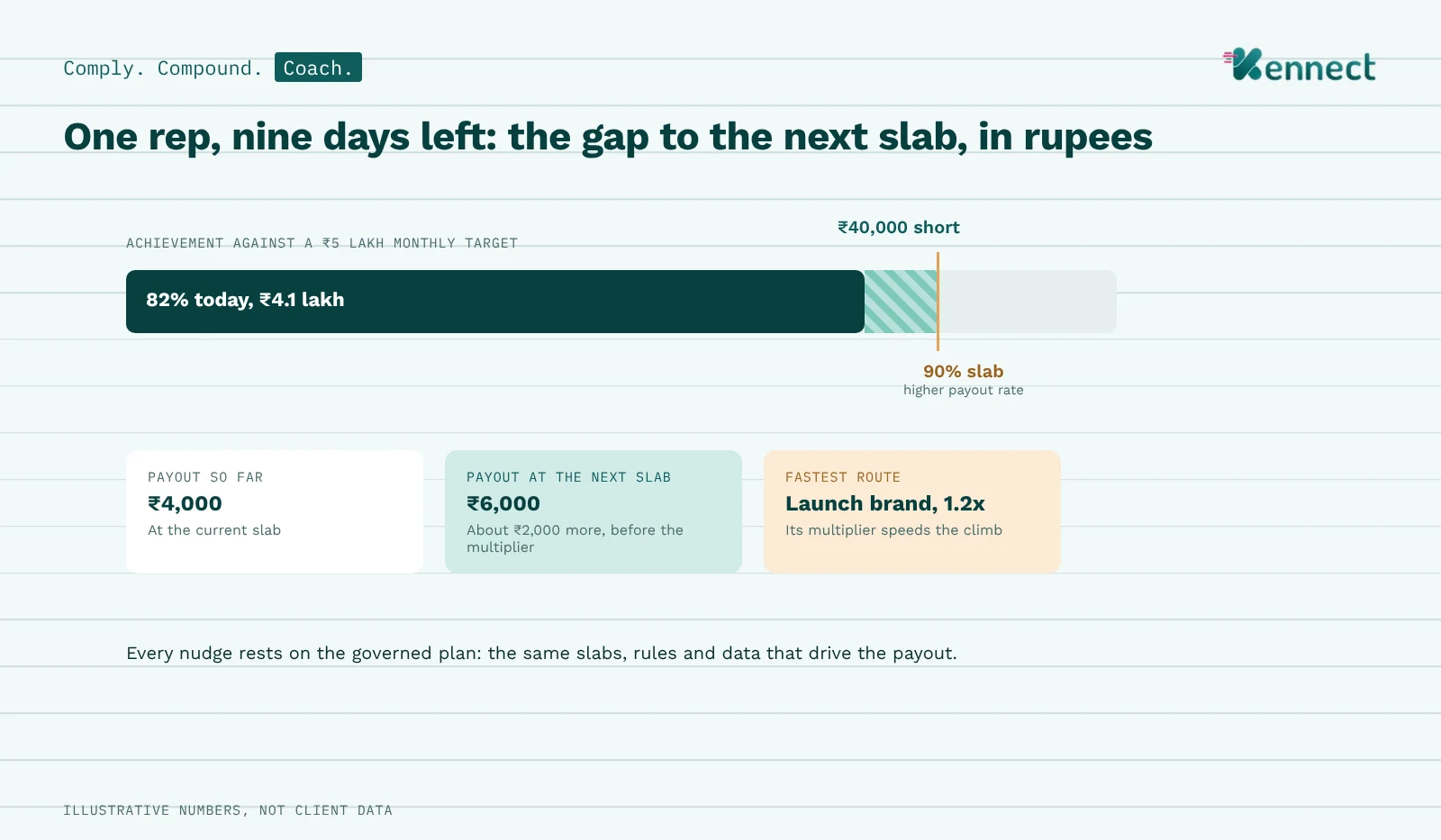
Take a medical representative in a pharma field team. She's at 82% of target with nine days left. The next slab pays a higher rate, and a new launch brand carries a multiplier.
What she sees
Today
With coaching
Achievement
82% of a ₹5 lakh target
₹40,000 short of the 90% slab
Payout so far
₹4,000 at the current slab
₹6,000 at the next slab
Fastest route
Not shown
The launch brand, with its 1.2x multiplier
What the push is worth
Not shown
About ₹2,000 more, before the multiplier
Illustrative numbers, not client data.
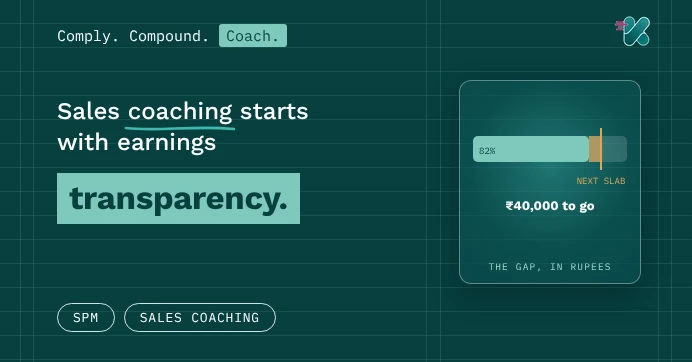
A tracking dashboard marks her amber. A coaching conversation shows her how far the next slab is, which brand gets her there fastest and what it's worth in rupees. That last number changes behavior. It turns a target into a choice she can weigh.
McKinsey's report includes a coaching case from a construction company. Its AI tool worked from captured customer conversations, and reps who used it saw conversion rise 4.5 percentage points. That case is about selling skill. We think the same principle holds for earnings. Reps act on a specific step more readily than on a general target.
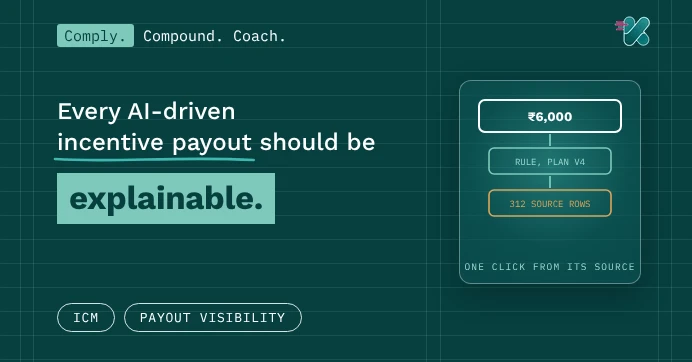
This is where growth and governance meet. Every nudge has to rest on the governed plan: the same slabs, rules and data that drive the payout. Otherwise a nudge can promise money the plan won't pay.
Reps act on coaching they can price in rupees.
What to check before an AI nudge reaches a rep
A nudge is a small promise. If the numbers behind it are wrong, trust breaks fast. Four checks matter before any AI suggestion reaches the field:
Source data. Does the nudge read the rep's calculated payout data?
Plan version. Does it use the plan version effective for this period?
Explanation. Can the rep or manager trace why this action was suggested?
Fairness. Are nudges reviewed for patterns that favor some teams or regions?
Adoption needs real budget. McKinsey has estimated about $3 of change management for every $1 spent on AI deployment. For coaching, that spend goes into manager habits, like opening every one-on-one with what to do next.
Trust in a nudge rests on the payout data behind it.
How Kennect supports coaching today
Kennect is an AI-led sales performance and incentive compensation management platform. Its Coach features share the rule engine that calculates payouts, so reps and managers see one set of numbers.
Coach: personal cockpit. Each rep sees achievement, current slab and earned payout for the period.
Coach: what-if simulator. A rep enters a sales figure and sees the resulting payout.
Comply: payout visibility. A rep sees how each payout line was calculated.
Compound: management cockpit. A manager sees team achievement against target across the hierarchy.
Coach: leaderboards. Reps see ranked achievement within a team or region, on the same tracker.
KAI in practice. A manager asks which reps sit within 10% of their next slab. KAI Insights lists them, with the KPI each one is short on. The Monday one-on-ones start from that list.
Coaching and payout should run on the same numbers.
AI ranks which reps need support and where results slip. Gartner surveyed 227 chief sales officers in 2026: teams giving sellers AI-recommended next actions were 2.6 times likelier to grow. Managers then spend the saved time coaching.
Tie each nudge to the rep's calculated payout data. Run four checks: source data, plan version, explanation and fairness. Skipped checks can promise money the plan won't pay.
Bain's 2026 survey suggests it does. Two-thirds of winning sales organizations run structured coaching programs with templates and playbooks, against about 55% of laggards.