Incentive app adoption in FMCG rises when salesmen see rupees
November 16, 2026
Puneet Gupta
Puneet Gupta
Key Insights
India had 958 million people actively online in 2025, 548 million of them rural (IAMAI and Kantar, 2026).
In this blog:
Why FMCG salesmen skip incentive apps
Four adoption pain points FMCG teams raise
What brings a salesman back to the app all month
What daily app use means for each FMCG leader
Many FMCG companies have tried an incentive app or dashboard. Usage peaks in launch week, then fades. Leaders blame the field. The field has a simpler reason. The app showed percentages, with no money attached. It said nothing about what to do today. Questions still went to the ASM. Fix those, and salesmen open it on their own.
Ask your MIS head this week: how many salesmen opened the app last week?
Table Of Content
Why FMCG salesmen skip incentive apps
Phones aren't the barrier. India had 958 million people actively online in 2025. 548 million of them were rural. 44% already use AI features like chatbots and voice search.
So salesmen are online, and they use apps every day. They skip incentive apps because those apps say nothing worth knowing.
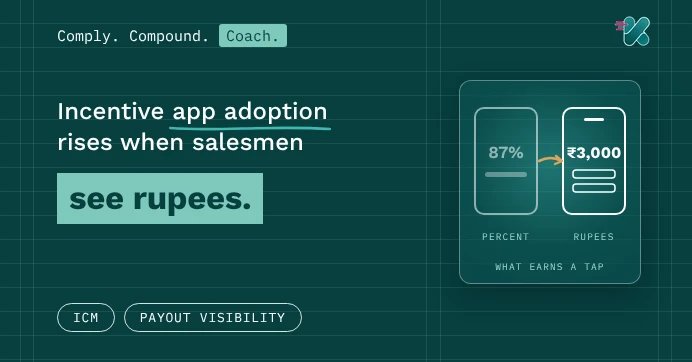
A view of "87% achieved" rarely earns a tap. A view of "₹3,000 unlocks with three more outlets" does.
Salesmen open apps that show their own money, in rupees.
Four adoption pain points FMCG teams raise
1. Percentages don't move anyone
What we heard: one FMCG company's SFA shows daily progress against its target. It doesn't show the payout.
Progress bars look tidy. A salesman thinks in rupees he can take home.
Show earnings per KPI, in rupees, every day. Show what the next slab pays.
Fix: turn every percentage into rupees.
2. Nothing says what to do today
What we heard: one FMCG team asked about nudges. How would they reach salesmen, and in which language?
Even with rupees on screen, he must guess which task pays today. Many pick the easy one.
Send nudges that name one action and its rupee value. Deliver them in the app or on WhatsApp. Use the language he reads, synced from the SFA. Cap nudges at one or two a day, so they stay worth reading.
Fix: one nudge, one action, one rupee value, in his language.
3. Earnings stay at zero until the 25th
What we heard: at one FMCG company, earnings show as zero until the 25th. Salesmen learn the rest after payout.
Some schemes lock earnings until a gate clears. If the app shows zero, the salesman stops looking. By the 25th, it's too late.
Show locked amounts, the gate that unlocks them and the gap. Add a what-if planner. He can test a target and save it as a goal.
Fix: show locked earnings and the gap, all month.
4. Questions go to the ASM instead of the app
What we heard: one FMCG IT team asked if every salesman would get the chatbot.
When the app can't explain a number, the salesman calls his ASM. The ASM emails MIS. The app looks useless.
Let the salesman ask the app directly. Why is my incentive locked? Which gate did I miss? Answers should come from the calculation. See how AI answers the field's money questions.
Fix: answer the field's questions inside the app.
Each fix gives the salesman a rupee reason to open the app.
What brings a salesman back to the app all month
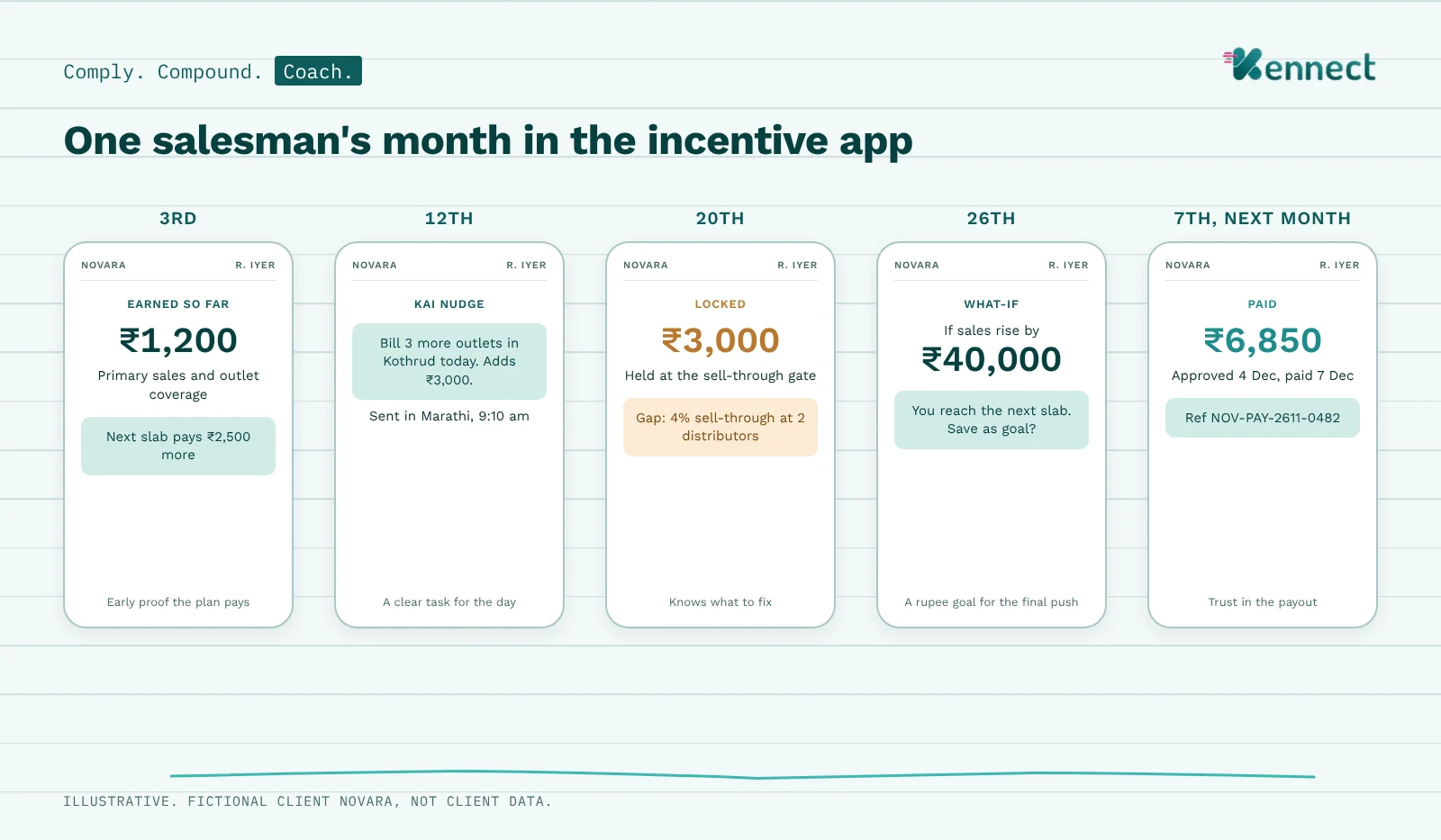
Here is what one salesman might see across a month.
Day
What he sees
Why he opens it
3rd
Earned so far: ₹1,200
Early proof the plan pays
12th
Nudge: bill 3 more outlets to unlock ₹3,000
A clear task for the day
20th
₹3,000 locked behind the sell-through gate
Knows what to fix
26th
What-if: ₹40,000 more in sales reaches the next slab
A last push with a rupee goal
7th, next month
Approved, paid, with date and reference
Trust in the payout
Illustrative example, not client data.
Each visit answers a real question. That is what builds the habit.
Measure adoption the same way every month. Track three numbers:
Weekly active salesmen. The share who opened the app at least once that week.
Nudge action rate. The share of nudges followed by the named action within a few days.
Queries per 100 salesmen. Incentive questions that still reach the ASM or MIS.
Set a baseline in the first month, then watch the trend. For where the app should sit, see incentives inside the SFA app.
Give the salesman a reason to open the app every week.
What daily app use means for each FMCG leader
When salesmen use the app daily, the benefit spreads company-wide. Here is how.
Leader
Their question
What this approach gives them
CEO or MD
Are incentives changing field behavior?
Salesmen see rupee goals and act on them daily
CFO
Is incentive spend reaching the right actions?
Nudges tie spend to specific actions
Sales head (CSO or NSM)
Why does my team chase the easy task?
Nudges that name the action that pays
CHRO
Do salesmen understand their pay?
Earned, locked and next slab, in their language
CIO or IT head
Is this another app to support?
Embedded in the SFA, with the SFA login
ASMs and managers
Why do I field every incentive query?
Answers from the calculation, inside the app
MIS or sales ops
Can we cut the query load?
Queries per 100 salesmen, tracked monthly
When the field uses the app, every leader feels the difference.
How Kennect and KAI drive daily use
Kennect is an AI-led sales performance and incentive compensation management platform. One rule engine runs salesman incentives, distributor claims and dealer schemes.
Coach: a daily tracker in rupees. Each salesman sees earned and locked amounts and the next slab. It opens inside the SFA, with the SFA login, or as a standalone app. See the personal cockpit.
Coach: KAI Nudges.Nudges name the next action and its rupee value. They arrive in the app or on WhatsApp. Everything on screen switches to local languages, and the setting can sync from the SFA.
Coach: what-if planning. A what-if planner lets salesmen test targets and save goals.
Coach: KAI Exceptions. Questions go to KAI inside the app, and the ASM stays free to coach. More for sales reps.
KAI in practice. On day 20, a salesman asks what is holding up his payout. KAI Exceptions names the sell-through gate and the gap. He checks two distributors' stock before pushing more.
Kennect gives salesmen a reason to open the app every day.
Built an incentive app nobody opens?
See the rupee view your salesmen would get, on your own plan.
Usually because the app shows percentages without rupees and says nothing about today's task. Show earnings in rupees and send nudges with a rupee value.