Pharma field force incentive management starts with a time map
November 22, 2026
Pulkit Agarwal
Pulkit Agarwal
Key Insights
Fewer than half of organizations share incentive updates with all participants (Pearl Meyer, 2025).
In this blog:
What an incentive time map is
Why timing breaks pharma field force incentives
How to build a time map for a field force
How Kennect runs incentives on a time map
When pharma teams show me their incentive process, they start with the plan. Slabs, gates, product weights. Rarely do they start with the calendar. Yet many payout problems I see begin with a date. Secondary data lands after the cutoff. An MR changes HQ mid-month. A launch brand joins the plan halfway through a quarter. The plan was right. The dates were never written down. A time map fixes that. It puts every date that touches an MR's payout in one place. It does so before the month begins.
Ask your sales ops lead this week: can you show me every date that affects this month's payout?
Table Of Content
What an incentive time map is
A time map is a calendar of every date behind an MR's incentive. It shows when each event happens, what it changes and who owns it.
It covers five kinds of dates:
Plan dates. When the plan year, quarters and contests start and end.
Data dates. When primary sales, secondary sales, stockist data and call data arrive.
Cutoff dates. The last day each data source counts for a given month.
People dates. Joins, exits, transfers, HQ changes, promotions and leave.
Payout dates. When statements go out, queries close and payroll runs.
Teams usually know these dates. They live in different heads and different inboxes. A time map puts them on one page.
The gap is common. Pearl Meyer surveyed nearly 280 organizations in June 2025. Fewer than half shared incentive updates with all participants. Only 17% explained how individuals can influence results.
If a date can change a payout, it belongs on the time map.
Why timing breaks pharma field force incentives
Pharma incentives run on data from many sources. Each source keeps its own clock. That is where things go wrong.
Secondary data arrives late. Primary sales come from the ERP on time. Secondary sales depend on stockists sharing their data. Some send it in the first week. Some send it much later. Without a fixed cutoff, every month's numbers keep moving.
People change mid-month. An MR moves HQ on the 14th. A new joiner starts on the 20th. A manager goes on long leave. Each change splits the month. Without a rule for that split, someone decides by hand.
Plans change mid-cycle. A launch brand enters the plan in month two of a quarter. A contest runs for six weeks. A target is revised after a price change. Each change needs a start date. Each start date needs a rule.
Periods overlap. Monthly payouts sit inside quarterly gates. Quarterly gates sit inside an annual plan. A late correction in one month can flip a quarterly result.
The plan design can be sound and still fail on dates. The cost shows up as late payouts, retro adjustments and disputes.
A good plan with no calendar still pays people wrong.
How to build a time map for a field force
A first version takes about a week. Start simple and add detail each cycle.
List every input in the plan. Primary sales, secondary sales, doctor coverage, call compliance and any manual inputs.
Write down when each input arrives. Use real arrival dates from the last few months. Planned dates hide the delays.
Set one cutoff per input. Decide the last day that counts for the month. Data after the cutoff moves to next month, by rule.
Set rules for people events. Decide how joins, exits, transfers and HQ changes split a month. Write the rule once.
Set the correction rule. Decide how late corrections to closed months are paid or recovered.
Fix the payout calendar. Set dates for statements, rep queries, approvals and payroll.
Name an owner for every date. Each date needs one person who makes sure it happens.
Share it with the field. MRs and managers should know the dates too.
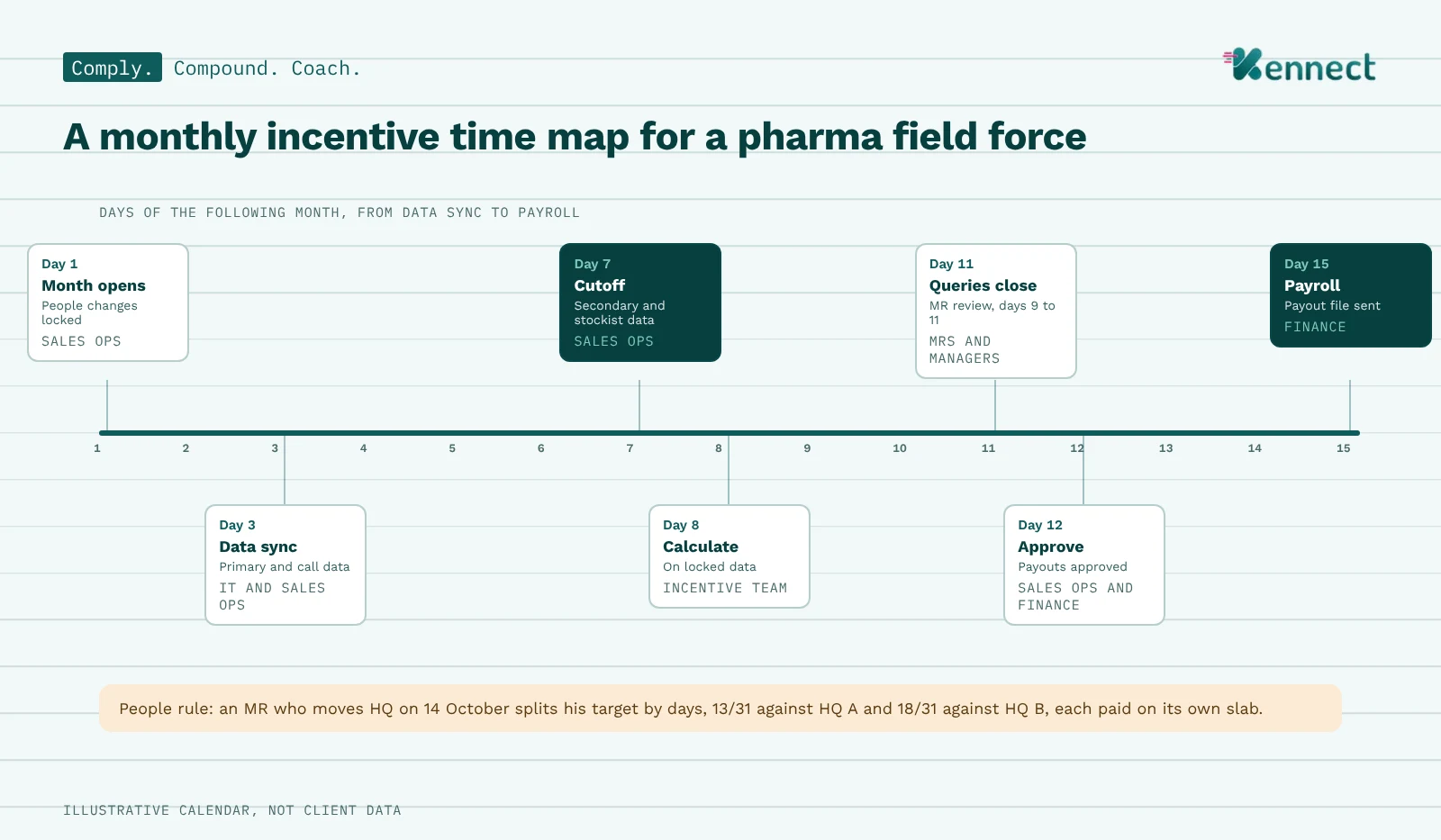
Here is a sample monthly time map. Dates will differ by company, but the shape is similar.
When
What happens
Owner
Day 1
New month opens; people changes from last month are locked
Sales ops
Days 1 to 3
Primary sales and call data sync for last month
IT and sales ops
Day 7
Secondary and stockist data cutoff
Sales ops
Day 8
Incentives calculated on locked data
Incentive team
Days 9 to 11
MRs review statements and raise queries
MRs and managers
Day 12
Queries closed and payouts approved
Sales ops and finance
Day 15
Payout file goes to payroll
Finance
Illustrative calendar, not client data.
Add plan-level dates on top: quarter-end gates, contest windows and the annual plan reset.
Here is how a people rule works. An MR moves from HQ A to HQ B on 14 October. He spent 13 of 31 days in HQ A, and 18 in HQ B. The rule splits his target by days: 13/31 against HQ A's target and 18/31 against HQ B's. Achievement is counted in each HQ for the same days. Each part pays on its own slab. The two parts add up. The rule is written once and applied to every move.
Illustrative example, not client data.
Write the dates down once, and stop deciding them every month.
What a time map fixes
With fixed dates, the same problems stop coming back.
Late payouts. Everyone knows when data must arrive. Delays show up early, well before payout day.
Moving numbers. Cutoffs lock each month's data. Late data rolls forward by rule, so closed months stay closed.
Late corrections. A correction to a closed month carries into the next payout. Recoveries follow the same rule as commission clawbacks.
Manual splits. Transfers and HQ changes follow a set rule. Nobody decides case by case.
Disputes. MRs know when statements arrive and when queries close. Questions come in on time, with a clear deadline. See how MR incentive disputes start.
Finance surprises. Accruals follow a known calendar. Finance can plan incentive cost through the month.
Audit questions. Every number ties to a dated input and a dated rule.
Trust changes too. When MRs see the same calendar every month, payouts feel predictable. Predictable pay is easier to believe.
A time map turns a monthly scramble into a routine.
How Kennect runs incentives on a time map
Kennect is an AI-led sales performance and incentive compensation management platform. Pharma teams at AstraZeneca, GSK, Sanofi and Boehringer Ingelheim run incentives on it. The time map is built into how the platform works.
Comply: scheduled data sync. Sales, stockist and CRM data flow in through APIs on set dates.
Comply: cutoffs by rule. Each input has its own cutoff. Late data moves to the right month automatically.
Comply: dated people changes. Transfers, HQ changes, joins and exits carry an effective date. Payouts split by rule.
Comply: plan versions with dates. New brands, contests and target changes apply from their start date.
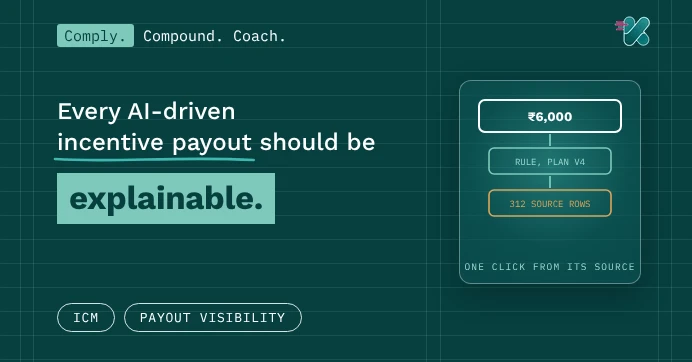
Comply: full audit trail. Every payout links to its dated inputs and the rule that applied.
Coach: payout calendar. Statements, query windows and approvals follow the same dates every month. The field can see them.
KAI in practice. An MR asks why a sale didn't count this month. KAI Exceptions explains it from his own data. The stockist data may have arrived after the cutoff. He sees the reason and when it will count. Fewer questions reach sales ops.
With the dates built in, the plan can do its job.
Many payout problems start with a date.
See an incentive calendar become rules that run every month.
A time map is a calendar of every date that affects a sales rep's incentive. It covers plan periods, data arrival dates, cutoffs, people changes and payout dates. Each date has an owner and a rule. Nobody remakes the same decisions by hand.
Set a fixed cutoff for secondary and stockist data each month. Data after the cutoff rolls into the next month by rule. Closed months stay closed, and payouts stop changing after approval.
Give every HQ change an effective date. Then split the month by a set rule. A common rule splits target and achievement by days worked in each HQ. Write the rule once and apply it the same way every time.
It depends on when the data arrives. That is why a time map comes first. With fixed cutoffs and automatic data sync, many teams close within the first half of the next month. See how a pharma payout close runs in five days.
Include plan start and end dates, quarter-end gates and contest windows. Add data arrival dates and cutoffs for each input. Add rules for joins, exits and transfers. Finish with statement dates, query windows, approval dates and the payroll date.