A new product launch incentive should pay for early signals.
October 23, 2026
Pulkit Agarwal
Pulkit Agarwal
Key Insights
In the twelve months to November 2025, new introductions added 2.1 percentage points to the growth of India's pharma market. Volume added 0.5 points. Every launch review I have sat in comes back to one question: how much field attention will the new brand get in its first quarter?
The answer usually sits in a kicker designed late and paid later. It pays on revenue, which a new product barely has in its first weeks, and it settles at quarter end, long after the field has moved on.
A new product launch incentive works better when it pays for early signals. Reach comes first, then first prescribers or first orders, then repeat orders, then sales. Each payment should cite the record it came from and arrive in the month it was earned. Research on reward timing found an immediate bonus raised persistence by 35%, against 19% for a larger reward paid later.
A question worth asking the head of sales before the next launch: which signal will the field be paid for in the first 30 days?
Table Of Content
What new products add to India's pharma market
India's pharmaceutical market closed calendar 2025 at about ₹2,40,672 crore, up 8.1%, on Pharmarack data reported by ANI. In the twelve months to November 2025, new introductions added 2.1 percentage points of the market's 8% growth. Volume added 0.5 points.
IQVIA data for the year to March 2026 tells a similar story: about 10% growth, with 2.8 points from new products.
For a CEO or CSO, that makes the launch calendar a growth line in its own right. The launch incentive decides how much field attention each new brand gets in its first quarter.
Sources: Pharmarack, as reported by ANI in The Tribune, 8 January 2026 · IQVIA, financial year 2025-26, as reported by HDFC Sky · growth contributions in percentage points of total market growth
New introductions add more to market growth than volume does, so the launch incentive is a growth decision.
Why a launch incentive needs its own design
A standing plan pays on sales against a target built from history. A new product has no history, and its sales in the first weeks are too small to separate effort from luck.
What the first weeks do show is adoption. A doctor detailed on the new brand, a first prescription, a first stockist order and a repeat order all appear months before the revenue settles.
A launch has no history to set a target from, so the first weeks need measures that show adoption.
What a launch kicker should pay for in the first 90 days
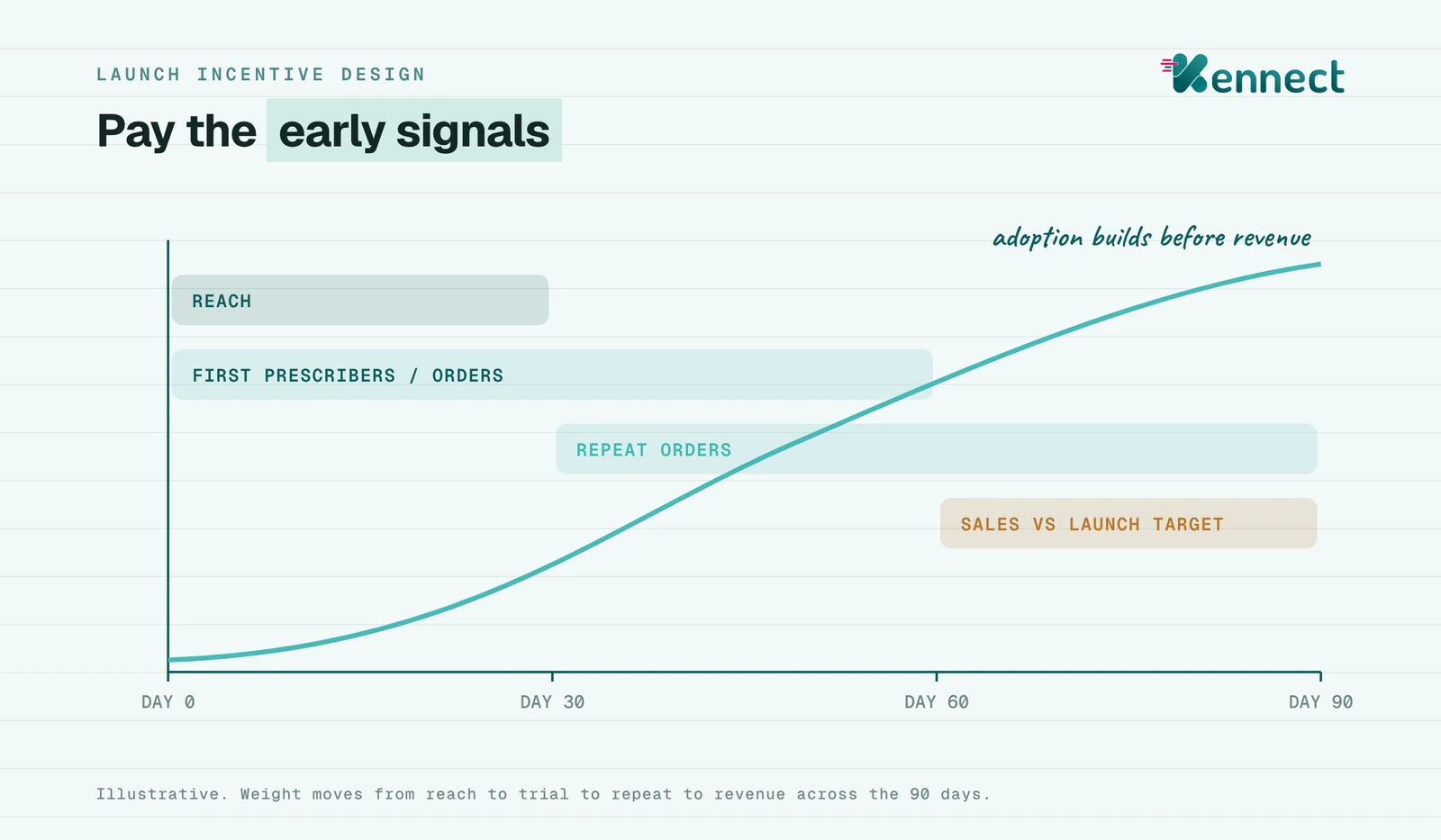
A launch kicker works when its weight moves from activity to adoption to sales as the quarter runs. Each phase pays on a signal the field can influence and the company can record.
Early adoption signals for a new product launch incentive, by phase
Phase
Signal to pay on
Why it predicts the launch
Where the data sits
Days 1 to 30
Target doctors or outlets reached with the new brand
Reach comes before any prescription or order
SFA call and visit records
Days 1 to 60
First prescribers or first stockist orders for the brand
Trial is the first sign of demand
Secondary sales and stockist data
Days 31 to 90
Repeat prescribers or repeat outlet orders
Repeat purchase separates adoption from trial
Secondary sales and DMS data
Days 61 to 90
Sales against the launch target
Revenue confirms the earlier signals
ERP and secondary sales
The activity phase has evidence behind it. In a three-year field study of a pharma sales force in South Asia, Rao, Viswanathan, John and Kishore found sales gains of 6% to 9% from each of two activity-based incentive interventions. Incentives aimed at supervisors were the more cost-efficient design.
Illustrative. The launch kicker's weight moves from reach to trial to repeat to revenue across 90 days.
In FMCG and consumer durables, the same structure applies with outlets billed for the new SKU, repeat orders and display compliance in place of prescribers.
Pay reach first, trial second, repeat third and revenue at the end, and each payment should cite the record it came from.
How to design a launch incentive for a new product
Seven decisions settle a launch kicker before it reaches the field.
Write it as a dated scheme. Give it a start date, an end date, the eligible roles and the products, separate from the standing plan.
Shift the weight across the phases. Pay mainly on reach in month one, on trial in month two and on repeat and sales in month three.
Pay in the month it is earned. An early reward does more than a larger reward paid at quarter end.
Let many reps win. In a field study, Lim, Ahearne and Ham found that sales contests with several winners outperformed a contest with one winner. Thresholds that many reps can cross work better than a top-ten list.
Include first-line managers. A manager kicker tied to team adoption spreads the launch across every territory.
A launch kicker costed under three adoption scenarios gives finance a number to approve and sales a ceiling to plan within.
A launch kicker with dates, phased weights, a budget ceiling and a closing reading can be approved, run and judged in one quarter.
Keeping a pharma launch incentive plan compliant
The Department of Pharmaceuticals notified the Uniform Code for Pharmaceutical Marketing Practices on 12 March 2024. UCPMP 2024 bars gifts for the personal benefit of healthcare professionals and cash grants to them. It bars companies from extending travel and hospitality to healthcare professionals for conferences and workshops, unless they attend as speakers. It caps free samples at 2% of domestic sales, with records of each sample given.
A launch incentive sits next to those rules. It should pay medical representatives on recorded, approved activity, such as calls on target doctors and samples logged within the cap. It should never pay on gifts or on prescriptions tied to a benefit given to a doctor.
Source: Department of Pharmaceuticals, Uniform Code for Pharmaceutical Marketing Practices 2024, notified 12 March 2024, as reported by PTI · this post is not legal advice
A launch incentive that pays on recorded, approved activity alone leaves a trail a compliance review can follow.
How Kennect runs a new product launch incentive
In the pharma and FMCG sales teams we work with, a launch kicker usually lives in a spreadsheet beside the main plan. So we run it inside the same engine, with its own dates, eligibility and cap, paid in the same cycle as the standing plan.
Scheme setup with AI. Admins define a launch KPI by describing it in a prompt, such as first prescribers for a brand in the first 60 days. Our AI KPI builder is live, and the same prompt-based plan builder follows shortly.
What the rep sees. Each rep sees the launch target, achievement and earning on every parameter, the slab reached and a what-if simulator for further business. AI-powered nudges tell a rep when the next slab is within reach. Reps also get a plain-language AI summary of what they have earned.
What the manager and leadership see. Managers get an AI coaching summary of where each team member stands on the launch. Every payout traces back to the plan and KPI behind it, with tracing to the underlying data following by the end of December 2026. Generative scenario modeling, expected between January and March 2027, will let a plan designer describe a change to a kicker and see its effect on payouts and cost.
In one Kennect deployment of 7,765 representatives, reps who used the app raised attainment by 4.2%, against 2.0% for reps who stayed off it.
Source: Kennect claim register · 7,765 representatives in the same role and plan, November 2025 against February 2026 · app users against reps who stayed off, same cohort · a correlation from an uncontrolled comparison
A launch kicker run in the same engine as the standing plan is visible to the rep, costed for finance and traceable for compliance.
What this means for the next launch
New introductions will keep adding to growth, and each launch will compete for the same field hours. The companies that pay early, on recorded signals, give a new brand those hours in the quarter that decides its trajectory.
A launch kicker that pays early, on recorded signals, gives a new brand the field attention it needs in its first quarter.
New products add 2 to 3 points of India's pharma market growth. A dated, phased and costed kicker turns that growth into a plan finance can approve.
See how Kennect runs launch incentives inside the same engine as the standing plan.