FMCG primary and secondary sales incentives need one sales credit rule
November 22, 2026
Puneet Gupta
Puneet Gupta
Key Insights
Traditional trade carried 85.3% of India's FMCG sales value in 2024 (NielsenIQ, 2025).
In this blog:
Primary and secondary sales: what each one rewards
Why both need one sales credit rule
Where sales credit rules break every month
Making secondary data usable for incentives
I ask every FMCG sales team one early question. Do you pay on primary or secondary sales? The answer is usually primary, because that data is clean. Secondary is closer to real demand, and much harder to get. Trouble starts when teams use both. Primary credit follows one mapping. Secondary credit follows another. One salesman then sees two stories about one distributor. My lesson is simple. Pay on primary, secondary or both. Credit them through one rule.
Ask your MIS head this week: who gets credit after a mid-month remap?
Table Of Content
Primary and secondary sales: what each one rewards
Primary sales are what the company bills to distributors. That data comes from SAP or another ERP. It is clean and on time. Primary rewards pushing stock into the channel.
Secondary sales are what distributors bill to retailers. That is much closer to real demand. The catch is data. Many distributors run their own systems and rarely share access. Some categories have two layers before the retailer. There, secondary may sit in no company system at all.
Primary sales
Secondary sales
What it measures
Company billing to distributors
Distributor billing to retailers
Where the data lives
SAP or another ERP
DMS, or distributor statements
Data quality
Clean and daily
Patchy, often monthly
What it rewards
Pushing stock into the channel
Selling stock out to outlets
Main risk
Month-end loading
Late or missing data
So, many FMCG teams pay on primary only. Others want secondary but track it by hand.
That gap matters, because sales still flow through distributors and kiranas. Traditional trade carried 85.3% of India's FMCG value in 2024. Even in the top eight metros, it held 62.5% in early 2025.
Primary is easy to measure. Secondary is closer to real sales.
Why both need one sales credit rule
A sales credit rule answers one question: whose sale is this? Credit here means whose target the sale counts toward. That decides who earns the incentive on it. The payout comes later, from the plan.
Companies usually answer it with a list. Each distributor is linked to one salesman. Each salesman reports to an ASM, and so on up. This list is called a mapping.
The same goods are sold twice. First, the company sells to the distributor. That is primary. Then the distributor sells to shops. That is secondary.
Problems start when each sale uses a different list. One salesman gets credit twice. Another gets nothing. Then come the arguments.
The fix is to use one list for both sales, for the same month. Then each salesman's two numbers match up. Only then can anyone fairly check whether stock is really selling.
One list, one month, used for both sales.
A simple example: one distributor, two salesmen
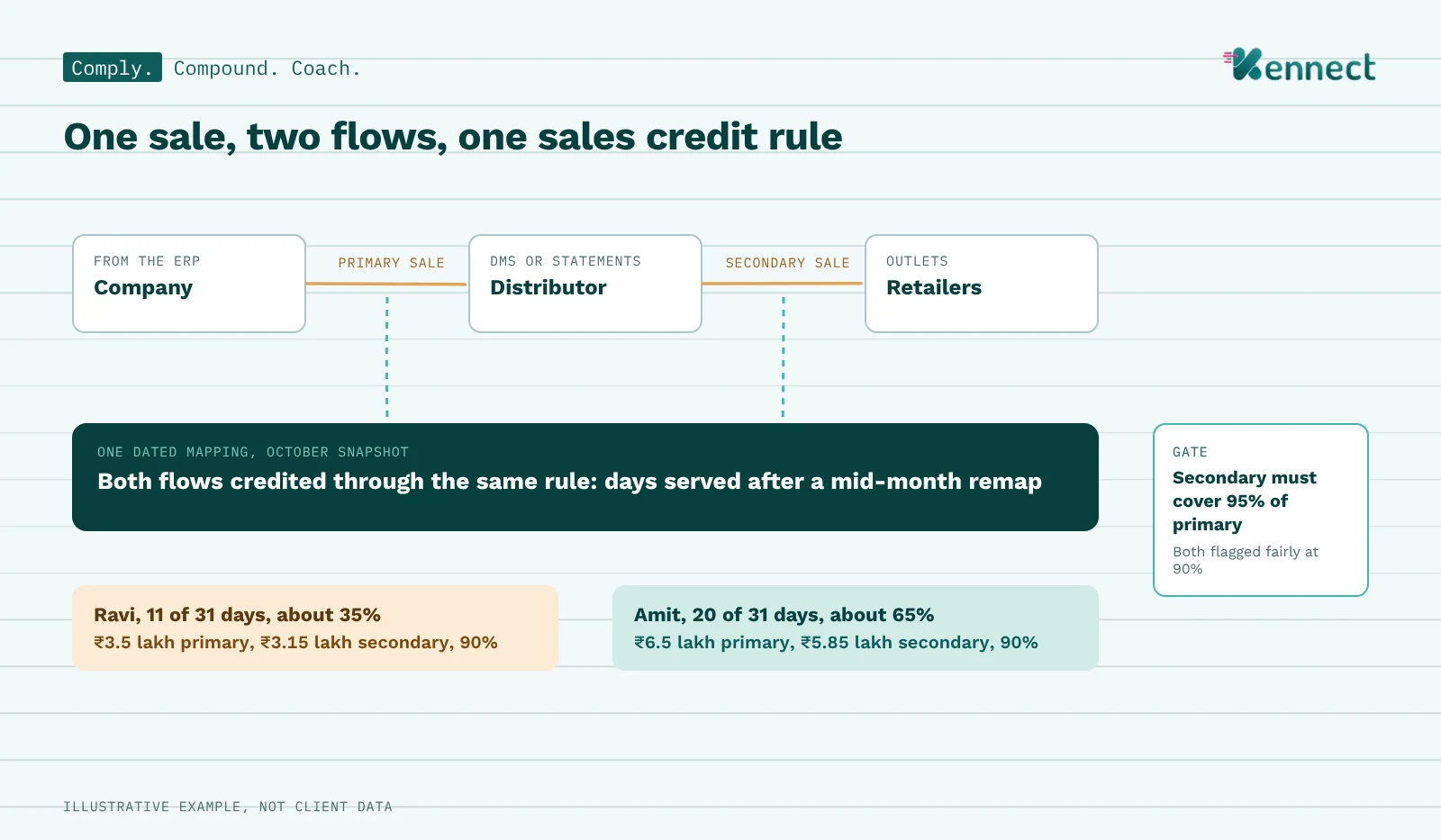
In October, one distributor is handed over from Ravi to Amit on the 12th.
That month, the company sells ₹10 lakh of stock to this distributor. ₹6 lakh of it is billed before the handover. The distributor then sells ₹9 lakh to shops. So 90% of the stock really sold.
Way 1: two different lists. Sales to the distributor go to whoever handled them on the invoice date. Sales to shops go to whoever owns the distributor at month-end.
Way 2: one list. Both sales are split by how many days each salesman looked after the distributor. Ravi had it for 11 of 31 days, about 35%. Amit had the rest.
October
Way 1: Ravi
Way 1: Amit
Way 2: Ravi
Way 2: Amit
Sold to distributor (primary)
₹6.0 lakh
₹4.0 lakh
₹3.5 lakh
₹6.5 lakh
Sold to shops (secondary)
₹0
₹9.0 lakh
₹3.15 lakh
₹5.85 lakh
Share that really sold
0%
225%
90%
90%
Illustrative numbers, not client data.
In Way 1, Ravi looks like he sold nothing to shops. Amit looks like he sold more than twice what came in. Both pictures are wrong.
In Way 2, both salesmen see the true picture: 90% sold. Say the plan pays only when secondary covers 95% of primary. Then both are flagged, fairly. The real issue is that the distributor holds too much stock.
One list for both sales turns an argument into a fair answer.
Where sales credit rules break every month
Credit errors usually come from a few predictable changes.
Mapping changes mid-month. Save each period's mapping as a dated snapshot. Each month's incentive then uses that month's mapping.
Shared distributors. Two salesmen may serve one distributor. The split must be a written rule, applied the same way every month.
Returns and month-end loading. When stock comes back, recalculate the past month. Recover the difference in the next cycle. Our guide to commission clawbacks covers the mechanics.
Changing masters. Town tiers and outlet classes change over time. Date them, so past months stay as they were.
Write the rule once, and let the system apply it monthly.
How to write a sales credit rule: six questions
A credit rule fits on one page. Answer these six questions, and get sales, MIS and finance to sign off.
When a mapping changes mid-month, who gets credit? Pick one: date of change, month-end owner, or days served.
Does primary credit follow the invoice date or the delivery date? Use the same date logic for secondary.
Who gets credit for a vacant beat? Usually the manager, until the seat is filled.
How is a shared distributor split? A fixed ratio, or by each person's outlets served.
Do returns reduce the month of the return, or the month of the sale? Many teams recalculate the month of the sale.
Who can override a credit, and how is it logged? Overrides need an approver and a reason.
When the rule changes mid-year, record why. A mid-year plan change needs a written decision trail.
If the rule is not written down, every remap becomes a negotiation.
Making secondary data usable for incentives
Some distributors will not share system access. Use what they already send: stock and sales statements. The field forwards each statement as PDF or Excel. Automation reads the layout and maps products to the company master. It extracts opening and closing stock and secondary sales. It also pulls primary received and returns.
Next, numbers are checked against primary sales, at product and distributor level. Only then is the data saved. Clean secondary data then follows the same credit rule. The result is reliable monthly secondary data. Real-time secondary needs a live DMS.
Secondary data becomes usable once checked against primary.
How Kennect and KAI keep both flows aligned
Kennect is an AI-led sales performance and incentive compensation management platform. One rule engine runs salesman incentives, distributor claims and dealer schemes.
Comply: both flows in. Kennect pulls primary sales from the ERP. Secondary comes from the DMS or automated statements. Both connect through standard integrations.
Comply: one credit rule. One credit rule runs across the hierarchy. Mappings are snapshotted every month. Past periods recalculate when returns post.
Coach: disputes with the record. A disputed credit is raised in the app, carrying the record behind it. Query and dispute resolution tracks it to closure.
KAI in practice. A salesman asks why his incentive is locked. KAI Exceptions shows his secondary-to-primary ratio is below 95%. A sales head asks how many people missed that gate. KAI Insights answers by zone, from the latest data load.
Kennect credits primary and secondary to the same people.
Paying on primary, secondary or both?
See your own mapping and credit rule run on Kennect.
Pay on the behavior the company wants, and gate on the other. Primary data is cleaner, so many teams start there. Add a secondary-to-primary gate, such as 95%. Then primary incentives stop rewarding stock that never sells.
Yes, by automating distributor stock and sales statements. The field forwards statements in any format. They are extracted, mapped and checked against primary before use. The data arrives monthly.
Save the mapping as a dated snapshot for each period. Each month's incentive uses that month's mapping, for primary and secondary alike. Admins log late corrections, so past payouts stay traceable.
Whoever the written credit rule names, every month. A common choice rolls vacant-beat credit to the manager. Shared distributors often split credit by a fixed ratio.
It decides whose target each sale counts toward. It covers mid-month remaps, vacant beats, shared distributors, returns and overrides. One rule should apply to both primary and secondary sales.