What churn-proof incentives mean for each FMCG leader
Every month, an FMCG incentive file starts clean. Then the changes arrive. Two salesmen resigned. One joined on the 18th. A distributor moved to a new beat. A beat sat vacant for a week. Each change means a manual fix. By payout day, nobody fully trusts the file. Attrition starts as an HR number. By month-end, it has broken the incentive math too.
Ask your MIS head this week: how many manual fixes went into last month's file?
Table Of Content
Why churn breaks incentive Excel files
Churn is built into FMCG field sales. Among outsourced FMCG associates, TeamLease found attrition near 27% in metros. Tier 1 and 2 cities were close behind, at about 26%. In the same data, 39% of leavers had earned no incentive.
The workforce is also more flexible than before. Across industries, 69% of employers are adopting flexi-staffing models.
Source: TeamLease Services, Employment Outlook Report, May 2025
More churn and more contract staff mean more mid-month changes. Excel was never built to track them.
Every resignation and transfer becomes a manual edit in Excel.
Five churn pain points FMCG teams raise
1. Master uploads lag the field
What we heard: at one FMCG company, salesman and distributor changes happen daily. Every master upload gets delayed.
The hierarchy in the incentive file is always a few weeks old. So sales get credited to people who have moved on.
Sync the hierarchy from HRMS or SFA. Snapshot it every month. Each month's calculation then uses that month's structure.
Fix: monthly hierarchy snapshots, synced from source.
2. Joiners and leavers get fixed by hand
What we heard: one FMCG team asked how people who join or leave mid-month are paid.
MIS works out each partial month by hand. Rules drift from one region to another.
Prorate by days in role, automatically. Apply eligibility rules, such as a joining-date cut-off, the same way everywhere. A salesman may move beats mid-month. Credit each sale to the beat he held on the invoice date.
Fix: prorate by days in role, with one set of rules.
3. Late changes reopen a frozen month
What we heard: one FMCG company freezes payouts at month-end. Then data or hierarchy changes later.
A late transfer or correction arrives after payout. Reopening the whole file risks every other number.
Recalculate only the affected month. Leave later months untouched. Pay or recover the difference next cycle, with a log.
Fix: recalculate the affected month alone, and log the difference.
4. New joiners face full targets
What we heard: one FMCG company told us salesman attrition is high.
A new salesman gets the same target as a veteran. He earns little in his first months. Many leave before they learn the beat.
Put new joiners on a ramp-up plan for their first months. Move them to the standard plan on a set date.
Fix: a ramp-up plan for the first months in role.
5. Leavers' payouts and recoveries slip through
A leaver may still be owed incentive for his last weeks. He may also owe a recovery, such as a clawback on returned stock. Once he has left, there is no next payout to adjust against.
Settle both in the full and final settlement. Calculate the leaver's final month early, so it lands in that settlement. Share the final figure with the staffing agency on the same date. See how incentive clawbacks work without losing field trust.
Fix: close every leaver's incentive inside the full and final settlement.
Each churn event follows a written rule. Nobody edits the file by hand.
One beat, three outcomes, one month
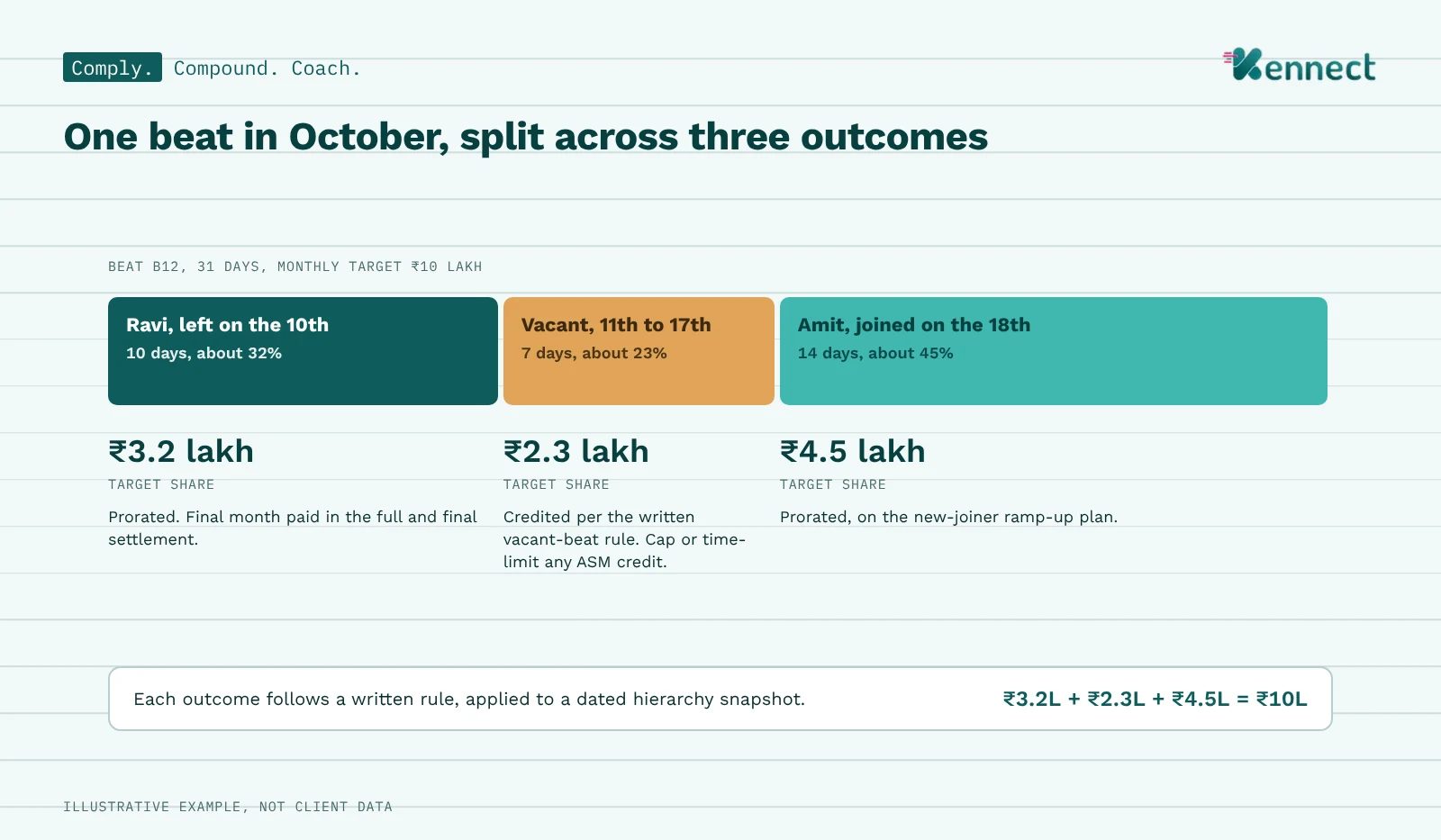
Here is how one beat might be credited in a 31-day October. The beat's monthly target is ₹10 lakh.
Person
Days
Share of the month
Target share
Rule applied
Ravi, left on the 10th
10
About 32%
₹3.2 lakh
Prorated; final month paid in full and final settlement
Vacant, 11th to 17th
7
About 23%
₹2.3 lakh
Credited per the vacant-beat rule
Amit, joined on the 18th
14
About 45%
₹4.5 lakh
Prorated, on the new-joiner plan
Illustrative example, not client data.
Write the vacant-beat rule carefully. Some companies credit the ASM who covers the beat. Others hold the credit in a pool, or credit nobody. If the ASM earns on a vacant beat, cap it or time-limit it. Otherwise he gains little by filling the seat.
In Excel, every beat like this means manual work. With dated snapshots and set rules, it needs none.
Write the churn rules once, and let the system apply them every month.
What churn-proof incentives mean for each FMCG leader
Field churn lands on many desks at once. Here is what each leader gets when the rules run themselves.
Leader
Their question
What this approach gives them
CEO or MD
Is churn costing us sales?
Fewer manual errors, and vacant beats visible early
CFO
Are we paying leavers, or missing joiners?
Automatic proration, eligibility rules and settled leavers
Sales head (CSO or NSM)
Are new joiners quitting too fast?
Ramp-up plans for their first months
CHRO
Are our good people leaving?
Leavers compared with stayers, by earnings
CIO or IT head
Do we need daily master uploads?
Monthly hierarchy snapshots synced from HRMS or SFA
Internal audit
Can a closed month change safely?
One-month recalculation, fully logged
MIS or sales ops
Can we stop fixing joiners by hand?
Set rules, applied every month
Churn rules written once save time in every function.
How Kennect and KAI absorb churn
Kennect is an AI-led sales performance and incentive compensation management platform. One rule engine runs salesman incentives, distributor claims and dealer schemes.
Comply: monthly snapshots. Kennect snapshots the hierarchy and mappings every month, from HRMS or SFA. Each calculation uses the structure as it stood that month. See the calculation engine.
Comply: proration and eligibility. Joiners and leavers are prorated automatically by days in role. Eligibility cut-offs apply on their own. New joiners can sit on a separate plan, assigned by months since joining.
Comply: one-month recalculation. When a late change arrives, that month alone is recalculated. Later months stay as they were. Every change is logged.
Compound: churn analytics. For operations teams, analytics flag vacant positions and compare leavers with stayers.
For the ASM's view, see team incentive dashboards for ASMs.
KAI in practice. A sales head asks where positions are vacant this month. KAI Insights lists them by area. He then checks which ASMs are covering those beats.
Kennect turns monthly churn from manual fixes into set rules.
How many manual fixes went into your last payout?
See joiners, leavers and transfers on your own hierarchy.
Whoever the written rule names. That is often the covering ASM, a pool, or nobody. Apply the same rule everywhere. If the ASM earns on a vacant beat, cap or time-limit it.
Inside the full and final settlement. Calculate the final month early, and net any recovery against it. Send contract staff figures to the staffing agency on the same date.