Distributor and retailer incentives in FMCG need shared numbers
November 19, 2026
Puneet Gupta
Puneet Gupta
Key Insights
India's 1.4 crore kirana stores carry nearly 75% to 80% of FMCG sales (DPIIT, 2026).
In this blog:
Why channel schemes need numbers both sides trust
Five channel pain points FMCG teams raise
One distributor's quarter, on shared numbers
What shared channel numbers mean for each FMCG leader
Distributor and retailer schemes cost FMCG companies serious money. Yet many run on regional Excel and WhatsApp updates. The distributor keeps his own numbers. The company keeps another set. At quarter-end, they argue. A channel scheme only motivates when both sides see the same number. They need to see it while there's still time to act.
Ask your channel head this week: do distributors know their scheme progress before quarter-end?
Table Of Content
Why channel schemes need numbers both sides trust
The channel is huge. India has over 450,000 FMCG distributors.
Source: All India Consumer Products Distributors Federation, via Storyboard18, 2025
They serve over 1.4 crore kirana stores. Those stores carry nearly 75% to 80% of FMCG sales. DPIIT and ONDC held an FMCG roundtable in June 2026. Leaders flagged fragmented retailer engagement and rising sales-force costs. They also flagged limited visibility into secondary sales.
Fix: one validated dataset for company and distributor.
2. Credit notes are hard to trace
What we heard: one FMCG company pays distributors through credit notes.
Credit notes are practical. They are often issued from a separate file, though. Months later, nobody can link a note to its scheme.
Generate the credit note from the approved incentive itself. Then each note traces back to its scheme and calculation. Credit notes also carry GST treatment. Agree the format with the tax team. Keep the scheme reference on every note.
Fix: issue credit notes from the approved incentive, with the scheme on each.
3. Trips and outlet schemes run on paper
What we heard: one FMCG company rewards top distributors with foreign trips. It also wants schemes for about 5,000 outlets in one city.
Trip contests and outlet schemes motivate the channel. At scale, paper tracking breaks. Qualifiers find out at the end.
Run trips as contests with KPIs and conditions. Calculate each retailer's incentive from its own KPIs, automatically. Capture retailer consent for any contact data the scheme collects. See how FMCG sales contests work on a steady plan.
Fix: run trips and outlet schemes on the same engine.
4. Distributor salesmen sit outside the structure
What we heard: one FMCG company described three layers in its sales structure. Distributor salesmen are one.
Distributor salesmen sell company products daily. They aren't on the company payroll. So they often sit outside the system.
Link them into the sales hierarchy. Give them their own schemes. Decide upfront who pays them: the company or the distributor. Record it in the scheme. Then their ASM can coach them like any SO.
Fix: bring distributor salesmen into the hierarchy, with a clear payer.
5. Claims arrive without the data behind them
Distributors raise scheme claims at quarter-end. The claim says what the distributor believes he earned. The company checks it against its own files, weeks later. Duplicate and inflated claims slip through.
Calculate the scheme payout from validated secondary first. Then compare the distributor's claim against it. Settle only the agreed figure.
Fix: compare every claim against the calculated payout before settling.
Each fix replaces a quarter-end argument with one number agreed every month.
One distributor's quarter, on shared numbers
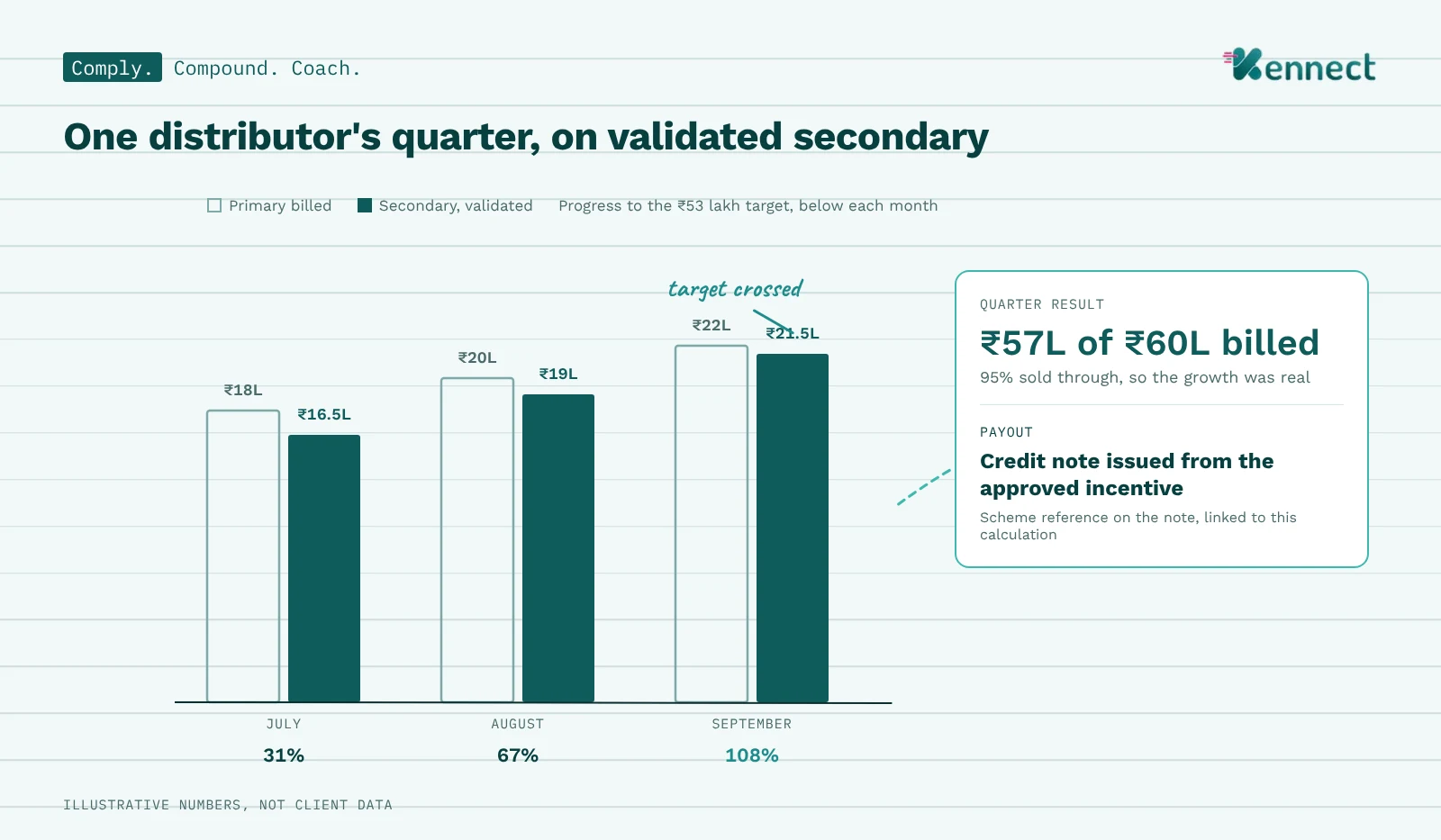
Here is one distributor's growth scheme, tracked month by month. The quarter's secondary target is ₹53 lakh.
Month
Primary billed
Secondary, validated
Progress to target
July
₹18 lakh
₹16.5 lakh
31%
August
₹20 lakh
₹19 lakh
67%
September
₹22 lakh
₹21.5 lakh
108%
Illustrative numbers, not client data.
Both sides worked from the same numbers every month. Secondary reached ₹57 lakh, 95% of the ₹60 lakh billed. So the growth was real sell-through. Little of it sat in the godown. In September, the distributor crossed the target. The payout went out as a credit note, linked to this calculation.
Same numbers every month, so quarter-end is a formality.
What shared channel numbers mean for each FMCG leader
Channel schemes cut across sales, finance and partners. Each leader gains from one agreed number.
Leader
Their question
What this approach gives them
CEO or MD
Is trade spend driving offtake?
Channel schemes paid on validated secondary
CFO
Can we trace every credit note?
Credit notes issued from approved incentives, with GST treatment agreed
Sales head (CSO or NSM)
Are distributor salesmen pulling their weight?
DSMs in the hierarchy, with their own schemes
Channel or trade marketing head
Why does quarter-end become an argument?
One dataset, and claims checked against calculated payouts
CHRO
Who coaches people off our payroll?
ASMs see and coach distributor salesmen
CIO or IT head
Do we need distributor system access?
Statements in, with no access to distributor systems
MIS or sales ops
Who runs trip and outlet schemes?
Contests and retailer KPIs on one engine
One agreed channel number settles debates before they start.
How Kennect and KAI run channel schemes
Kennect is an AI-led sales performance and incentive compensation management platform. One rule engine runs salesman incentives, distributor claims, dealer schemes and retailer schemes.
Comply: channel schemes as plans. Trade promotion runs like a sales-team plan: distributor-wise targets, growth, value and volume. The same approvals and audit trail apply.
Comply: validated secondary. Secondary comes from distributor statements through secondary sales automation, validated against primary.
Comply: credit notes and claims. Credit notes are generated against approved incentives. Claims are compared with the calculated payout.
Compound: trips and retailer schemes. Trips run as contests with qualifying conditions. Retailer incentives are calculated on each retailer's own KPIs.
Coach: distributor salesmen and disputes. Distributor salesmen link into the hierarchy, with their own schemes. Disputes are raised in the app and tracked to closure. See query and dispute resolution.
For the ASM's view, see team incentive dashboards for ASMs.
KAI in practice. A channel head asks how many distributors earned nothing. KAI Insights answers from the latest data load. He knows which ones to call first.
Kennect gives the company and its channel one number to work from.
Still settling channel schemes by argument?
See a distributor scheme run on validated secondary.
Incentives for the channel. Think distributor targets, growth, or value and volume on chosen products. It should run like a sales-team plan, with the same approvals and audit trail.
Yes, if each note is generated from the approved incentive. It should carry the scheme reference. Agree the GST treatment of the notes with the tax team.
Link them into the sales hierarchy and give them their own schemes. Decide who pays them, the company or the distributor. Their ASM can then coach them like any SO.