FMCG salesmen chase incentives they can see inside the SFA app
November 24, 2026
Puneet Gupta
Puneet Gupta
Key Insights
In one FMCG staffing study, 39% of attrition came from associates who earned no incentive (TeamLease Services, 2024).
In this blog:
Why FMCG salesmen ignore separate incentive apps
Five visibility pain points FMCG teams raise
What a salesman should see inside the SFA
How Kennect and KAI sit inside the SFA
An FMCG salesman's day already lives in one app. His beat plan is there. His kirana list and orders are there. Then he is asked to check his incentive somewhere else. A second app, a portal, an emailed Excel file. Few ever do. A salesman who can't see his incentive soon stops chasing it. I have watched good FMCG schemes fail for this reason alone. The plan was fine. It sat in the wrong place.
Ask your sales head this week: where does a salesman check his incentive today?
Table Of Content
Why FMCG salesmen ignore separate incentive apps
FMCG field selling runs at huge scale. India has about 13 million kirana stores and over 450,000 FMCG distributors. Company and distributor salesmen cover them beat by beat. Field time is short. Every extra login competes with the next outlet.
Source: All India Consumer Products Distributors Federation, via Storyboard18, 2025
The field also churns fast. Among outsourced FMCG associates, attrition runs at 27% in metros. Tier 1 and 2 cities see 26%. New salesmen join every month. Each one needs to see, quickly, what he can earn.
Incentives sit at the center of that churn. In TeamLease's data, 39% of leavers earned no incentive at all. Another 21% were high performers whose incentives beat the company average. Salaries barely differed between those who stayed and those who left. Incentives did.
Head office often adds more reports to fix visibility. Dashboards in a BI tool. Excel files from regional MIS. A portal for each scheme. The field rarely has BI access anyway. The one app FMCG field teams open every day is the SFA. Good SFA incentive integration fixes this at the source.
Put incentives where the salesman already works, or he won't look.
Five visibility pain points FMCG teams raise
1. Another app means another login
What we heard: one FMCG IT team asked about a separate app. Their field only uses the SFA.
A separate app needs a download and a password. It also needs a reason to open it. Many salesmen forget the password within weeks. Adoption drops, and MIS goes back to emailing Excel.
The problem reaches beyond FMCG. Gartner found 49% of B2B sellers feel overwhelmed by the technology their job needs. Those sellers are 43% less likely to hit quota.
Embed incentives inside the SFA instead. The salesman taps one button and sees his earnings, with one login.
Fix: one app, one login, with incentives inside it.
2. Dashboards exist, but nobody opens them
What we heard: one FMCG company has dashboards, Excel reports and portals. Adoption is still very low.
More reports do not mean more visibility. Each new view splits attention further. Salesmen stop trusting any single number. Then they call their ASM instead.
Replace the scattered reports with one tracker. Every scheme, central or regional, should land in the same place.
Fix: one incentive tracker for every scheme.
3. The SFA shows percentages, and the field wants rupees
What we heard: one FMCG team's salesmen see zero until the 25th. The SFA shows progress, with no pay figure.
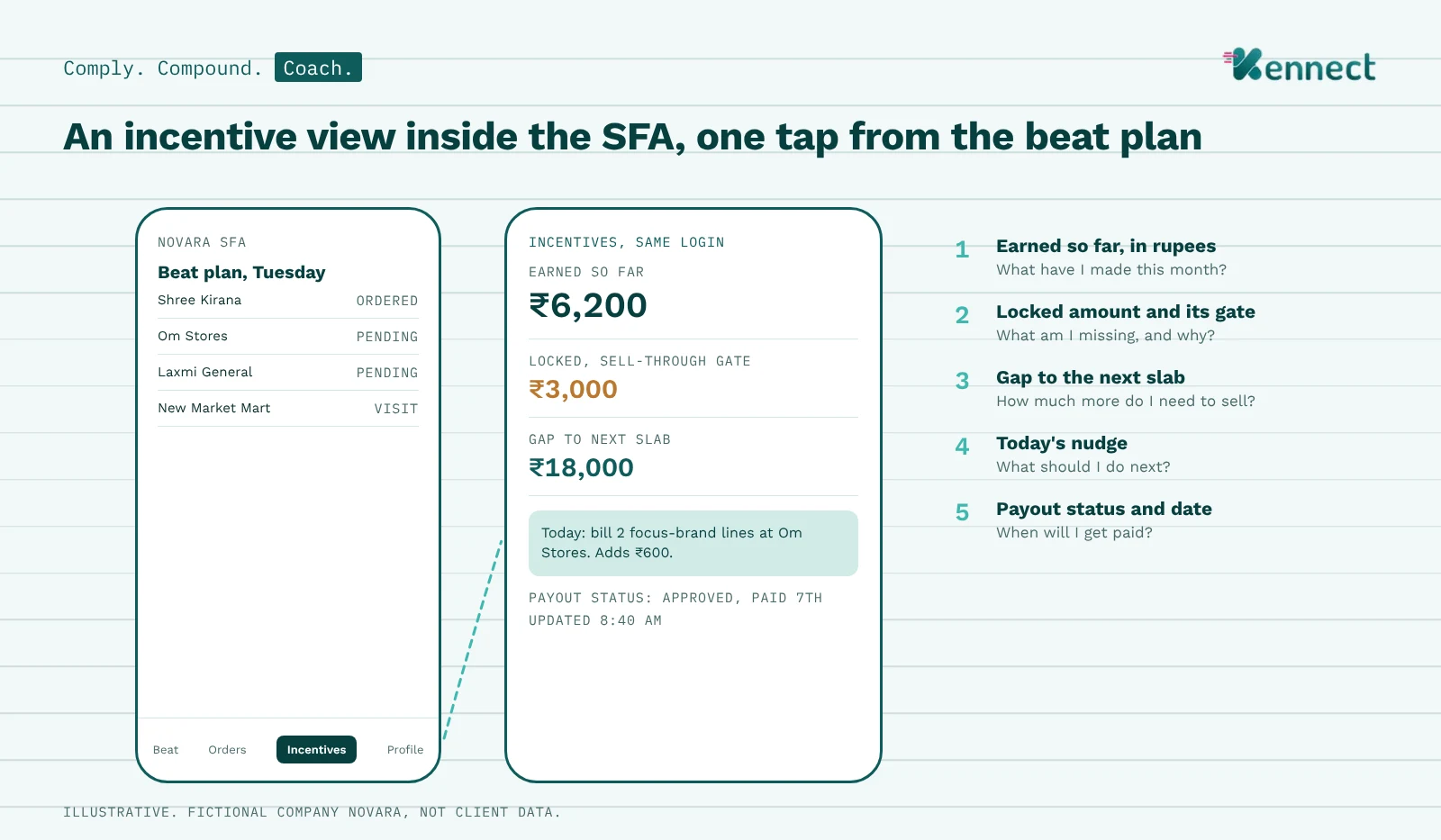
"You are at 87% of target" changes little. "You have earned ₹6,200, and ₹3,000 more is locked" changes a lot. Many SFAs show the first line and stop there.
Show earnings in rupees, every day. Include locked amounts and the gate that unlocks them. Add the gap to the next slab. See how slabs and gates work in FMCG.
Fix: turn progress into rupees the salesman can chase.
4. The app only speaks English
What we heard: one FMCG company asked for nudges in local languages. They wanted the setting pulled from the SFA.
Many field salesmen read Hindi, Tamil or Marathi more comfortably than English. That matches wider habits. 57% of urban Indian internet users prefer content in Indian languages. Almost all, 98%, use Indian-language content at least sometimes.
Source: IAMAI and Kantar, Internet in India 2024
An English-only tracker gets skimmed. Few salesmen will open settings to change the language.
Let the whole incentive view switch languages, nudges included. Pick up the language from the SFA, or ask once at first login.
Fix: show incentives in the salesman's language by default.
5. IT worries about another integration
What we heard: one FMCG IT team asked for APIs. Their SFA vendor would need them to show incentives.
IT teams have seen integrations drag for months. They want a clear method and a light build. No extra login system should need managing.
Use a web embed with a back-end login handshake. Back it with open APIs. Ask three more questions before signing off:
Data scope. Each salesman sees only his own numbers. Each manager sees only his team.
Low bandwidth. The view should load on a weak rural connection. It should show the last refresh time.
Ownership. The SFA vendor builds the button. The incentive vendor owns the view behind it.
Fix: a light web embed, backed by open APIs and clear data scope.
Visibility fails at the login, the language and the format, long before the plan.
What a salesman should see inside the SFA
One tap from the beat plan should answer five questions.
What he sees
What it answers
Earned so far, in rupees
"What have I made this month?"
Locked amount and its gate
"What am I missing, and why?"
Gap to the next slab
"How much more do I need to sell?"
Today's nudge
"What should I do next?"
Payout status and date
"When will I get paid?"
Managers need one more view. An ASM should see his whole team's earnings and a leaderboard. Then he can coach during joint field work.
Hidden earnings are one of six common plan design mistakes. See the six FMCG plan design mistakes.
Five answers, one tap, inside the app he already opens.
How Kennect and KAI sit inside the SFA
Kennect is an AI-led sales performance and incentive compensation management platform. One rule engine runs salesman incentives, distributor claims and dealer schemes.
Coach: inside the SFA. Kennect opens inside the SFA as a web view. It uses an iframe or third-party embed. Login happens through a back-end handshake, so the SFA login works for Kennect.
Coach: earnings in rupees. Each salesman sees earned, locked and next-slab amounts, refreshed with each data load.
Coach: nudges in local languages.KAI Nudges tie the next action to a rupee value. They arrive in the app or on WhatsApp. The whole view switches to local languages.
Comply: connections. Kennect connects to SFAs through their APIs. It has an existing Salesforce integration. See all integrations.
Teams that prefer one can also use a standalone Android, iOS or web app.
KAI in practice. A salesman taps the incentives button in his SFA. He asks why his incentive is locked. KAI Exceptions shows the gate he missed and the gap. An ASM asks how his team stands this month. KAI Insights answers from the latest data load.
Kennect puts every incentive one tap away inside the SFA.
Want to see what your salesmen would see?
See the incentive view in an SFA screen, on your own plan.
No. Incentives work well inside the SFA app salesmen already use. One button opens them, with no second login. A standalone app suits teams without an SFA, or those that prefer one.
As a web view, through an iframe or third-party embed. A back-end handshake logs the salesman in with his SFA login. To the salesman, it feels like one app.
No, not when the module is embedded. The SFA login carries over through a back-end handshake. Salesmen tap the incentives button and see their earnings directly.
Yes, with any SFA that provides an API. Custom SFAs connect through the same web embed and open APIs. Kennect also has an existing Salesforce integration.