Sales contests in FMCG work best on top of a steady plan
November 20, 2026
Puneet Gupta
Puneet Gupta
Key Insights
In 2026, 66% of companies are leaning further into pay-for-performance (Alexander Group, 2026).
In this blog:
Why FMCG contests fail on a shifting base
Four contest pain points FMCG teams raise
One month: a base plan and three layers
What steady plans with contests mean for each FMCG leader
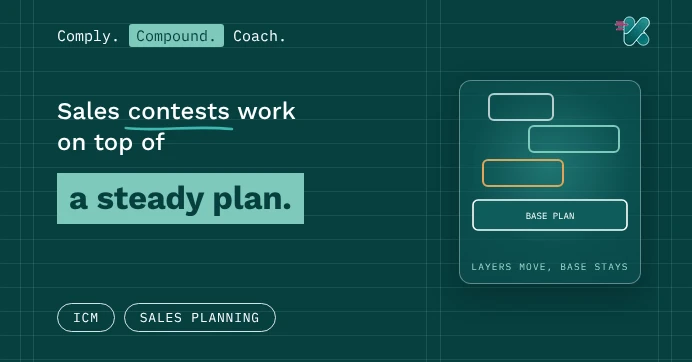
FMCG sales teams love a contest. A brand push, a festive booster, a trip for top distributors. Run well, contests lift a quarter. Run badly, they confuse it. The usual mistake is changing the base plan with every new contest. Then nobody knows what they earn. Contests work better on top of a plan that stays still.
Ask your sales head this week: how many schemes does one salesman track?
Table Of Content
Why FMCG contests fail on a shifting base
Companies keep adding pay-for-performance. Alexander Group found 66% are leaning further into it in 2026. 97% changed their plans for 2026. The same survey shows a push for simpler plans, with fewer measures.
Complexity has a cost. The Sales Management Association found complicated sales compensation plans are less effective. Plans the field understands are nine times likelier to be rated effective.
In FMCG, contests stack on top of the plan. One salesman may track three schemes at once. A base plan, a regional booster, a brand contest. If the base keeps moving too, nothing feels certain.
A steady base gives every contest something to stand on.
Four contest pain points FMCG teams raise
1. Boosters live in separate files
What we heard: one FMCG company pays boosters for tasks like collecting retailer contacts.
Boosters often run in a separate sheet from the main plan. The salesman sees one and misses the other. So he can't tell what a day's effort is worth.
Run boosters on the same tracker as the base plan. Show both, in rupees, side by side. A booster that collects retailer contacts should capture consent in the SFA too.
Fix: one tracker for the base plan and every booster.
2. Brand contests pile up
What we heard: one FMCG company runs contests by brand and KPI. They cover salesmen, distributors and retailers.
Every brand team wants its own contest. Each one is reasonable. Together, they compete for the same hours.
Give each contest clear dates, a defined group and an end. Retire contests that are done. Keep only a few live at once. Hold contest spend to a budget share agreed with finance.
Fix: dated contests for defined groups, inside an agreed budget.
3. Distributor trips run on paper
What we heard: one FMCG company sends top distributors on foreign trips.
Trip contests motivate distributors. Progress, though, often lives in a regional file. Distributors find out if they qualified at the end.
Set up the trip as a contest with its own KPIs and qualifying conditions. Track it through the period, on the same data as other schemes. Check the tax treatment with the finance team too. In India, trips given to a business can attract tax deduction at source.
Fix: treat trips as contests, with tracked progress and tax checked.
4. Regional boosters overlap central schemes
What we heard: one FMCG company's regions build schemes from a central budget.
A regional booster and a central scheme can reward the same sale. Nobody checks until finance sees the bill.
Check every new contest against live schemes before launch. Flag overlapping slabs and duplicate criteria. Model the combined cost. See regional incentive schemes in FMCG.
Fix: check overlaps and cost before any contest goes live.
Each contest needs dates, a group, a budget and an overlap check.
One month: a base plan and three layers
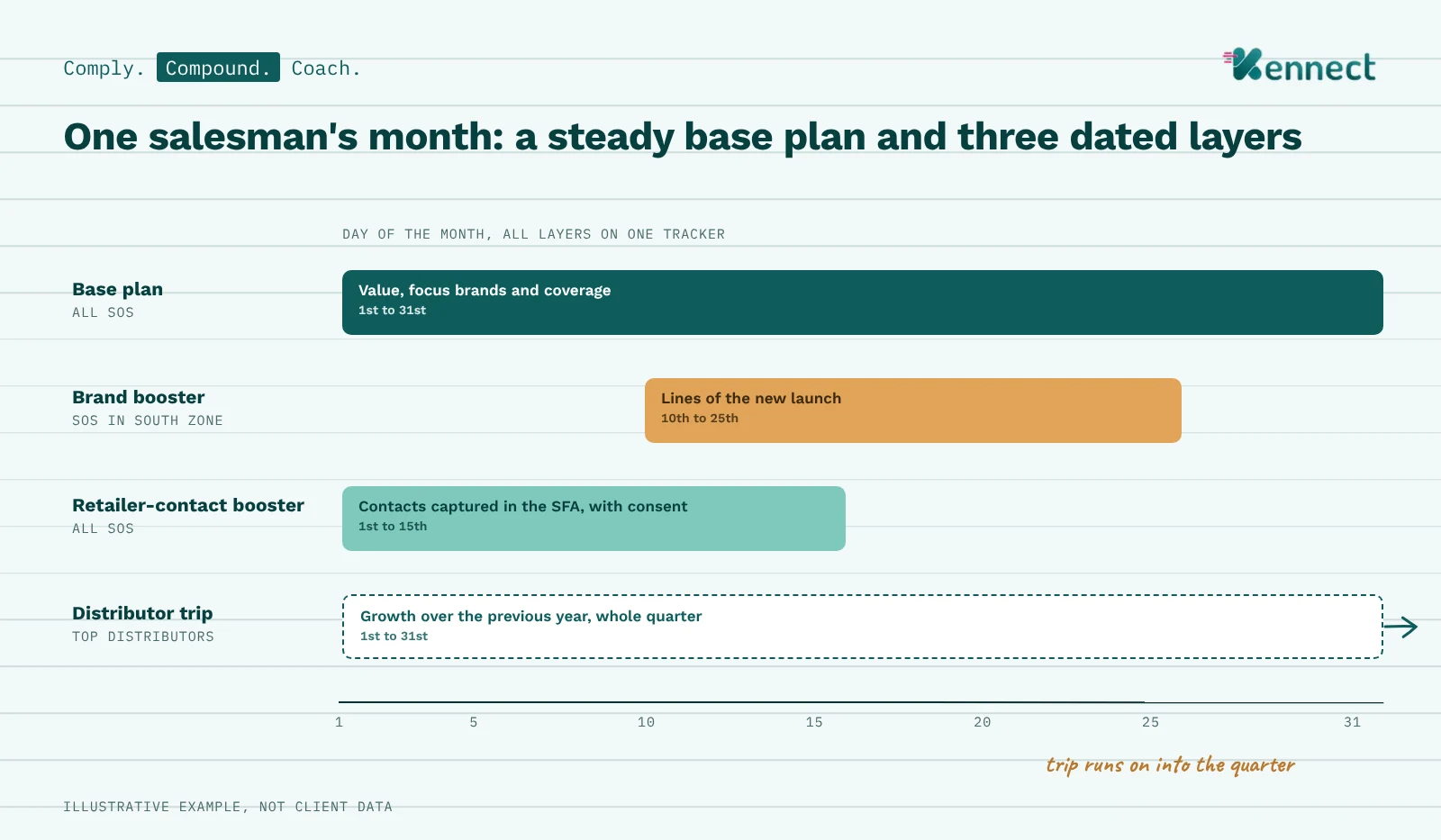
Here is how layered schemes can stay clear for one salesman.
Layer
Who
Dates
Pays on
Base plan
All SOs
Whole month
Value, focus brands and coverage
Brand booster
SOs in South zone
10th to 25th
Lines of the new launch
Retailer-contact booster
All SOs
1st to 15th
Contacts captured in the SFA, with consent
Distributor trip
Top distributors
Whole quarter
Growth over last year
Illustrative example, not client data.
The base plan never changes mid-month. Boosters come and go around it. Every layer shows on one tracker.
After each contest ends, review it. Compare the contest group's results with a similar group that didn't run it. Keep contests that lifted sales, and retire the rest. See how to measure incentive impact on revenue, one scheme at a time.
Boosters move. The base plan stays put.
What steady plans with contests mean for each FMCG leader
Contests touch budgets, brands and people, beyond sales. Here is what each leader gets.
Leader
Their question
What this approach gives them
CEO or MD
Are contests lifting sales, or just costs?
Contest cost modeled, results reviewed, base plan stable
CFO
Do boosters overlap and pay twice?
Overlap checks, a contest budget share and tax checked on trips
Sales head (CSO or NSM)
Can I run a push without confusing the field?
Boosters on the same tracker as the base plan
Brand or marketing head
Will my launch get field attention?
Dated brand boosters for chosen groups
Channel or trade marketing head
Can trip contests run on real numbers?
Trips run as contests, on the same data as other schemes
CHRO
Is the field tired of new schemes?
Fewer live schemes, on one clear tracker
MIS or sales ops
Who builds every contest?
Contests set up as short plans in the front end
A stable base with clear contests works for every leader.
How Kennect and KAI run contests
Kennect is an AI-led sales performance and incentive compensation management platform. One rule engine runs salesman incentives, distributor claims and dealer schemes.
Compound: contests as short plans. A contest is a short plan with its own dates, KPI and prize. It can target salesmen, distributors or retailers. Trips work the same way, with qualifying conditions.
Coach: one tracker. Contests run alongside the base plan, on the same tracker. KAI Nudges tell each salesman what a booster is worth in rupees.
Comply: checks before launch. Validation flags overlapping slabs and duplicate records. KAI Simulations and scenario modeling show the contest's cost on past data. Regional teams configure schemes within head-office approvals.
KAI in practice. A salesman asks why his booster hasn't paid yet. KAI Exceptions names the condition still open and the gap. He knows exactly which lines to push.
Kennect keeps contests exciting without shaking the base plan.
Keep the base plan steady and run contests as separate short plans. Each contest gets dates, a group and an end. Show the base plan and contests on one tracker.
Set the trip up as a contest with KPIs and qualifying conditions. Track it through the period on the same data as other schemes. Check tax deduction on the benefit with the finance team.
Compare the contest group's results with a similar group that didn't run it. Look at the contest period and the month after. Keep contests that lifted sales, and retire the rest.