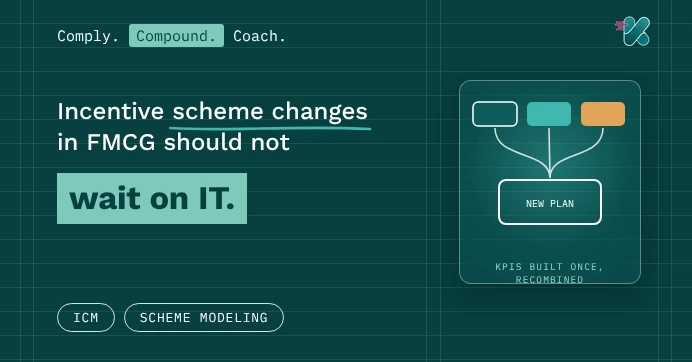
Incentive scheme changes in FMCG should not wait on IT
November 20, 2026
Puneet Gupta
Puneet Gupta
Key Insights
97% of companies changed their sales compensation plans for 2026 (Alexander Group, 2026).
In this blog:
Why FMCG schemes change faster than IT cycles
Four change pain points FMCG teams raise
What a safe monthly change looks like
What faster scheme changes mean for each FMCG leader
FMCG schemes change every month. A brand needs a push. A region needs a booster. A competitor cuts prices. The business moves in days. The incentive system moves in quarters, because every change is an IT ticket. By the time the change ships, the moment has passed. Scheme changes belong with the business, with the right controls around them.
Ask your MIS head this week: how long did the last scheme change take to go live?
Table Of Content
Why FMCG schemes change faster than IT cycles
Plan change is now the norm. Alexander Group found 97% of companies changed their plans for 2026. A year earlier, it was 86%. 77% said competition had affected their plan design or management.
Those are annual changes. FMCG adds monthly ones on top: boosters, regional schemes, launch pushes. Execution is already stretched. 46% named allocating quotas on time as their top program management challenge. About 65% want to improve their sales compensation governance.
If every change needs an IT sprint, the plan always lags the market.
Schemes that wait for IT arrive after the moment they were meant for.
Four change pain points FMCG teams raise
1. IT holds changes to a quarter
What we heard: one FMCG company said leadership would change plans daily. IT holds them to a quarter.
Leaders want to react to the market. IT wants stable releases. Both are right. The plan changes four times a year. The market moves twelve.
Move routine changes to a front end the business controls. Keep IT for data feeds and access.
Fix: let MIS change plans, with approvals built in.
2. The in-house tool broke on a big change
What we heard: one FMCG team built a configurable tool in-house. Big rule changes broke it.
In-house tools usually hard-code today's scheme shape. A new structure means new code. So big changes stall.
Keep KPIs separate from plans. Build each KPI once. Combine KPIs, slabs and conditions into plans. A new structure becomes a new combination.
Fix: separate KPIs from plans, so changes are combinations.
3. Formula tools end up with IT anyway
What we heard: one FMCG team had used formula-based incentive tools before. The logic ended up with IT.
Some tools promise no-code setup. In practice, complex KPIs need a developer. The bottleneck just moves.
Use a KPI builder with Excel-like steps that MIS can own. A managed service can handle setup and changes instead.
Fix: no-code KPIs or a managed service, with IT kept for data.
4. Nobody knows what a change will cost
What we heard: one FMCG sales head raised a fair worry. Would a KPI tweak cause overspending?
Fast changes scare finance, and rightly so. A small slab change can add many more earners.
Replay every change on past months before it goes live. Compare its payout and earners against today's plan.
Fix: model the cost of every change before approval.
Each fix moves a change from an IT queue to a business step.
What a safe monthly change looks like
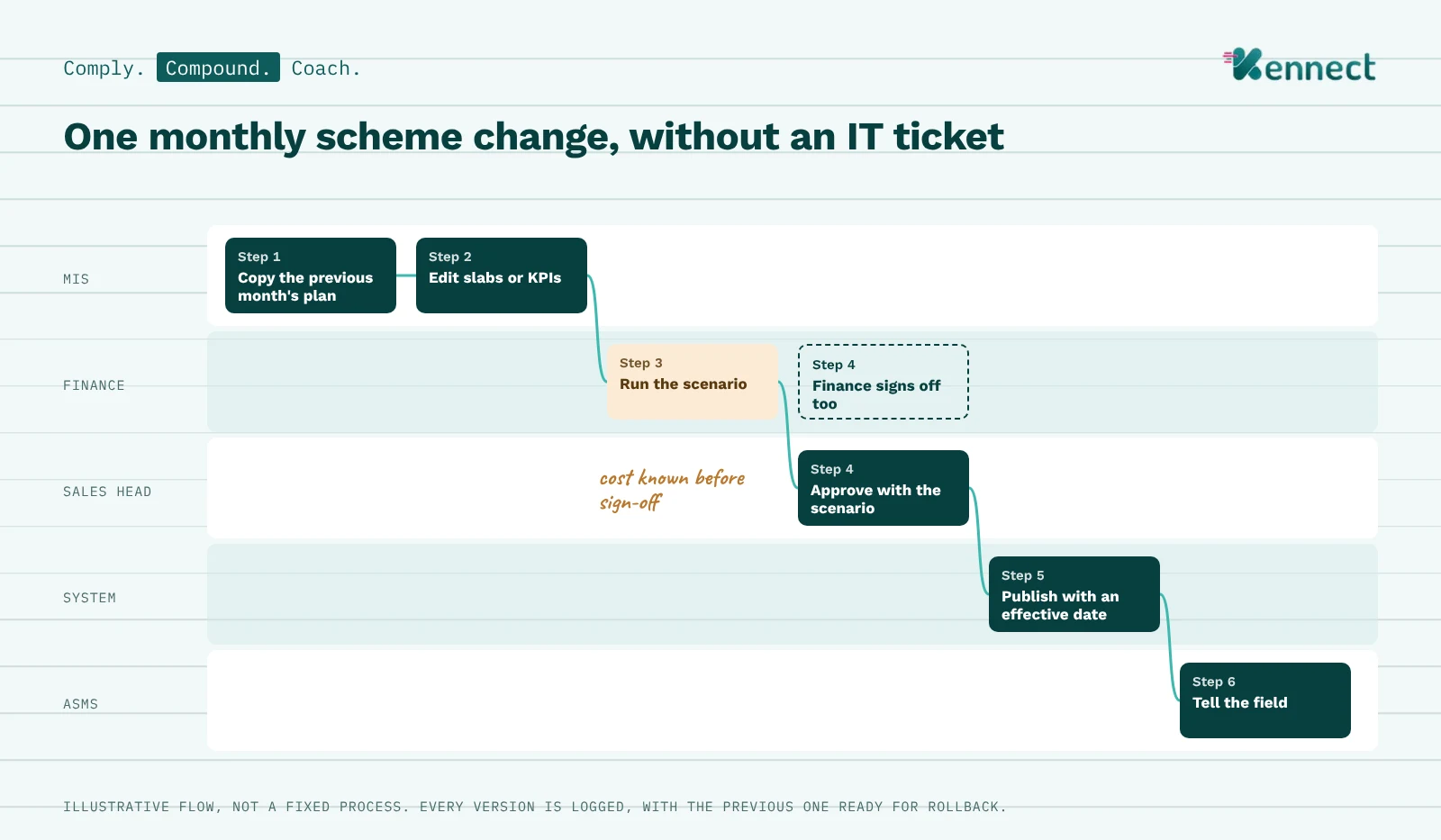
Here is how one monthly change might move, without IT.
Step
Who
What happens
1. Copy last month's plan
MIS
Start from what already works
2. Edit slabs or KPIs
MIS
In the front end, or via an Excel template
3. Run the scenario
MIS and finance
Replay on past months and compare cost
4. Approve
Sales head and finance
Sign off with the scenario in hand
5. Publish with an effective date
System
New version goes live from its date and is logged
6. Tell the field
System and ASMs
Salesmen see what changed and what it pays
Illustrative flow, not a fixed process.
Set two rules before the first change. Changes apply from an effective date, never backwards into a closed period. Mid-month changes need an extra sign-off. Salesmen have already planned the month. Keep the previous version ready to roll back a bad change.
Speed and control work together here. The scenario gives finance its comfort. The version log gives audit its trail. See how mid-year plan changes stay defensible.
Fast changes are safe when every change is modeled, approved, dated and logged.
What faster scheme changes mean for each FMCG leader
Taking scheme changes out of the IT queue helps every function. Here is what each leader gains.
Leader
Their question
What this approach gives them
CEO or MD
Can we answer a competitor this month?
Scheme changes in days
CFO
Will fast changes blow the budget?
Scenario cost and finance sign-off on every change
Sales head (CSO or NSM)
Can I launch a booster next week?
Front-end changes, approved and logged
CIO or IT head
Why are incentive tickets in my queue?
IT keeps the data feeds; MIS owns plan changes
CHRO
Will constant change confuse people?
Effective dates, a mid-month rule and change notes to the field
Internal audit
Which version paid what?
Every payout traces to its plan version
MIS or sales ops
How do we edit plans safely?
Reusable KPIs, Excel templates, validation and rollback
Faster changes with controls suit the CEO, CFO and CIO alike.
How Kennect and KAI make changes safe
Kennect is an AI-led sales performance and incentive compensation management platform. One rule engine runs salesman incentives, distributor claims and dealer schemes.
Compound: front-end plans. MIS configures plans from the front end. Each KPI is built once and reused in any plan. For each plan, Kennect generates an Excel template. The team fills it in, and the upload is validated.
Compound: cost before approval. KAI Simulations drafts a KPI from a plain description. Scenario modeling replays the change on past data.
Comply: validation and versions. Validation warns about overlapping slabs before publishing. Approvals run through set levels, and every version is logged.
Coach: change notes. The field sees the new version and what it pays.
Kennect also offers plan setup and changes as a managed service. The company still approves every change.
For warning signs in untested schemes, see six FMCG plan design mistakes. For changes that differ by zone, see regional incentive schemes.
KAI in practice. An MIS lead describes a new booster KPI in plain words. KAI Simulations drafts it. The scenario shows its cost on last month's data. The sales head approves it the same week.
Kennect moves scheme changes from IT tickets to business decisions.
Is your next scheme change stuck in an IT queue?
See a monthly change configured, modeled and approved on Kennect.
As often as the business needs. Boosters change monthly, and the base plan yearly. What matters is control. Every change should be modeled, approved, dated and logged.
Yes, if plans are configured from a front end. MIS edits slabs, KPIs and conditions. Approvals and a version log are built in. IT keeps the data feeds.
Yes, if the system generates a template from each plan's KPIs. The team fills it in and uploads it. The upload should be validated before anything publishes.
Run it on past months first. Scenario modeling compares payout and earners with the current plan. It estimates cost. Sales uplift is measured after launch.
Avoid it where possible. Apply changes from an effective date, usually the next period. A mid-month change needs extra sign-off and a clear note to the field.