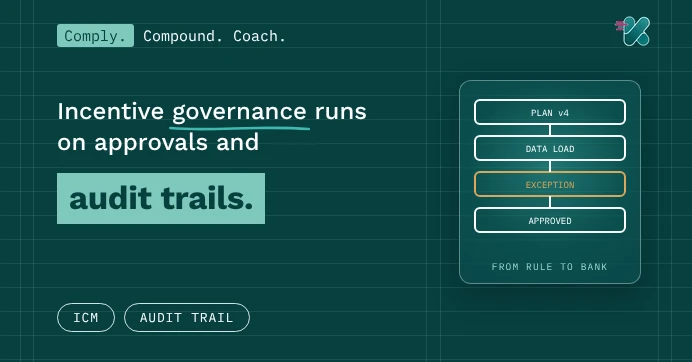
Incentive governance in FMCG runs on approvals and audit trails
November 19, 2026
Puneet Gupta
Puneet Gupta
Key Insights
About 65% of companies want better sales compensation governance (Alexander Group, 2026).
In this blog:
Why FMCG incentive governance breaks in spreadsheets
Five governance pain points FMCG teams raise
A payout's trail, step by step
What payout governance means for each FMCG leader
Every FMCG finance head has faced the same auditor question. Why was this salesman paid this amount? In many companies, the answer is a chain of emails. A regional Excel file. Someone's memory. Good governance means answering that question in a minute, for any payout. The paperwork follows from that.
Ask your finance head this week: can you trace last month's largest payout to its rule?
Table Of Content
Why FMCG incentive governance breaks in spreadsheets
Governance is a known gap. Alexander Group found about 65% of companies want better sales compensation governance.
Recovery rules are patchy too. WorldatWork studied short-term incentive plans. 41% of public companies had clawback policies. Only 15% of private companies did.
In India, the stakes are formal. Under the Companies Act, 2013, statutory auditors report on internal financial controls over financial reporting. Incentive payouts are a large, recurring expense inside that scope.
FMCG adds volume to the problem. Many schemes, many regions, many payees, every month. Spreadsheets can't hold the trail.
If a payout can't be traced, it can't be defended.
Five governance pain points FMCG teams raise
1. Two schemes pay for the same sale
What we heard: one FMCG team asked a direct question. If two schemes share criteria, are people paid twice?
Schemes get copied, renamed and relaunched. Two can end up rewarding the same sale. Nobody notices until payout.
Check for duplicates before payout, at scheme and product level. Warn about overlapping slabs before a plan goes live. See six FMCG plan design mistakes.
Fix: catch duplicates and overlaps before they pay.
2. Exceptions live in email
What we heard: exception emails reach one FMCG MIS team monthly. One salesman at 99.8% wants to be paid anyway.
Some near-misses deserve an exception. Email hides who asked, who approved and why.
Raise exceptions in the system, with a reason code. Route them up the hierarchy. Log every decision. Review exceptions as a share of payout each month. Otherwise they quietly become the plan.
Fix: one exception flow, with reasons and approvals on record.
3. Month-end dumping still gets paid
What we heard: one FMCG sales team raised month-end dumping. The returns came back after payout.
Stock pushed at month-end earns incentive. Next month, it comes back. The incentive stays paid.
Recalculate the month when returns post. Recover the difference in the next payout. Gate primary pay on sell-through, too.
Fix: recalculate on returns and claw back the difference.
4. Nobody can show how a number was computed
What we heard: one FMCG team asked for an audit trail of how each incentive was computed.
Plans change. Data gets corrected. A month later, nobody can rebuild the number.
Log every change with who made it and when. Keep each plan version. Tie every payout to the version and data behind it. See how manual handoffs create payout errors.
Fix: every payout traces to its plan version and data.
5. The same person builds and approves
In many MIS teams, one analyst configures the plan and runs the payout. The same analyst sends it for sign-off. Approvers see a total, without the change behind it. That is a control gap auditors look for.
Separate the roles. The person who configures a plan or override should not approve it. Limit who can see and edit payout data by role.
Fix: separate makers from checkers, and limit access by role.
Every change needs a maker, a checker and a record.
A payout's trail, step by step
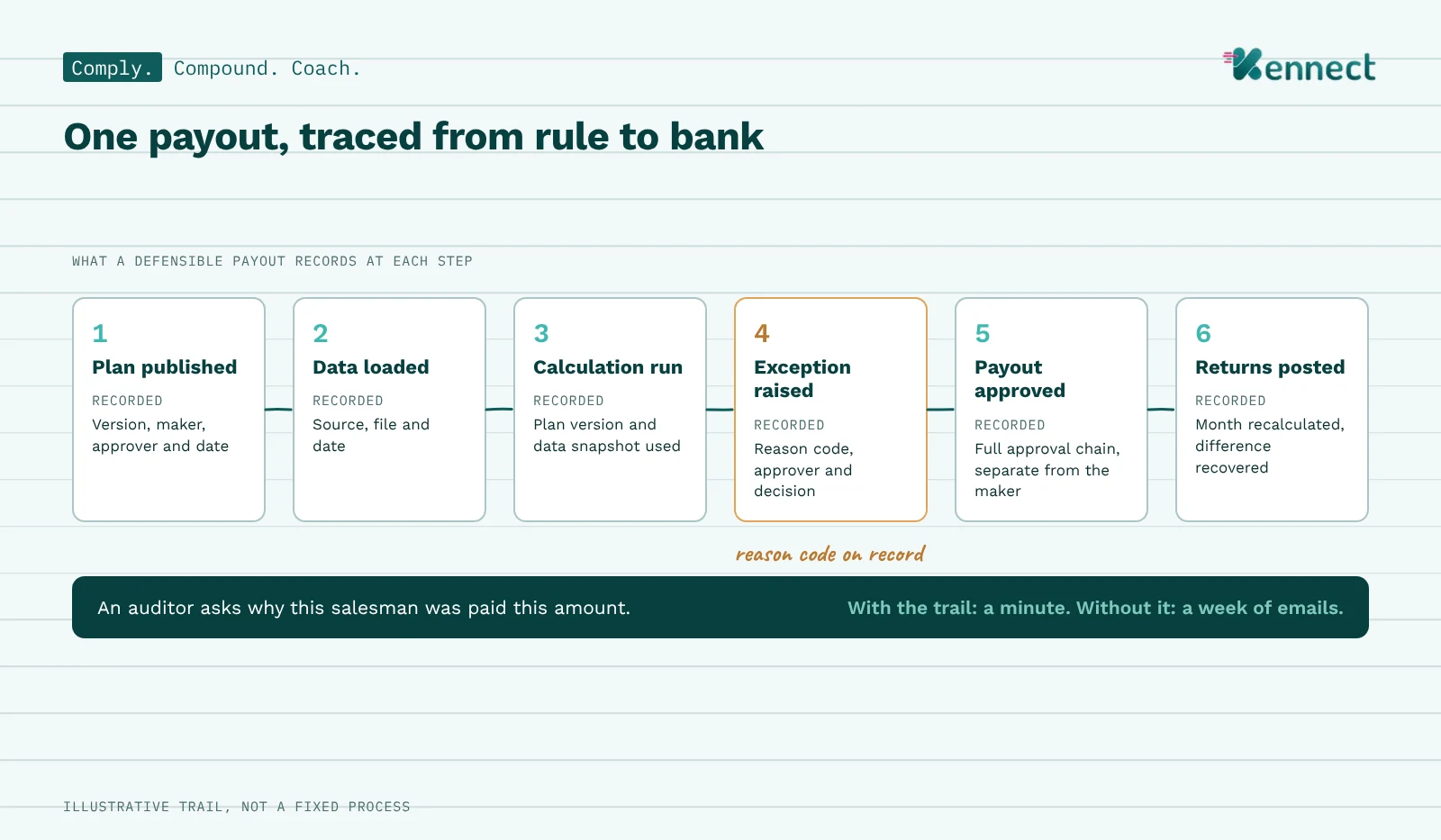
Here is what a defensible payout records, from rule to bank.
Step
What gets recorded
Plan published
Version, maker, approver and date
Data loaded
Source, file and date
Calculation run
Plan version and data snapshot used
Exception raised
Reason code, approver and decision
Payout approved
The full approval chain, separate from the maker
Returns posted
Month recalculated; difference recovered next cycle
Illustrative trail, not a fixed process.
With this trail, an auditor's question takes a minute. Without it, it takes a week of emails.
Every rupee needs a trail from rule to payout.
What payout governance means for each FMCG leader
Governance is often left to finance. Yet every leader needs a payout they can defend.
Leader
Their question
What this approach gives them
CEO or MD
Could an audit question embarrass us?
Every payout traceable to its rule
CFO
Are we paying twice, or paying for dumping?
Duplicate checks, clawbacks on returns and evidence for internal financial controls
Sales head (CSO or NSM)
Will exceptions slow my team down?
In-app exceptions with clear approvals
Internal audit or compliance
Who approved this, and when?
A logged approval chain, with makers and checkers separated
CHRO
Are disputes handled fairly?
Reasons and decisions on record for every case
CIO or IT head
Is the change history complete?
Every change logged, with access limited by role
MIS or sales ops
Can we stop rebuilding numbers for audits?
Each payout tied to its plan version and data
A clear trail protects every leader, finance included.
How Kennect and KAI keep payouts defensible
Kennect is an AI-led sales performance and incentive compensation management platform. One rule engine runs salesman incentives, distributor claims and dealer schemes.
Comply: approvals and logs. Kennect runs multi-level approvals for plans and payouts. Every change is logged with who made it and when. Each payout traces back to its plan version and source data.
Comply: checks before payout. Kennect flags duplicate records at scheme and product level. It warns about overlapping slabs and weightages that don't add up. It flags people left without a calculation.
Comply: exceptions and clawbacks. Exceptions start in the app and move up the hierarchy. See query and dispute resolution. Returns trigger a recalculation of that month. The difference is clawed back. More in our guide to commission clawbacks.
Comply: role-based access. Access follows roles, so makers and approvers stay separate.
KAI in practice. A finance head asks why one zone's payout jumped this month. KAI Insights breaks it down by scheme and region, from the latest data load. The trail behind each number is one click away.
Kennect makes every incentive payout defensible to finance and audit.
Could you trace last month's payouts to their rules?
See approvals, logs and clawbacks on your own schemes.
In the system, with a reason code. A manager raises the exception. It moves up the hierarchy for approval. Every decision is logged. Exceptions are reviewed as a share of payout.
Recalculate the month when returns post, and recover the difference next cycle. Log the change. A sell-through gate helps prevent the dumping in the first place.