ASC 606 commission capitalization is a sales ops problem first
October 14, 2026
Key Insights
Everyquarter-end, the same two numbers refuse to match. Sales ops has thecommissions that were earned. Finance has the commissions that are allowed tosit on the balance sheet. Both teams are right, and nobody has written down whythe figures differ.
ASC 606 is therevenue standard, but the rule that creates this gap lives in its companion,ASC 340-40. It says the incremental cost of winning a contract, which for mostcompanies means sales commission, is spread over the period the customerbenefits instead of being expensed the day it is paid. IFRS 15 and Ind AS 115say much the same.
Finance doesthe amortization. Sales ops supplies what it stands on: which payout belongs towhich contract, whether it was earned for winning the deal, and what happenswhen the deal is cancelled. When that tagging is missing, the schedule getsrebuilt by hand every quarter.
A questionworth asking your controller this week: for last quarter's commissions, whichpayouts were capitalized, and where is the record that says why?
Everyquarter-end, the same two numbers refuse to match. Sales ops has thecommissions that were earned. Finance has the commissions that are allowed tosit on the balance sheet. Both teams are right, and nobody has written down whythe figures differ.
ASC 606 is therevenue standard, but the rule that creates this gap lives in its companion,ASC 340-40. It says the incremental cost of winning a contract, which for mostcompanies means sales commission, is spread over the period the customerbenefits instead of being expensed the day it is paid. IFRS 15 and Ind AS 115say much the same.
Finance doesthe amortization. Sales ops supplies what it stands on: which payout belongs towhich contract, whether it was earned for winning the deal, and what happenswhen the deal is cancelled. When that tagging is missing, the schedule getsrebuilt by hand every quarter.
A questionworth asking your controller this week: for last quarter's commissions, whichpayouts were capitalized, and where is the record that says why?
Table Of Content
What commission capitalization actually means
Capitalizing acommission means recording it as an asset first and moving it to expensegradually. The rule behind it is ASC 340-40, which sits beside ASC 606 andcovers the cost of obtaining a contract with a customer. A company capitalizesthe incremental costs of obtaining a contract when it expects to recover them.
Incremental isthe word that matters. A cost is incremental if the company would not have paidit had the contract not been won. A commission on a signed deal passes thattest. A salary does not, because the rep is paid either way.
Take a rep whocloses a three-year deal and earns $8,000. Expensing it in the quarter of thesale shows a large cost today for revenue that arrives over years. Capitalizingit spreads the cost across the same period as the revenue, so reported profitstays closer to the economics of the deal.
When the cashgoes out does not decide any of this. The customer relationship does.
A commissionis an asset first and an expense later, and the pace of that move is set by thecustomer relationship, not by the payout date.
Why this lands on your desk, not finance's
Finance ownsthe journal entries. Sales ops owns the facts that decide them. Whichcommissions were paid for winning a contract? Which were paid for somethingelse, such as a team bonus? Which deal does each payout belong to?
Most commissiondata was built to pay people, not to feed a schedule. A payout line shows anamount and a rep. It rarely shows a contract ID, the plan component thatproduced it, or whether the money was for a new deal, a renewal or an upsell.
So financeasks, sales ops digs through exports, and the answer is rebuilt from aspreadsheet each quarter. It is the same pattern behind manual commissioncalculation errors, where the fix lands on the output while the rule staysunwritten.
Finance canonly amortize what sales ops has tagged, so the tags are the real work.
Which payouts get capitalized and which do not
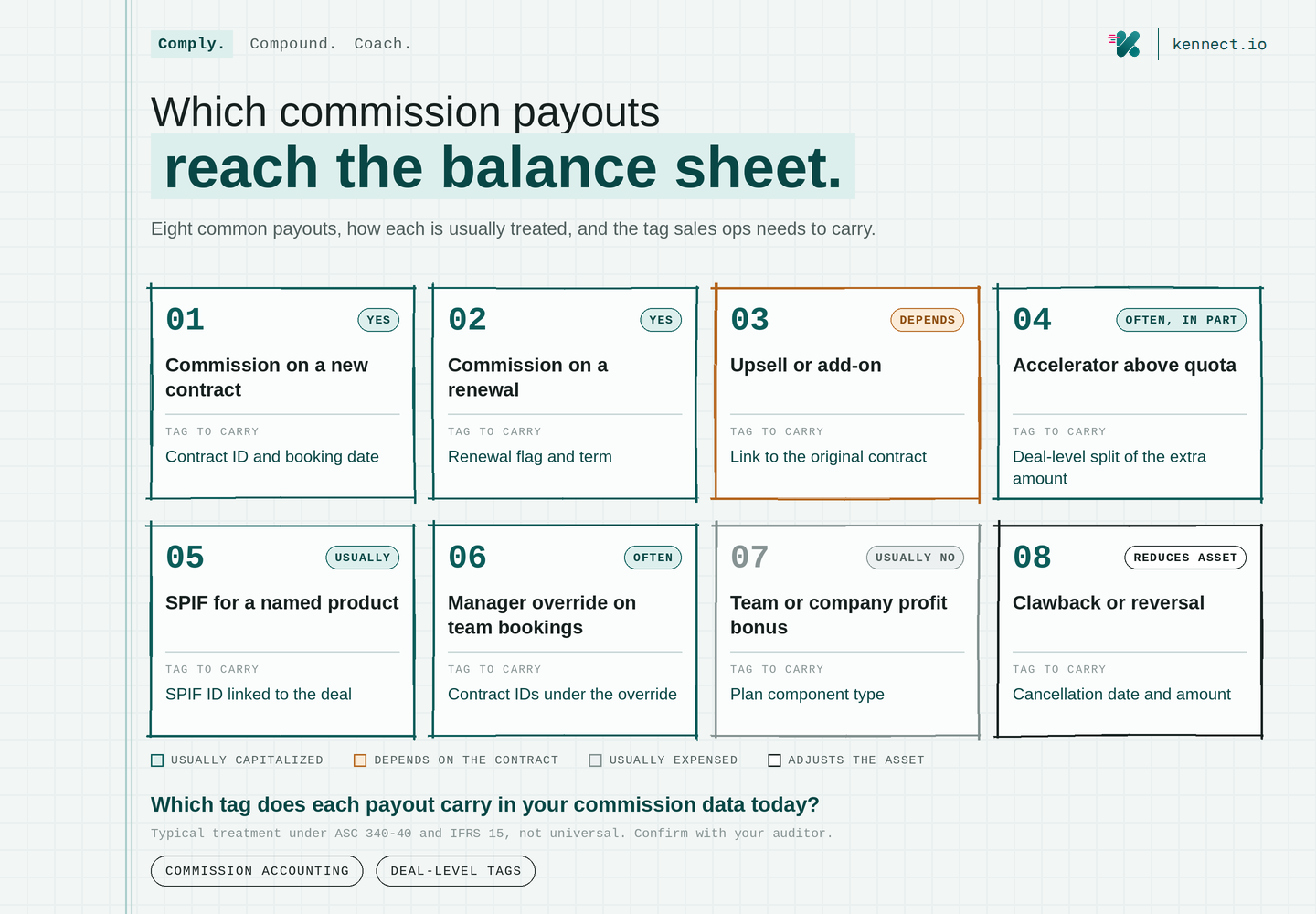
No singleanswer fits every plan, and your auditor has the final say. The table belowshows how common payouts are usually treated and the tag sales ops needs tocarry for each.
How common commission payouts are usually treated, and the tag each needs
Payout Type
Usually capitalized?
Why
Tag sales ops needs
Commission on a new contract
Yes
It would not exist without the deal
Contract ID and booking date
Commission on a renewal
Yes
The renewal is its own contract, amortized over the renewal term
Renewal flag and term
Upsell or add-on
Depends
Turns on whether it is a new contract or a change to the old one
Link to the original contract
Accelerator above quota
Often, in part
Only the share tied to specific contracts qualifies
Deal-level split of the extra amount
SPIF for a named product
Usually
Paid for winning the contract
SPIF ID linked to the deal
Manager override on team bookings
Often
Based on contracts won, though the link is indirect
Contract IDs under the override
Team or company profit bonus
Usually no
Not tied to winning a specific contract
Plan component type
Clawback or reversal
Reduces the asset
Adjusts the balance when a deal is cancelled
Cancellation date and amount
Source: ASC340-40, Other Assets and Deferred Costs, Contracts with Customers, and IFRS 15.Treatment shown is typical and should be confirmed with your auditor.
Eight common commission payouts and the tag each needs. Treatment is typical and should be confirmed with your auditor.
Each payout type needs a tag that says what it was paid for, because that tag decideswhether it reaches the balance sheet.
A worked example: one deal, five years of schedule
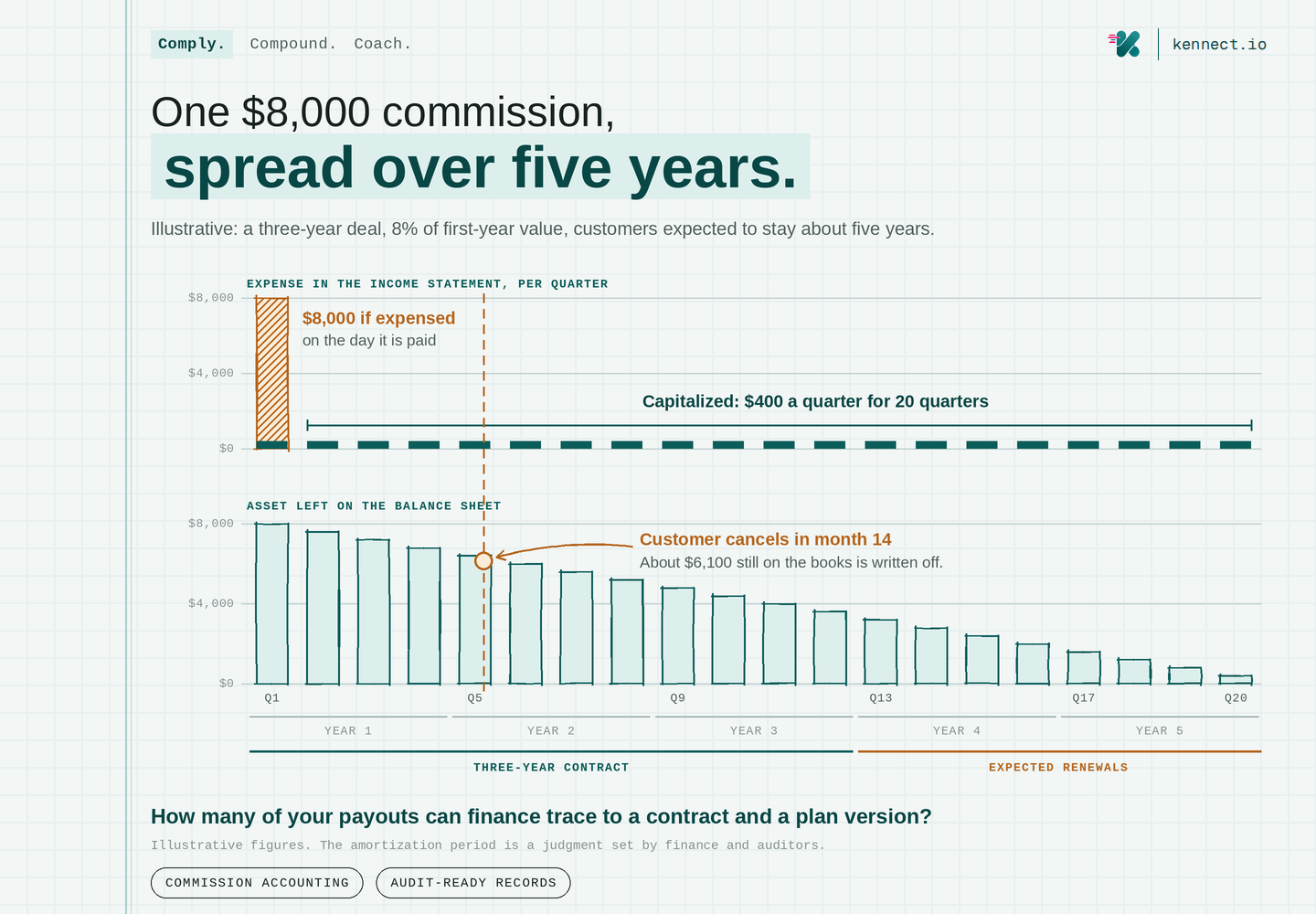
A rep closes athree-year software contract worth $100,000 a year. The plan pays 8% offirst-year value, so the commission is $8,000. Renewals pay 4%.
First, is itincremental? Yes. The commission exists only because the deal was won, so it iscapitalized.
Second, howlong is it spread? The renewal rate of 4% is lower than the initial 8%, so therenewal commission does not cover the full benefit of winning the customer.Part of the $8,000 effectively buys the renewals. If the company expectscustomers to stay about five years, the commission is spread over five years,not three.
Third, theschedule. $8,000 over five years is $1,600 a year, or $400 a quarter. In thequarter of the sale, the income statement shows $400 instead of $8,000, and thebalance sheet carries the rest as an asset.
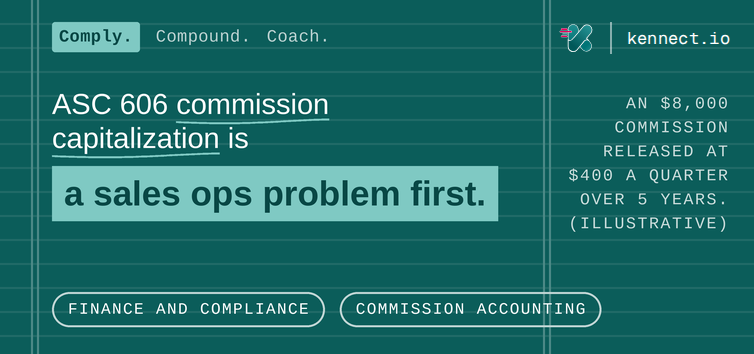
One $8,000 commission released at $400 a quarterover five years. Illustrative figures.
If the customercancels in month 14, the remaining balance, about $6,100, is written off, andany clawback the rep repays reduces that cost. That is why clawback terms needto be written into the plan, not discovered afterwards.
One more point.If the amortization period would be a year or less, a company can choose toexpense the commission straight away. The figures here are illustrative, andthe five-year estimate is a judgment that finance and auditors set.
One deal produces a payout today and a schedule for years, and the schedule only worksif the deal, the plan and the amount stay linked.
Where the schedule breaks
Three gapscause most of the quarter-end rework.
1. A payout with no contract ID
Commissions arepaid per rep per period, while the deal list sits in the CRM. When the two arejoined by hand, a split deal or a renamed account breaks the link, and theschedule carries an amount nobody can trace.
2. A plan change nobody dated
An acceleratorraised mid-quarter changes what a deal pays. Without a dated plan version,finance cannot tell which rate applied to which deal. The discipline behind amid-year incentive plan change applies here: version the plan and apply thechange from a date.
3. A cancellation that never reaches finance
A customercancels, the rep's commission is clawed back and the CRM is updated. Theamortization schedule keeps running because nobody told it. The asset stays onthe books after the benefit is gone.
Untagged payouts, undated plans and silent cancellations each leave finance holding an amount it cannot explain.
A checklist sales ops can run before quarter-end
Five steps putthe record in place before the auditor asks for it.
1. Give every payout a contract ID and a booking date.
2. Tag each plan component as new, renewal, upsell,accelerator, SPIF or team bonus.
3. Agree with finance which components count asincremental, and get the auditor's view in writing.
4. Version every plan change with a start date.
5. Send every cancellation and clawback to finance withthe original contract ID.
A commission record that finance cannot trace to a contract leaves the schedule to be defended from memory.
How Kennect supports the schedule
Kennect is not an accounting system, and the amortization stays in your ledger. What changes is the record the schedule is built from.
We hold each payout at deal level, with the plan version and the calculation behind it. Plan components carry the type a controller needs, so a renewal, an accelerator anda team bonus are never mixed in one line. Adjustments and clawbacks postagainst the original deal.
Finance gets a deal-level view to build the schedule from, instead of reconstructing it from payout exports. Sales ops stops answering the same question every quarter, andreps still see one number.
One record per payout, tied to its contract, turns a quarter-end scramble into a lookup.
What this means for the next quarter-end
Commission capitalization is an accounting rule, but the work behind it is data work, andthat data starts in sales ops. A team that tags every payout at the source canhand finance a schedule that holds up under audit.
The rule itself is stable. What changes each quarter is the plan, the deals and the cancellations. The record that links all three is the control that matters.
A payout tied to a contract, a plan version and a reason is a payout finance can capitalize without a second look.
See how incentive compensation management keeps commission records audit-ready.
Latest Blogs
The Supreme Court's pharma order reaches the MR incentive plan.
October 14, 2026
ASC 606 commission capitalization is a sales ops problem first
October 14, 2026
Insurance agent commission software needs clawbacks written in.
October 11, 2026
Bancassurance incentive management starts with who gets credit.