Unlock 2024 Sales Comp Secrets: Our "Ultimate Guide to Sales Compensation" is here!Unlock 2026 Sales Comp Secrets: Our "Ultimate Guide to Sales Compensation" is here!Download Guide

Blog
How to Design Sales Territories
April 12, 2023


Key Insights


How to Design Sales Territories: The Balance Test
What this covers.
Territory design decides how fair your comp plan is before a single rule is written. This sets out the two axes that actually matter, a four-state test you can run on every patch this week, the data to gather before you draw a line, and how to realign without breaking the plan mid-cycle. For sales leadership, revenue operations and the finance teams who inherit the consequences.
Why territory design is a compensation decision
A comp plan can only measure what the territory allows. Give two reps the same quota against patches with different opportunity, and the plan is no longer measuring performance. It is measuring the allocation, and paying out on it.
This is why territory arguments feel disproportionate. The rep arguing about a boundary is not being difficult. They are arguing about their pay, correctly, because the boundary sets their ceiling before they make a single call.
It also explains why territory problems present as compensation problems. When attainment skews low across the team with a few far above, the instinct is to look at the plan. Often the plan is fine and the patches are not comparable. Territory, quota and payout resolve from the same data, which is the case for running them on the unified compensation platform rather than in three separate files.
This is not a fringe view. Writing in Harvard Business Review, Zoltners, Sinha and Lorimer observed that companies are using more analytics to enable better sales force decisions, yet territory design is still too frequently undervalued (August 2015). Kellogg research on territory alignment puts the consequence plainly: many sales forces are losing millions of dollars each year because of territory imbalances (Zoltners and Lorimer, Journal of Personal Selling and Sales Management, 2000).
Four states, and none of them are geography
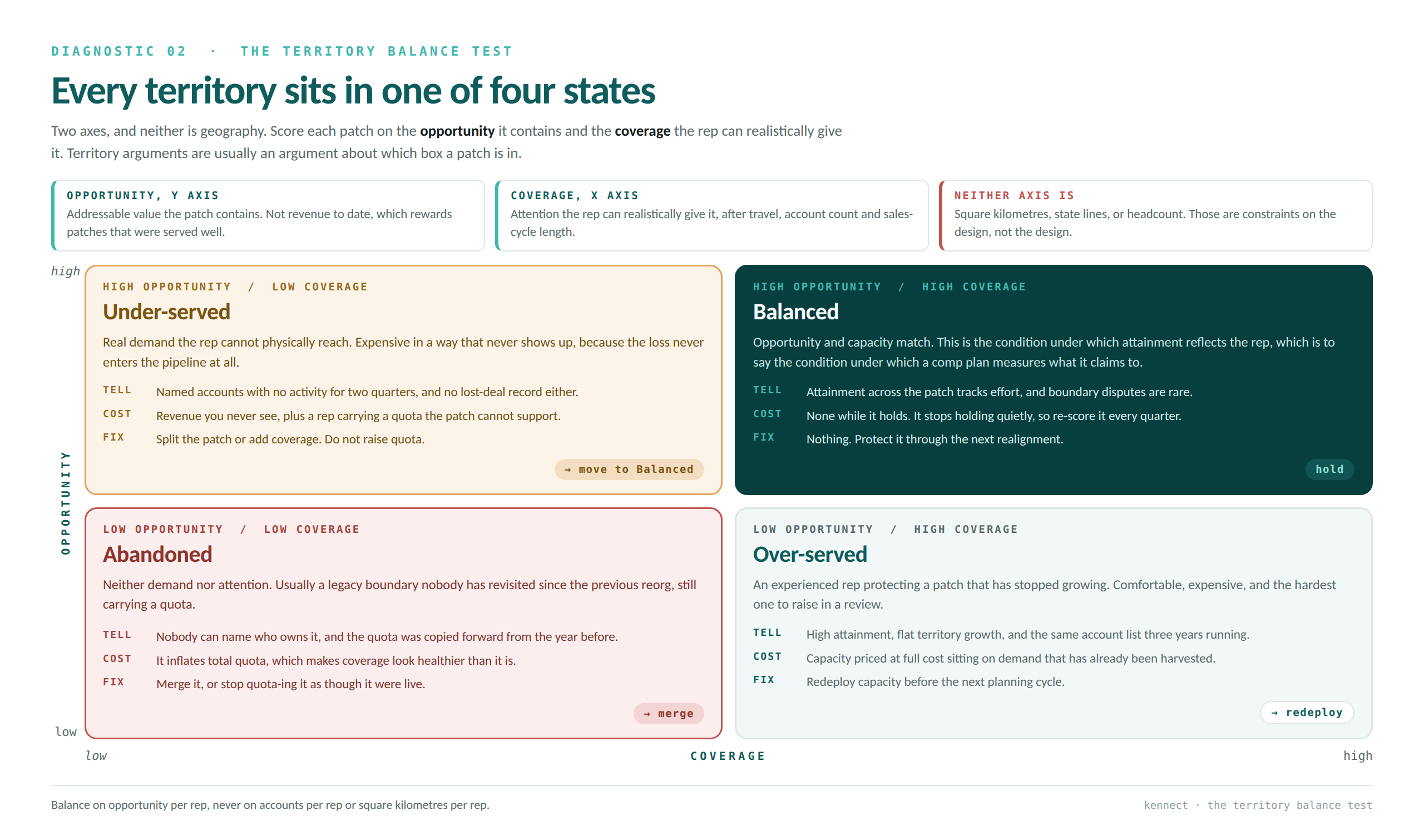
Score each territory on two axes. Opportunity is the addressable value the patch contains. Coverage is the attention the rep can realistically give it, accounting for travel, account count and cycle length. Neither is square kilometres.
- Under-served (high opportunity, low coverage). Real demand the rep cannot physically reach. The costliest state, because the loss never appears in the pipeline at all. Split the patch or add coverage. Do not raise quota.
- Balanced (high, high). Opportunity and capacity match. This is the condition in which attainment reflects the rep, which is to say the condition in which your comp plan measures what it claims to.
- Abandoned (low, low). Neither demand nor attention. Usually a legacy boundary nobody has revisited since the previous reorg, still carrying a quota. Merge it, or stop quota-ing it as though it were live.
- Over-served (low opportunity, high coverage). An experienced rep protecting a patch that has stopped growing. Comfortable, expensive, and the hardest one to raise in a review. Redeploy capacity before the next planning cycle.
Run it on every territory once a quarter. A patch that moves quadrant is a leading indicator that something in the market changed before your pipeline shows it. Doing this across a large field force is what territory management software is for, once the method is settled.
The data you need before you draw a line
Territory design fails on inputs more often than on method. Four things, and the third is the one people skip. The territory planning guide covers the modelling itself; this is the input list that has to exist first.
- Addressable value per account, not revenue to date. Historic revenue rewards patches that were served well and punishes ones that never were.
- Account count weighted by cycle length. Forty accounts on a nine-month cycle is not comparable to forty on a six-week cycle, and headcount maths treats them as identical.
- Travel and reach reality. In Indian field structures this is decisive and routinely omitted. A patch spread across three states with a distributor tier in each is not the same job as a metro cluster with the same nominal value.
- Channel overlap. Where a distributor or partner already covers an account, direct coverage is duplicated cost, not extra capacity.
How to realign without breaking the plan
The realignment itself is not the risk. The comp consequences are.
- Never realign mid-period. A boundary that moves inside a live cycle destroys trust faster than any payout error, because the rep can see exactly what it cost them.
- Protect in-flight deals by crediting rule, not by exception. Write the rule once: deals past a named stage at the cut-over date credit to the originating rep. Exceptions handled case by case become the untraceable logic you spend the next three years explaining.
- Re-baseline quota with the territory, in the same decision. Moving a boundary without moving the number attached to it is a reliable way to turn a fair realignment into an unfair plan, which is why setting sales quotas belongs in the same decision.
- Publish the method before the map. Reps accept a patch they lost if they can see the rule that produced it. They do not accept a map that appeared. The output of the whole exercise is a profitable territory plan that survives contact with the comp cycle.
The 8-point territory audit
- Can you state the addressable value of each territory, not just its revenue to date?
- Is account count weighted by sales-cycle length?
- Does the model account for travel and reach, not just geography?
- Is channel coverage netted off direct coverage?
- Can you place every territory in one of the four states?
- Has any territory changed quadrant since the previous review?
- Is there a written crediting rule for deals in flight at realignment?
- Does quota move with the boundary, in the same decision?
Where to start
Take your five largest territories and place them on the balance test. If more than one lands in under-served, you have a coverage problem being reported to you as a performance problem, and the comp plan is currently paying for it.
For the mechanics of the split, see how to strategically divide your sales territories. For making the exercise repeatable rather than annual firefighting, see systemising sales territory planning. And if you would rather see how teams run this in practice before designing anything, start there.
Frequently asked questions
How do I know if our sales territories are balanced?
Score each territory on addressable opportunity and realistic coverage, then place it in one of four states: under-served, balanced, abandoned or over-served. Balance means opportunity per rep, not accounts per rep or area per rep.
What data do I need before designing sales territories?
Four inputs: addressable value per account rather than revenue to date, account count weighted by sales-cycle length, travel and reach reality, and any channel coverage that already serves those accounts.
Should sales territories be based on geography?
Geography is a constraint, not a design principle. Territories built on map boundaries produce patches with wildly different opportunity, which means the comp plan ends up measuring the allocation rather than the rep.
How often should sales territories be realigned?
Review quarterly, realign annually, and never mid-period. A boundary that moves inside a live cycle damages trust faster than a payout error because the rep can see exactly what it cost them.
What happens to deals in flight when a territory changes?
Write one crediting rule rather than handling exceptions individually: deals past a named stage at the cut-over date credit to the originating rep. Case-by-case exceptions become untraceable logic that takes years to unwind.
Why do territory problems look like performance problems?
Because they surface in the same report. When reps sit below target with a few far above, the plan is usually fine and the patches are not comparable, but the attainment number cannot tell you which.
Does territory design affect commission fairness?
Directly. A comp plan can only measure what the territory allows, so two reps on the same quota against unequal patches are being paid on the allocation rather than on their own performance.
Related reading
- How to strategically divide your sales territories
- Systemising sales territory planning
- Creating a profitable sales territory plan
- Understanding and setting sales quotas

ReKennect : Stay ahead of the curve!
Subscribe to our bi-weekly newsletter packed with latest trends and insights on incentives.
Thank you! Your submission has been received!
Oops! Something went wrong while submitting the form.
Your data is in safe hands. Check out our Privacy policy for more info
Related Articles





Contact
Phone : (415) 799-4494
Email : info@kennect.io
Social


Achivement


Address
P3, Officebing, Kailash Business Park, Hiranandani Link Rd, Vikhroli (W), Mumbai, Maharashtra 400079 India
3rd Floor, Orchid Centre, Sector 53, Gurugram, Haryana 122002 India
224 W 35th St, Ste 500-820New York, NY 10001USA
© 2024 Kennect - All Rights Reserved.
Privacy Policy