Unlock 2024 Sales Comp Secrets: Our "Ultimate Guide to Sales Compensation" is here!Unlock 2026 Sales Comp Secrets: Our "Ultimate Guide to Sales Compensation" is here!Download Guide

Blog
How to Manage Sales Compensation
January 19, 2023


Key Insights


How to Manage Sales Compensation: A Governance-First Guide
What this guide covers.
Sales compensation management is usually taught as plan design. That is the smallest part of it. This guide treats it as an operating system with three jobs: prove the number, plan the number, and use the number to change behaviour. You get two frameworks you can reuse on any comp decision, a worked example from an Indian distributor structure, a 12-point checklist you can run before the next cycle closes, and a clear answer on who should own what.
Who it is for
CFOs and finance leaders who carry the audit, CROs and sales leaders who carry the number, and the sales ops teams who carry both.
What sales compensation management actually is
Sales compensation management is the end-to-end process of designing pay plans, calculating what each person has earned, governing the approval of those payments, and proving afterwards that the numbers were right. Plan design is one of four parts, and it is the part articles tend to discuss.
The other three are where the cost sits. A plan that cannot be calculated repeatably produces disputes. A plan that cannot be governed produces audit findings. A plan whose results cannot be proven produces a quiet loss of trust that shows up as reps building their own spreadsheets to check yours.
It is worth being precise about the stakes, because compensation is routinely treated as an administrative cost rather than a growth lever. McKinsey’s research found that smart revisions of compensation models have a 50 percent higher impact on sales than changes in advertising investment (McKinsey, October 2018). The plan is not the paperwork behind the growth strategy. In many organisations it is the growth strategy, operated by finance.
A large share of organisations are operating it by hand. A WorldatWork and SalesGlobe study found that 39 percent of organisations still calculate sales compensation manually, and 28 percent run it on a purpose-built system (WorldatWork and SalesGlobe, August 2021).
Framework 1: the 2G Grid
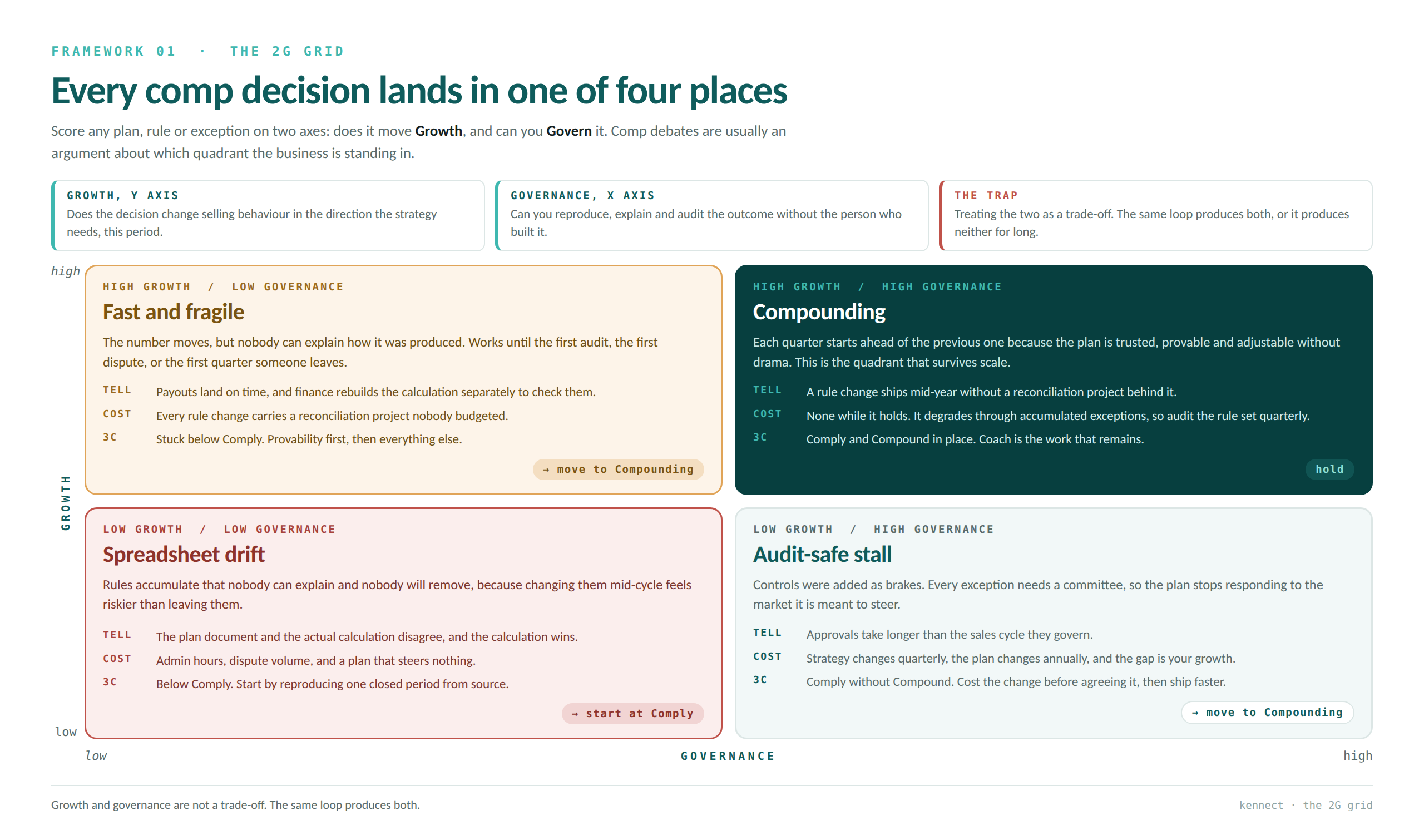
Almost every argument about a comp plan is really an argument about two things at once: whether a decision moves Growth, and whether you can Govern it afterwards. Separating them makes the argument tractable.
Reading your own quadrant
The grid’s real use is that it is reusable. Take any single decision, not just the whole plan - a new accelerator, a clawback clause, a channel slab - and place it. If a change moves you right on governance without moving you up on growth, you have added a brake. If it moves you up without moving you right, you have added a liability. Growth and governance are not a trade-off, and a decision that only buys one of them is usually the wrong decision.
Framework 2: the 3C Ladder
The 2G Grid tells you where you are standing. The 3C Ladder tells you what to build next. Three stages, in order, because each one makes the next possible.
Stage 1. Comply: the number is provable
You can hand an auditor the plan document in force for a given period, the calculation trail showing how each payment was derived, and the change log showing who altered which rule and when. Organisations routinely think they are at this stage. The diagnostic question that settles it: can you reproduce last March’s payout run today, from the system, without anyone’s memory? If the answer needs a person, you are not at stage 1.
Stage 2. Compound: the number is planned
Quota, territory and payout resolve from the same dataset, so you can model a plan change before you make it rather than discovering its cost at quarter end. The diagnostic question: can you tell your CFO what a two point change to the accelerator will cost, before the quarter starts? Stage 2 is what turns compensation from a monthly calculation into a lever with a forecast attached.
Stage 3. Coach: the number changes behaviour
Every rep can see the gap between where they are and the next threshold, and what action closes it. The plan stops being a statement issued after the fact and becomes something people act on during the period. The diagnostic question: can a rep tell you, unprompted, what they need to do this week to move their own number? The order is not negotiable. Coaching on a number people do not trust makes the distrust worse, because you are now asking reps to change behaviour based on maths they cannot verify. Compliance first, always. It is the enabler, not the brake.
Who owns sales compensation
Design belongs to sales, because it sets behaviour. Control belongs to finance, because it carries the audit. The arrangements that fail are the ones where a single function holds both: sales-owned plans drift out of governance, finance-owned plans drift out of the market.
In practice the split works when three things are named. Sales leadership owns plan design and quota. Finance owns the calculation, the approval workflow and the audit trail. Sales operations owns the plan logic as documentation, so the rules live somewhere other than in one person’s head. Ambiguity on that third point is a recurring cause of a comp process that cannot survive a resignation.
A worked example: the distributor tier nobody could explain
A mid-size Indian manufacturer ran direct sales and a three-tier distributor network from the same plan. Direct reps were paid on invoiced revenue. Distributors were paid on secondary sales, reported by stockists on their own cycle.
The two motions had been merged into one spreadsheet years earlier, and an accelerator had been added for a single quarter’s push. Nobody removed it. Three years later it was still paying, and finance had built a manual adjustment each cycle to net it out - an adjustment that existed only in the workbook of the analyst who created it.
Placed on the 2G Grid, this is textbook spreadsheet drift: the plan document and the calculation disagreed, and the disagreement was being patched by hand every month. On the 3C Ladder it failed stage 1 outright. They could not reproduce a past payout run without that one analyst.
The fix was not a new plan. It was separating the two motions so each had its own crediting basis, then documenting every surviving rule with the date and reason it was introduced. The dead accelerator was retired in the same pass, because a rebuild is a realistic moment to remove a rule nobody can defend. Reaching stage 1 took one quarter. The plan redesign everyone had assumed was needed turned out not to be.
The 12-point sales compensation checklist
Run this before your next cycle closes. Any “no” is a finding, not a preference.
- Can you produce the plan document that was in force for any past period, as it stood then?
- Can you reproduce a past payout run from the system, without relying on anyone’s memory?
- Is there a change log showing who altered which rule, and when?
- Does every rule in the live calculation appear in the plan document, and vice versa?
- Can you name the date and reason each accelerator and exception was introduced?
- Are direct and channel motions credited on their own basis, rather than merged?
- Does any part of the calculation depend on a file held by one individual?
- Can you model the cost of a rule change before making it?
- Are commissions treated correctly under ASC 606 or IFRS 15, where applicable?
- Is there a defined route for a rep to dispute a payout, with an owner and a clock?
- Can a rep see their gap to the next threshold without asking anyone?
- If your comp analyst resigned tomorrow, does the process survive the month?
Points 1 to 5 are stage 1 of the ladder. Points 6 to 9 are stage 2. Points 10 to 12 are stage 3. If you fail anything in the first block, fix that before touching the rest.
Where to start
Start with point 2 on the checklist, because it is the point that cannot be argued about. Pick a closed period, ask for the payout run to be reproduced from the system, and time how long it takes and how many people it involves. Whatever that exercise reveals is your real starting position, regardless of what the plan document says.
Then place yourself on the 2G Grid honestly. Organisations that describe themselves as fast usually stand in “fast and fragile”, and the distance from there to compounding is shorter than it looks, because governance is the axis they have never deliberately worked on.
Frequently asked questions
How do I set up and manage sales compensation for my team from scratch?
Start with the calculation and the record, not the plan design: decide how each sale is credited, where that data comes from, and how a past payout will be reproduced later. A simple plan you can prove beats a sophisticated plan you cannot, and it is far easier to add sophistication to a governed process than to add governance to a clever one.
Who should own sales compensation, finance or sales?
Design belongs to sales because it sets behaviour, and control belongs to finance because it carries the audit; the arrangements that fail are the ones where one function holds both. Sales operations should own the plan logic as written documentation so the rules do not live in one person’s head.
How often should we change our sales compensation plan?
Annually for the plan and never mid-period for the rules, because a rule changed inside a live cycle destroys trust faster than any payout error does. If a mid-year change is genuinely unavoidable, apply it forward from a stated date and tell everyone affected before it takes effect.
What does an auditor actually ask for when reviewing sales commission payments?
Three things, consistently: the plan document in force for the period, the calculation trail showing how each payment was derived, and the change log showing who altered a rule and when. Disputes with auditors usually turn on the third one, because it is the artefact spreadsheets cannot produce.
Can we manage sales compensation accurately in Excel?
Accurately, yes, up to a point; repeatably and provably, no, because a spreadsheet cannot show who changed which rule on which date, and that record is exactly what a commission audit asks for. The practical threshold is not headcount but plan complexity: multiple legal entities, channel tiers or crediting rules are what break a spreadsheet, not the number of reps.
How much does poor sales compensation management cost?
The cost shows up in three places rather than one: the finance hours spent rebuilding the calculation each cycle, the payout errors corrected after the fact, and the selling time reps lose to disputes. The first is the easiest to measure and usually the one that gets ignored.
What is the difference between sales compensation management and incentive compensation management?
They describe the same system, and the terms are used interchangeably in this market along with sales incentive software. Where a distinction is drawn, sales compensation tends to include base pay while incentive compensation refers to the variable portion alone.
Related reading
- The basics of sales incentive compensation
- How to choose an incentive structure
- Sales incentive program management
- What is incentive compensation, after all

ReKennect : Stay ahead of the curve!
Subscribe to our bi-weekly newsletter packed with latest trends and insights on incentives.
Thank you! Your submission has been received!
Oops! Something went wrong while submitting the form.
Your data is in safe hands. Check out our Privacy policy for more info


Contact
Phone : (415) 799-4494
Email : info@kennect.io
Social


Achivement


Address
P3, Officebing, Kailash Business Park, Hiranandani Link Rd, Vikhroli (W), Mumbai, Maharashtra 400079 India
224 W 35th St, Ste 500-820New York, NY 10001USA
3rd Floor, Orchid Centre, Sector 53, Gurugram, Haryana 122002 India
© 2024 Kennect - All Rights Reserved.
Privacy Policy