How 12,000 people in Dr. Reddy's field force came to trust their incentive, line by line
Dr. Reddy's Laboratories runs pharma sales force incentive management for 12,000+ medical representatives and area, zonal and regional business managers across six business units. Incentives on 150+ SKUs in SKU groups, under 80+ schemes on four periodicities, were calculated in spreadsheets that had grown too heavy to run. Kennect went live in January 2026 after an implementation that began in November 2025. Every payout is now generated as an audit-ready advice, with recoveries traced to their component, and payout accuracy stands at 100%.
At a glance
| Item | Detail |
|---|---|
| Industry | Pharma and life sciences, India |
| Field users | 12,000+ medical representatives, area, zonal and regional business managers |
| Structure | 6 business units (2 more being added), 6 clusters by therapy, divisions and teams inside each |
| Plans | 80+ schemes across monthly, quarterly, half-yearly and annual cycles, each with its own payout |
| Products | 150+ SKUs, with incentives calculated on SKU groups |
| Data | Sales data dump and a separate HR dump with employee details |
| Timeline | Implementation from November 2025, live January 2026 |
| Modules | Calculation engine, payout management (advice generation), what-if simulator, scheme nudges, query management and analytics |
| Service model | Kennect managed services, including impact analysis of every scheme logic change |
Why were 12,000 people waiting on a spreadsheet to learn their incentive?
Every month, a medical representative at Dr. Reddy's finished the month without knowing what it had earned. So did the area business manager above them, and the zonal and regional managers above that. The number sat in spreadsheets in head office, and those sheets had grown heavy enough to strain under the users they served.
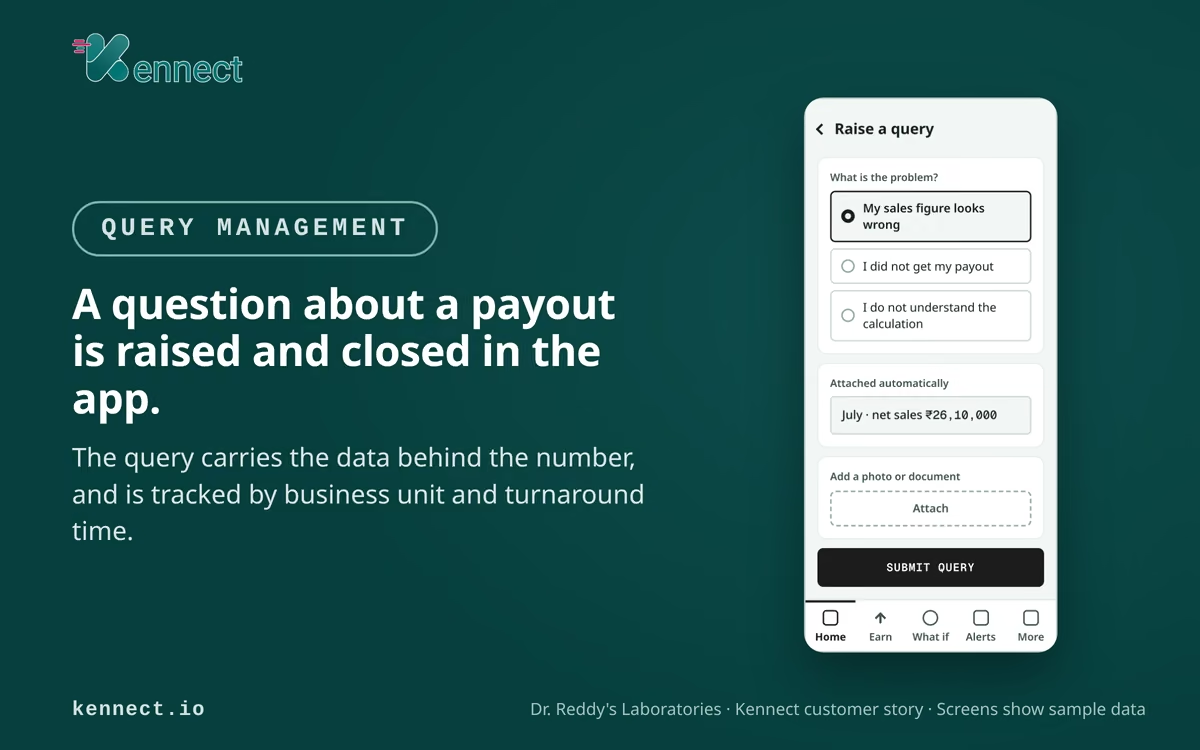
There was no dashboard for the field. When a rep wanted to know where they stood, they asked, and the question travelled up a line of managers to a small team that already had a month-end to close. Queries arrived in volume because asking was how the field saw the number, and incentive query management had become a job of its own.
What made incentives at this scale so hard to run in Excel?
The structure of the business. Six business units, with two more on the way. Six clusters organised by therapy, divisions inside each cluster, and teams inside each division. 80+ schemes, and many of them change month on month and quarter on quarter as divisions shift focus.
Incentives are earned on SKU groups drawn from 150+ SKUs, so each SKU group incentive calculation carries its own target. They run on monthly, quarterly, half-yearly and annual cycles, each with a payout of its own. Sales data arrives as one dump and employee details as a separate HR dump, and the two have to agree before a single number is right.
Each of these is manageable in a workbook. Together, across 12,000 people, every cycle depended on a few people holding the whole structure in their heads.
What was the real concern before saying yes?
Calculating a payout was one part of it. The harder question was what happens after a payout has been made. When a rep moves division after a cycle closes, or a scheme is recalculated, the number changes after the rep has already been paid on it. Management wanted to know whether a system could recover money from a medical rep, or pay them more, and still leave the rep able to see exactly why.
There was a second concern underneath. Incentive payouts had not yet been through an audit. The first audit year was coming, and every rupee paid to the field would need a record behind it.
How does commission clawback management work across six months of payouts?
The principle Kennect built around: every rupee paid, and every rupee recovered, carries its reason.
- We take the sales dump and the HR dump as they arrive today.
- We configure all 80+ schemes on SKU groups, across four cycles, in one calculation engine.
- We generate each month's payout as an advice, reconcile it against the previous month, and hand it to finance ready to release.
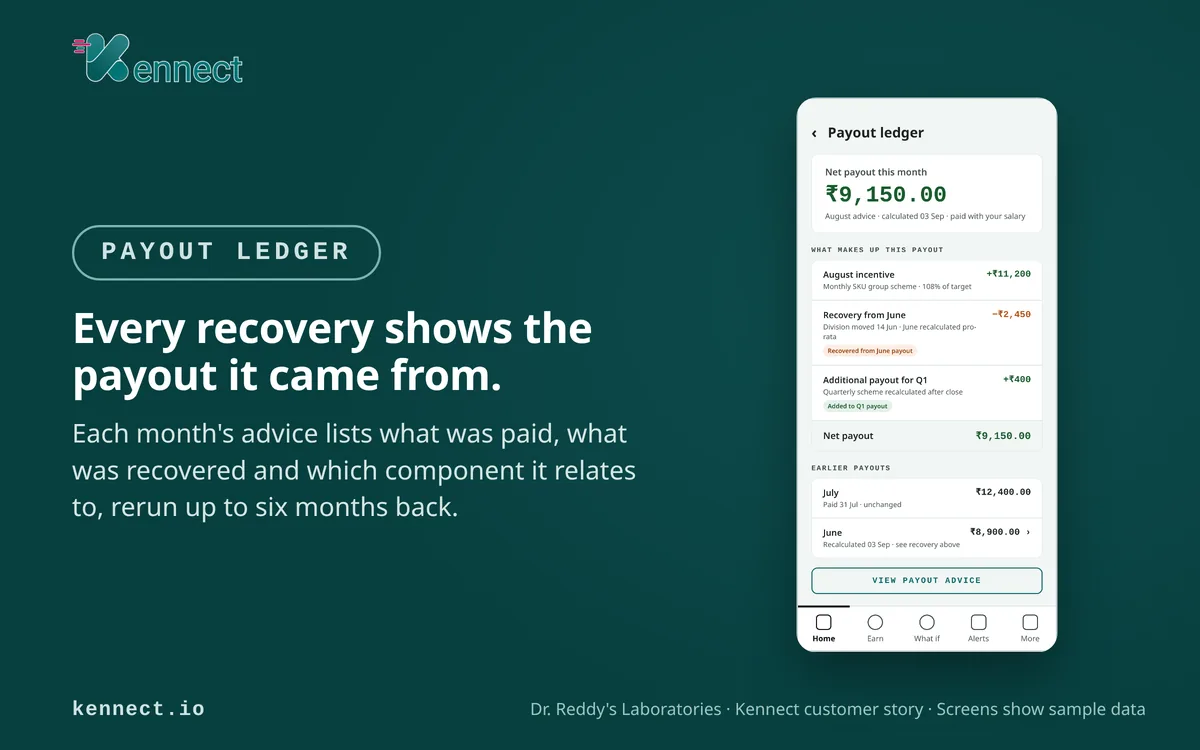
- We rerun the last six months whenever a number behind them changes, so each recovery or additional payout lands against the component it came from.
The result is an incentive payout ledger for every sales rep, a passbook on their phone. A rep who sees a recovery this month can see which earlier payout and which component it relates to. Every exception is captured, and each ledger can be shown to an auditor as it stands. That record is what makes these audit-ready incentive payouts.
Before any logic goes live, scenario modelling tests it, and the Kennect team shares an impact analysis of each scheme change with Dr. Reddy's.
How are incentive proration rules applied when a rep moves division mid-cycle?
One case took real work during onboarding. When a rep moves division after a cycle has closed, the achievement criteria that applied to them change after the fact. When the move happens mid-cycle, the incentive has to be pro-rated across two divisions and two sets of targets. Both cases are now written into the rules and tested through scenario modelling before each change ships.
Across roles, the change looks like this:
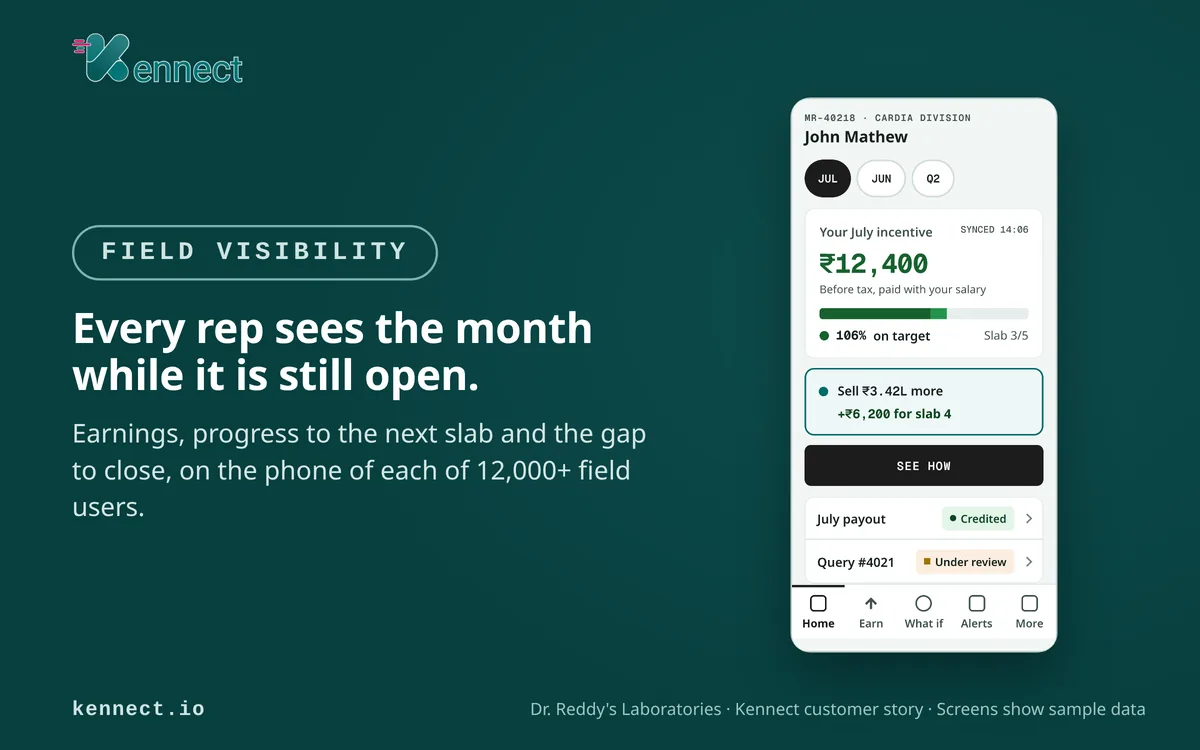
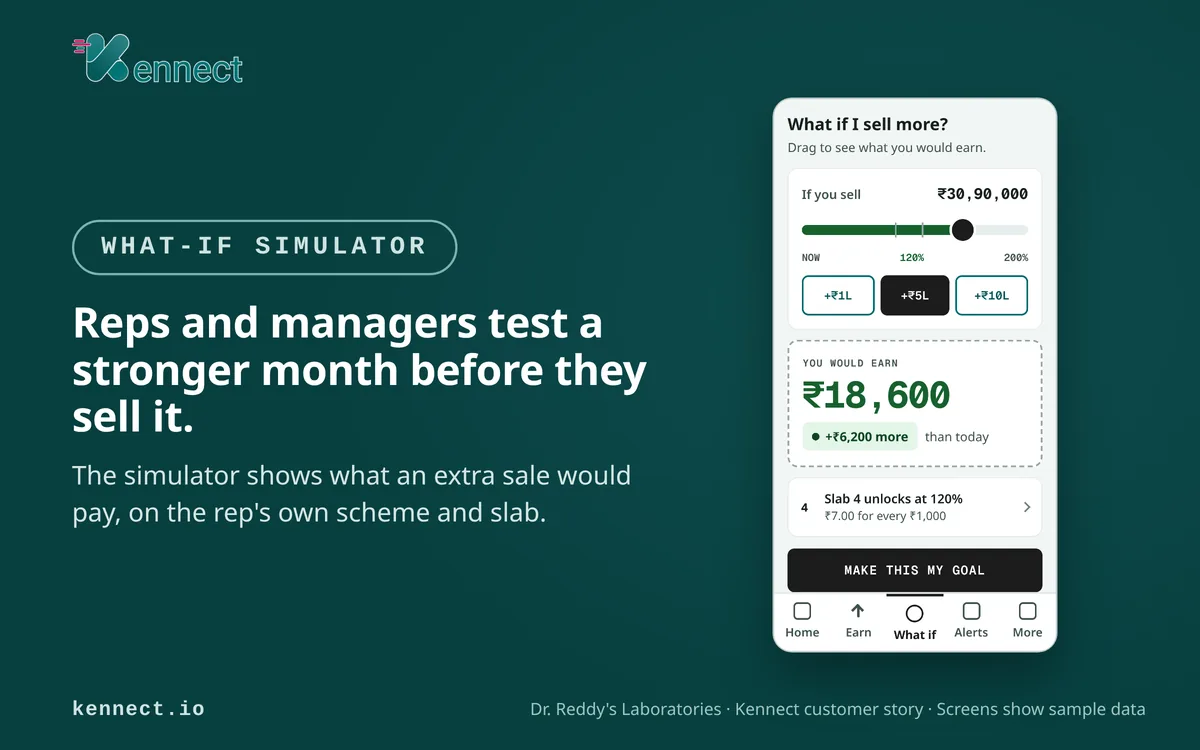
- Medical representatives see their earnings, their ledger and regular scheme nudges, and use the what-if simulator to see what a stronger month would pay.
- Area, zonal and regional business managers simulate earnings for themselves and their teams.
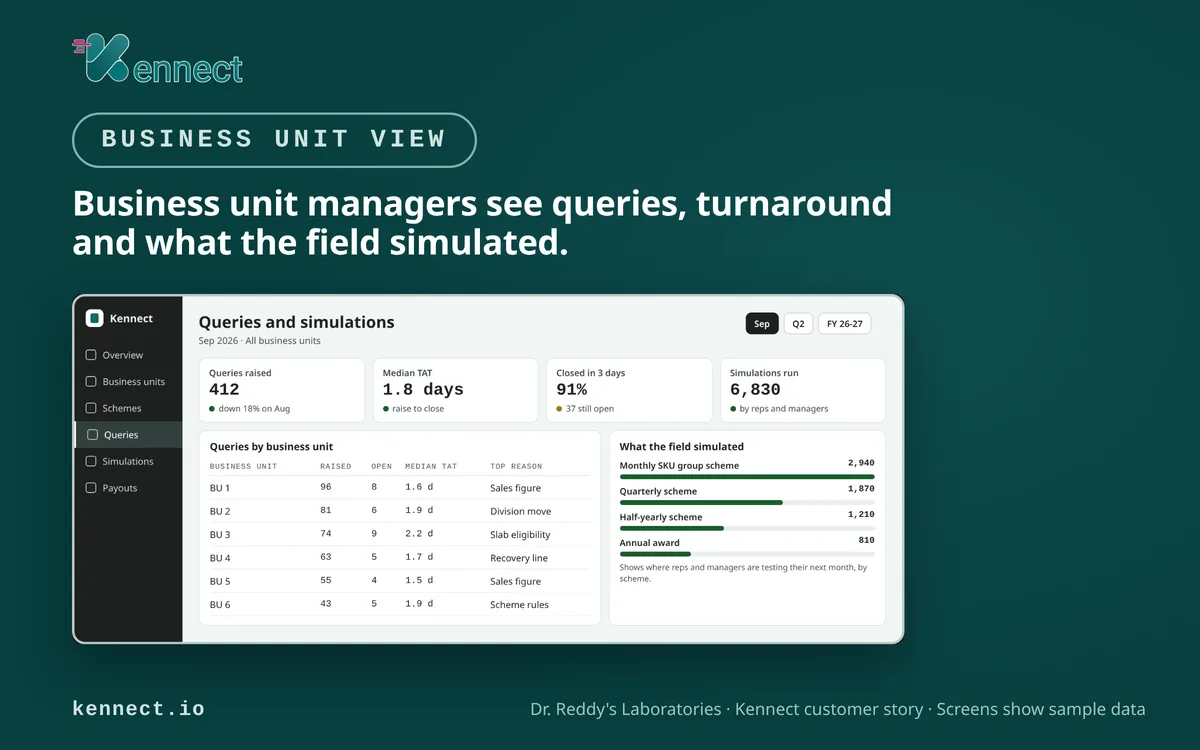
- Business unit managers receive reports on what reps and managers simulated, a direct read of where the field is putting its effort.
- Finance receives payout advices that are reconciled and ready to release.
- Management holds audit-proof ledgers, with every exception recorded, as the first audit year begins.
What changed after go-live?
| Metric | Before | After | Basis |
|---|---|---|---|
| Payout accuracy | - | 100% | Since go-live, January 2026 |
| Kickoff to live | - | About 2 months | November 2025 to January 2026 |
| Payout recalculation window | Spreadsheets | Last 6 months, rerun automatically | Payout management (advice generation) |
| Field visibility | No dashboard access | Earnings, ledger and simulator on the app for 12,000+ users | Since January 2026 |
| Incentive queries | High, because the field had no dashboard access | [PLACEHOLDER: queries per cycle and query TAT] | Query analytics, by business unit |
| Payout audit | Not run | First audit year beginning, on audit-proof ledgers | Management |
In their words
[PLACEHOLDER: 25 to 40 word quote from Dr. Reddy's]
Run incentives for your field force on one auditable ledger
See how Kennect calculates SKU group incentives, reruns six months of payouts and gives every rep a live view of what they earn.
Book a demoFAQs
How does SKU group incentive calculation work for medical representatives?
Each scheme defines groups of SKUs and a target for each group. Kennect reads the sales data against those groups, applies the slab or rate for the cycle, and pays on the result. At Dr. Reddy's this covers 150+ SKUs across 80+ schemes.
How do pharma companies recover incentive already paid to a medical rep?
Through a written clawback rule applied in the next payout advice. Kennect reruns the previous six months when a number changes, and the rep sees the recovery against the exact earlier payout and component it relates to.
What makes an incentive payout audit-ready?
A payout advice reconciled to the previous month, a ledger line for every payout and recovery, recorded exceptions, and the rules version used for each cycle. Finance and auditors can then trace any rupee back to its source data.
How is incentive pro-rated when a rep changes division mid-cycle?
The cycle is split by the dates the rep spent in each division, and each part is measured against that division's targets and scheme. A division change after a cycle closes is handled as a separate rule, tested in scenario modelling before it goes live.
How long does it take to go live for a field force of 12,000?
At Dr. Reddy's, implementation began in November 2025 and the platform went live in January 2026, across six business units and 80+ schemes.
Explore more case studies




.avif)

Contact


Social


Achivement