Passenger vehicle dealers held 38 to 40 days of stock at the end of August 2026, against the 21 days FADA recommends. This post explains how a festive scheme paid on billing rewards stock the dealer has yet to sell. It names four ways a scheme ends up paying for the wrong car and three conditions that predict it. It closes with five scheme choices, each costed with scenario modeling before the circular goes out.
Passenger vehicle dealers held 38 to 40 days of stock at the end of August 2026, against the 21 days FADA recommends. This post explains how a festive scheme paid on billing rewards stock the dealer has yet to sell. It names four ways a scheme ends up paying for the wrong car and three conditions that predict it. It closes with five scheme choices, each costed with scenario modeling before the circular goes out.
Table Of Content
WHEN THE CHANNEL IS FULL
A festive scheme without scenario modeling pays for billed stock.
A festive scheme paid on dispatches rewards stock the dealer has yet to sell, and in August 2026 about 37,000 more passenger vehicles were billed than registered. Scenario modeling runs the scheme on sales history before launch, so finance sees what it pays at each level of retail. Kennect builds that model on the live plan.
The stake sits in dealer yards. Passenger vehicle retail in August 2026 was 4,02,398 units, and factory dispatches were 4,39,309. Network stock reached 38 to 40 days, against the 21 days FADA recommends. Fifty six percent of dealers held more stock than a month before. Every festive scheme approved between now and Diwali on 8 November pays out against that position. A scheme that pays on billing adds to it. A scheme that pays on registrations draws it down. Both sit in the same budget line, and finance signs that line before anyone can see which way the money went.
Four symptoms a sales head sees before anyone calls it a problem
The first sign looks like good news. Billing targets close on time, area sales managers clear their slabs, and the incentive run for the month is on budget. The registration numbers for the same territories arrive a few days later and sit below billing.
The second sign comes from the dealer. The dealer principal calls about the funding line, then about a scheme claim from the previous quarter that has not settled. Every day of stock above the recommended level is a day of interest, and the dealer is counting them.
The third sign is in the mix. One variantwaits in the yard while buyers ask for another. A scheme written on total units pays the same for both.
The fourth sign is the calendar. The festive circular reaches the field after the dealers have placed their orders,and the first questions from reps are about which models count.
Each symptom is ordinary on its own,and together they describe a scheme that pays for the channel’s position.
Four ways a festive scheme ends up paying for the wrong car
Each of these has a sound reason behind it, which is why each one survives from season to season.
i) It pays on billing
Targets sit on dispatches because billing is the number the plant sees first and trusts. It closes daily, it tiesto invoices, and it needs no dealer data. With 37,000 more vehicles billed than registered in August, a billing slab pays the area sales manager for stock the dealer still has to sell. His statement shows a strong month. The dealer’s yardshows the same month from the other side.
ii) It drains dealer capital
Every day of stock above 21 is a dayof interest on a funding line. A scheme that rewards taking in more cars adds to that cost before it adds to retail. FADA’s August release named the same risk, asking manufacturers to bill strictlyto retail so dealer capital is not locked in aging inventory. A dealer carrying that cost reads every new circular for one thing: whether it pays on what he buys or on what he sells.
iii) It pays on the wrong mix
In August, CNG, hybrid and electric cars together took 41.95 percent of passenger vehicle retail, ahead of petrolat 40.85 percent for the first time. A scheme written on total units pays the same for a slow petrol trim as for a CNG variant buyers are asking for. Stock can pile up in one while the other runs short, and the scheme pays for both alike.
iv) It arrives after the orders
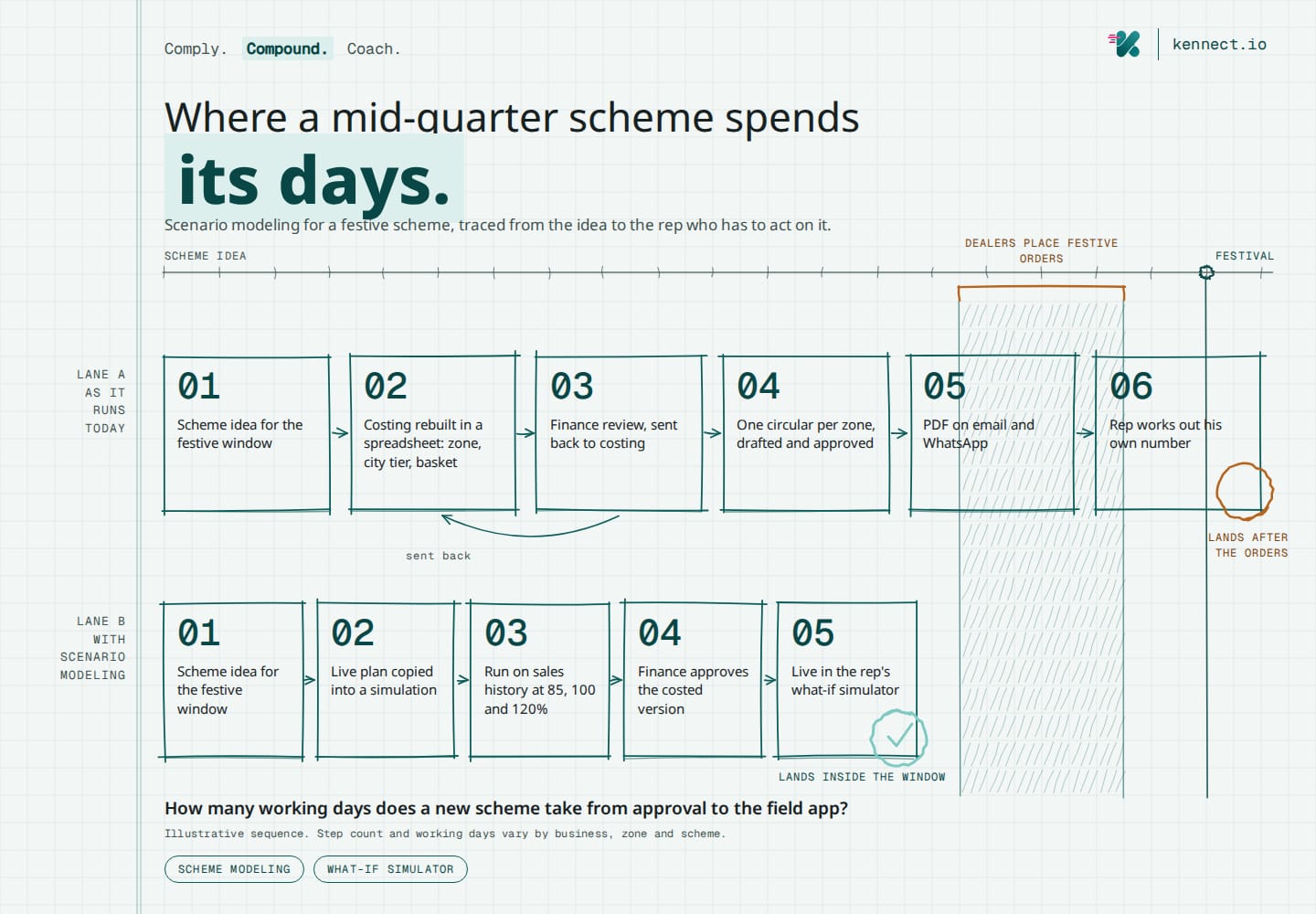
Festive stocking is already underway by the time a mid-quarter scheme is approved. Between the idea and the rep, the scheme passes through costing, finance review, a circular per zone and aforward on WhatsApp. The costing is rebuilt in a spreadsheet for every zone,city tier and product basket. The new slab has to be read against the quarterly plan already running, where one invoice can count twice or cross a cap. Repswho changed territory inside the quarter have to be costed on the reporting line they had on the day of the sale. Alexander Group’s 2026 Sales Compensation Trends Survey found 46 percent of organizations report difficulty allocating targets on time. A scheme that clears all of this after the yards are full pays for cars already billed. When a reward reaches the field shapes how much it moves behavior, a pattern set outin incentive timing psychology.
Flow diagram comparing two paths for a festive scheme: six handoffs from idea to rep that land after dealers place festive orders, and five steps with scenario modeling that land inside the order window. Tagged Scheme Modeling and What-If Simulator.
Each failure is a design choice madefor a good reason, and each one moves incentive money toward stock and away from the showroom.
Three conditions predict it in any channel business
The test works for cars, and it works equally for consumer durables, paints, tyres or packaged goods sold through distributors. If all three conditions hold going into a festive quarter, the scheme will pay for stock.
Channel stock sits above its own norm. For passenger vehicles the norm is 21 days. Every business has its equivalent, and the sales head usually knows it without looking it up.
The scheme pays on primary billing with no retail gate. Dispatch, invoice or primary order is the measure, and nothing in the payout checks what reached the end customer.
The field sees the scheme days after approval. The rep learns the rule from a circular, and cannot yet see what it means for his own number.
One question settles the first condition quickly: how much of the stock in the network today is older than 30 days, and in which variants?
The strain is building and has not broken. In FADA’s August survey, 41.03 percent of dealers called their liquidity good, and stock sits below the 56 days of August 2025.
Where all three conditions hold, the outcome follows from the design, whatever the intent behind the scheme.
What the August 2026 FADA reading shows
FADA’s August release gives a currentview of the channel a festive scheme pays into. Passenger vehicle stock was about 28 days in March, 33 to 35 days at the end of July, and 38 to 40 days at the end of August. Fifty six percent of dealers reported more stock than a month earlier. Dealers said the festive curtain-raiser came in below their expectations, and 29.06 percent named festive demand under delivering as their first risk for Septemberto November. In FADA’s Dealer Satisfaction Study 2026, fielded July to August, two-wheeler dealers asked manufacturers for more disciplined sales incentives. It is the channel itself asking for schemes it can plan around.
The same survey keeps the reading in proportion. 41.03 percent of dealers called their liquidity good and 11.54 percent called it bad. Stock is lower than a year ago, when August 2025 closed near 56 days. Discounting has so far stayed in check.
The reading has limits. FADA reports network averages. It does not report stock age or fuel mix by dealer, and atleast one large network sat near 16 days in the same period. It measures stock,and it says nothing about what any scheme paid.
FADA vehicle retail data, 1,467 of 1,469 RTOs, collated 4 September 2026 · Inventory from FADA’s member survey,March, July and August 2026 releases · Dispatch figure from SIAM via Business Standard, 20 September 2026 · Network averages, no OEM or dealer identified
The August reading describes a channel under building strain, which is when a scheme’s design decides where the money goes.
Five scheme choices that pay for the car leaving theshowroom.
Each of these can be costed before a circular goes out, which is the point of modeling first.
1. Gate billing payouts on retail
A qualifier releases the billing slab once registrations reach a share of billing that the business sets for the month. The area sales manager still earns on dispatch, once the cars are moving.
2. Pay by stock age
Slabs that step up for older stock, tied to the individual vehicle, move money to the older cars, where the dealer’s holding cost has run up.
Stock age comes from the dealer management system. The stock-in date for each vehicle is pulled from the DMS feed, and the registration or sale date closes its time in stock.
3. Balance the mix
Full payout needs achievement acrossthe variants in demand and the ones in stock, so a quick push on one variant cannot carry the whole slab.
4. Settle dealer claims quickly
A scheme claim settled inside the month returns capital to a dealer already carrying 40 days of stock.
5. Model it on history first
Each of these choices changes theoutgo. Run the scheme on the previous festive quarter at 85, 100 and 120 percent of target, and finance approves a number it has already seen.
This is the work incentive plan modeling software is for. In Kennect, the live plan is copied into a simulation, so the payout the field sees today stays untouched. The new scheme runs on the business’s own sales history, and finance sees the out go, the number of earners and the average earning at each level of attainment. Retail gates, stock-age slabs and mix conditions sit as qualifiers on one scheme, with a maker and a checker on every change. The reporting line each person had on the day of the sale is held, so a transfer inside the quarter lands where it belongs. Once approved, the scheme appears in each rep’s what-if simulator, with nudges on the gapto the next slab. The structure of a sound sales incentiveplan is set out separately.
A scheme costed on history and gated on retail can go out the week it is approved, because finance has already seen what it pays.
Choices made at design time, andcosted before launch, decide whether a festive scheme pays for stock or forsales.
What this leaves with a sales head
A festive scheme pays out into the channel it finds. This post set out why a scheme paid on billing rewards the position of the channel when stock runs at 38 to 40 days. It named five design choices that move that money back to retail. It does not cover how to set the retail share or the stock-age thresholds, which belong to each business and its own history.
Cost the scheme on history, gate it on retail, and it pays for the car that leaves the showroom.
Latest Blogs
WHEN THE CHANNEL IS FULL
September 30, 2026
Incentive effectiveness has two readings, ROIP and ROO
September 30, 2026
How to Manage Sales Incentives: A Governance-First Guide










.jpeg)