When I ask a manufacturer what its channel costs, the answer usually comes in two parts. There is the margin, agreed once and paid on every invoice for the rest of the relationship. Then there are the schemes on top of it: quarterly, launch, festive and regional, approved by different people in different months.
The margin is the harder of the two to use. It is permanent, it is uniform across a class of dealers, and it sits inside the price where the dealer books it as buying terms. A payment with those three properties cannot ask a dealer to do anything, because the dealer already has it.
A scheme is the same money with four things attached: a payee set, a slab, a qualifying period and a version number. Those four are what let a manufacturer ask for a specific change and check at settlement whether it happened.
A question worth asking the head of channel sales this week: for the scheme that closed two quarters ago, which version was used to settle it, and who approved it?
When I ask a manufacturer what its channel costs, the answer usually comes in two parts. There is the margin, agreed once and paid on every invoice for the rest of the relationship. Then there are the schemes on top of it: quarterly, launch, festive and regional, approved by different people in different months.
The margin is the harder of the two to use. It is permanent, it is uniform across a class of dealers, and it sits inside the price where the dealer books it as buying terms. A payment with those three properties cannot ask a dealer to do anything, because the dealer already has it.
A scheme is the same money with four things attached: a payee set, a slab, a qualifying period and a version number. Those four are what let a manufacturer ask for a specific change and check at settlement whether it happened.
A question worth asking the head of channel sales this week: for the scheme that closed two quarters ago, which version was used to settle it, and who approved it?
Table Of Content
What the channel already costs you
Take the margin points you concede to a dealer. Multiply them by every invoice you raise to that dealer for as long as the relationship continues. That is a committed cost with no expiry date and no review gate.
Now add the schemes you run on top of it. Quarterly volume schemes, launch schemes, festive schemes and regional corrections. In a business running two thousand dealers, those are approved by different people, in different formats and in different months.
Neither of those two numbers is conditional on a dealer doing anything differently this quarter. The first one cannot be. The second one usually is not, because nobody wrote down what it was asking for.
The margin is a standing cost with no expiry date, and the scheme sitting on top of it usually behaves like one as well.
Why a margin stops changing behavior
Three properties make a margin what it is. Each one is useful. None of them can be turned into a condition.
It is permanent
A margin is set at appointment or at the annual review, and it survives every quarter after that. Withdrawing it reopens the trading terms, which means a negotiation with a dealer who has already built their pricing around it.
So it does not get withdrawn. It gets frozen at the current rate, and the next thing you want from the channel has to be paid for separately. A cost you cannot switch off cannot be used to ask for anything, because the dealer already has it.
It is uniform
The dealer who grew this year and the dealer who declined receive the margin at the same rate. That is the point of a margin. It is a trading term, applied across a class of dealers, and differentiating it dealer by dealer would take you back into the same annual negotiation.
Uniformity is what makes a margin administratively cheap. It is also what makes it silent about performance. Nothing the dealer did this quarter changed the number.
It is invisible
A margin sits inside the price. The dealer books it as their buying terms, alongside credit period and freight. It does not arrive as a separate credit note with a period attached to it.
A payment the dealer cannot attribute to a specific action cannot reinforce that action. Ask the dealer what they earned from your margin in the previous quarter, and you will get a number from their accountant, not from their sales team.
This is old ground in the research. Jeuland and Shugan showed in Marketing Science in 1983 that uncoordinated decisions over margins leave both the manufacturer and the reseller worse off. The schedule they derive to close that gap is conditional on volume.
A cost that cannot be withdrawn, cannot be differentiated and cannot be attributed has no route to changing what a dealer does next quarter.
What a scheme is built to do
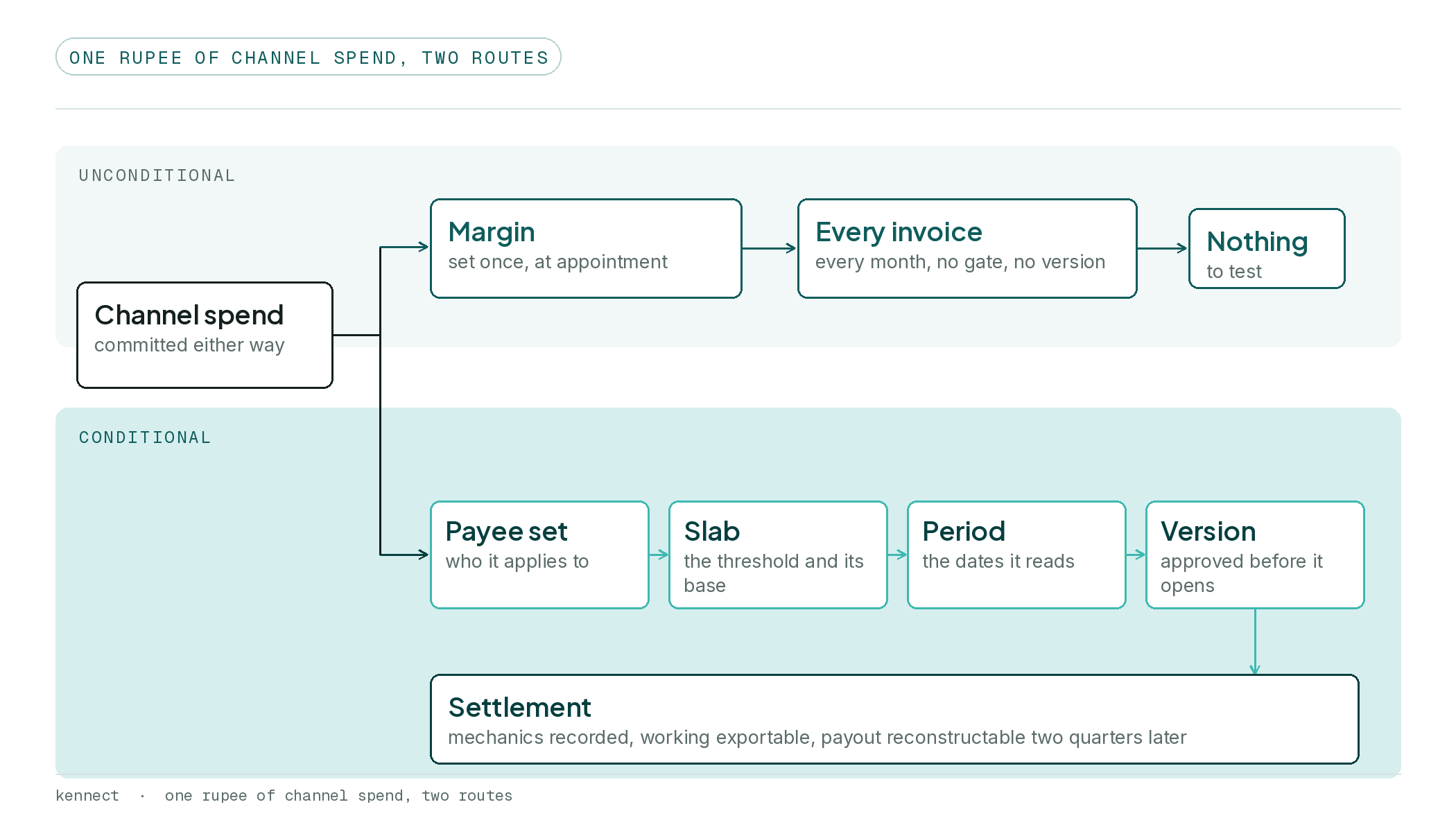
A scheme is the same money with four things attached to it: a defined population, a threshold, a period and a version. Those four are what make it possible to ask for something and then check whether it happened.
Two routes for the same channel spend, and what each one can be tested against
Building one runs in five steps, in order.
Define the payee set. Which dealers, distributors or sub-dealers the scheme applies to, and on what basis they were included.
Set the slabs. The floor, the step size, the base the slab reads from, and whether payout above a slab is retrospective on the full volume or incremental above the threshold.
Fix the qualifying period. The dates the scheme reads, and the cut-off after which data arriving late is handled as a restatement.
Version and approve. The scheme is given a version number and an approval before the period opens, not after the payout is questioned.
Settle and evidence. The payout is calculated, the mechanics applied at settlement are recorded, and the working is exportable.
Kennect builds this in Scheme Builder. The mechanics applied at step five are the same as at any close: stockist credit, winback, pro-rating, returns, slab logic and activity qualifiers.
The difference between the two instruments is narrower than it looks, and it sits in one column.
A margin and a scheme compared on five criteria
Criterion
A margin
A scheme
Conditional on performance
No
Yes, through the slab and the qualifying period
Differentiated by dealer
No, applied across a class
Yes, through the payee set
Attributable by the dealer
No, sits inside the price
Yes, settled separately with a period attached
Versioned
No, it is a trading term
Yes, with an approval before the period opens
Reconstructable after settlement
Not applicable
Yes, through the recorded mechanics and the export
A scheme can carry a condition because the payee set, the slab, the period and the version are all written down before the quarter starts.
What one deployment shows
In demos with manufacturers over the past two years, one exchange repeats. We ask how a scheme from two quarters ago was calculated. Somebody opens a workbook, then opens a second one, because the first was superseded partway through the period. The scheme itself is rarely in dispute. The record of it is.
The published reading Kennect holds on this is from a field force rather than a channel. In an anonymized deployment at a mid-sized Indian pharma company, the gap between period close and payout moved from 2 to 3 months to 5 days. Queries raised per cycle fell 80%. The spreadsheets in use each cycle went from seven to ten, to none.
Source: mid-sized Indian pharma company, 1,000 or more medical representatives · period close to payout, 2 to 3 months before against 5 days after · anonymized active Kennect deployment
That is a field force, and it is a different payee population from a dealer network. What transfers is the structure rather than the reading. A scheme that is versioned can be reconstructed, and a scheme that can be reconstructed stops generating the query about how the number was arrived at. No channel reading has been published, and this post does not present the pharma one as though it were.
The reading above comes from a field force, not a dealer network. Read it for the structure it shows, not as a channel result.
The wider difficulty is not ours alone. Blattberg and Levin noted in Marketing Science in 1987 that very little research existed on how to measure the profitability of trade promotions. The measurement problem is older than the software.
The measurable change is the speed of correction and the volume of queries, not a return on the scheme spend.
Where this leaves you
A margin is what you pay a dealer to carry your product. A scheme is what you pay a dealer to do something specific, and it works when the specific thing is named, dated and versioned before the quarter opens.
Both are committed spend. The scheme is the instrument carrying a condition you can test at settlement, which is what makes it possible to judge. Once a scheme carries a version number, the questions that follow are smaller ones: which slab, read against which base, and settled on which data.
A margin buys presence. A scheme buys a change you can name.
Anything that cannot be withdrawn is presence, whatever it is called on the invoice. A scheme with a payee set, a slab, a period and a version can be tested at settlement.
See how incentive compensation management holds dealer and distributor schemes as versioned records.
Oops! Something went wrong while submitting the form.
FAQs
Questions buyers ask
We give a flat extra 2% margin to dealers who cross their annual number, and sales wants a quarterly scheme instead. What does a scheme buy that the margin does not?
Our distributors treat the extra margin as an entitlement. What happens to the relationship when a standing margin becomes variable?
How do manufacturers separate margin cost from scheme cost in reporting?
Can a dealer scheme and a margin increase run at the same time, or does that mean paying twice for the same volume?
If we move spend from margin into schemes, what has to exist before the first one goes live?


.jpeg)